John Dickson (Studio)
When Argentinian artists Marianela Perelli and Pool Paolini released a series of religious Barbie and Ken dolls back in 2015, they made headlines around the world. Argentinian artists risk religious wrath with ‘Barbie, read The UK’s Telegraph headline. Check out the images in the show notes. Among them are ‘Crucified Jesus’ Ken doll … ‘Jesus the Shepherd’ Ken doll, and ‘Baby Jesus’ Barbie. The artists told The Telegraph at the time that they wanted to “update religious icons to reflect contemporary ideals”. Plenty of people didn’t like it, and their exhibition was cancelled. Apparently, they’re trying to bring it back soon, as part of the 2023 Barbie movie cultural moment. These artists are not the first people to try and make Jesus fit with contemporary ideals. Actually, we probably all do it, all the time. Our guest today has written:
“With varying degrees of self-awareness, each one of us may worship self-help Jesus, historical Jesus, super-angry Jesus, archconservative Jesus, lefty anarchist Jesus, or some combination thereof.”
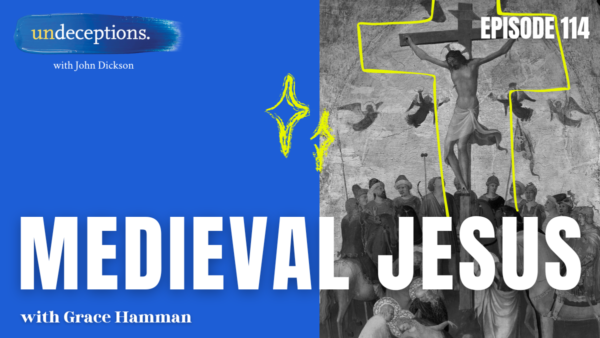
The fact is: throughout history, people have tended to emphasise different aspects of Jesus’ character that seem to resonate with our moment in time. It was true in ancient times. One of the oldest churches ever uncovered, over in Dura-Europos in Syria, has a fresco depicting Jesus wearing the philosopher’s robe with the philosopher’s distinctive short haircut. In the Renaissance, people liked to highlight Jesus’ humanity, his meals with tax collectors, his passion on the cross, and so on. Today, we’re focusing on the period between antiquity and the Renaissance, the so-called ‘middle ages’. They may not have played with Barbies, but they had some pretty kooky ways of looking at Jesus. Some of their ideas were weird … but others, as we’ll see, were beautiful. It might be the case that those backward, medieval, dark ages folks actually have some light to shed – again!!!
I’m John Dickson, and this is Undeceptions.
Undeceptions theme
Grace Hamman:
So the medieval world differed from our world in a lot of ways, but a huge one that people, um, often it’s helpful to orient yourself around is that this is before the Reformation. So, before Martin Luther has nailed up his theses on the church door and it spans from about 500 to 1500, but people use all kinds of different definitions, but that’s sort of the rough, uh, working one that I like to use. So you think from about, um, the end of Augustine’s writing to the Reformation.
John Dickson (Studio)
That’s medievalist Dr Grace Hamman. Among other things, she’s the author of the marvellous Jesus Through Medieval Eyes – just out. Her podcast is Old Books With Grace, and I’m sure there are some Undeceptions nerds who’ll love her talk of old literature and theology. We had two episodes on the 16th-century Reformation last season. Go check them out. That topic needed a double whammy because it was one of the greatest ruptures in Western history, and it sort of blacked out the period before it, the middle period. The word “medieval” is from the ecclesiastical Latin phrase medium aevum, “middle age”. It became popular in the 19th century, as a way of talking about the period in between the apparently more exciting eras of Roman antiquity (up to about 500) and the early modern period from the 1500s on. So, a thousand years of human history is relegated as just the middle bit!! For some, it’s the dark bit, too.
John Dickson:
So, yeah, just picking up on that Dark Ages perception that’s out there that I know annoys medieval scholars. Um, but was this period you were talking about, um, a period of literary output, philosophy, learning, art, et cetera?
Grace Hamman:
Oh yeah, so the Middle Ages, uh, gave us some of our most important institutions. So if you think of hospitals and universities, those were born in the middle ages. Those started developing in the later middle ages. So, um, this is not some sort of benighted world of just superstitious fanatics. This is people who are thinking, um, super deeply about philosophy and theology in the birth of the universities. People thinking about what hospitality means, what it means to care for one another, and for the sick and for the needy in the birth of the hospital. And it also gives rise to some really interesting things architecturally in an art. So you think of the absolutely stunningly beautiful and dramatic medieval cathedrals. You walk into York or Notre Dame, and you are amazed by the amount of engineering and architecture that they were capable of. So people think of the Dark Ages and have, obviously, Dark Ages is a very negative name. But in this time, uh, there was a lot of different cultural and artistic, uh, philosophical and theological development going on that were very vibrant and alive in ways, even that, um, that we are surprised by and that, uh, can teach us.
John Dickson:
Before we talk specifically about Christianity and Jesus in the medieval period, um, obviously one of the great differences was the, you know, the ability to read and write. Um, and so therefore, um, I’m assuming, am I right, that really only elites could read and write, and therefore art. was one of the principal ways people conveyed ideas. Or am I slightly off there?
Grace Hamman:
No, I think that, um, it’s a generalization, but it’s definitely a generalization that has a lot of truth in it. A lot of, uh, a lot of middle-class folks by the end of the Middle Ages, there was a, there’s a big rise in literacy. But, um, the main source that a lot of people were receiving their, uh, spiritual education from was through art, which is why when you go into these beautiful medieval cathedrals or medieval churches, you see so much art there. Gregory the Great described art as a way for the illiterate to read and understand.
John Dickson (Studio)
Gregory the Great, by the way, was the bishop of Rome in the year 600. He was amazing! He sent the first missionaries to England. He wrote the most influential leadership book in history–all about humility–and, it turns out, he was a lover of art! He definitely gets an episode one day!
Reading
“Pictures are used in churches so that those who are ignorant of letters may at least read by seeing on the walls what they cannot read in books.” Gregory the Great, letter to Bishop Serenus
Grace Hamman:
There are certain representations of Jesus that were very popular in the Middle Ages. So one of these representations that appeared over and over in medieval churches was Christ as a judge at the end of days on, on On the doomsday, as they would have called it a doom. And so, Christ was, uh, sitting in judgment above the, those who were going to be saved and those who were going to be damned. And this was a very popular, um, subject to portray because it reminded everybody sitting in church that, They were all going to be together again on the last day and that, um, that they, too, were going to be called to account and think about the choices that they had made and actually see the face of Jesus. And these portrayals are really fascinating because they are the parts that show hell and heaven are a little frightening and scary, but um, at the center of these of these, uh, portrayals as Jesus, and he’s always showing his wounds, um, so they were really emphasizing Christ as the same Christ who died on the cross, and not just, um, terrifying vision of judgment, uh, for Judgment Day.
John Dickson (Studio)
One of the best examples of a Doom painting can be seen in St Thomas’s Church in the medieval cathedral city of Salisbury, in the south of England. Like many Doom paintings in cathedrals across Europe, it was painted over during the Reformation – not because the Reformers hated art (though they weren’t huge fans, sadly) but as a theological statement. In 2020, the Salisbury Doom restoration was complete, with another 60 paintings being restored around England. The Salisbury Doom is huge – reaching 45ft above the nave of the church, where the public would sit during church. It shows the dead climbing naked from the grave, with sinners dragged by demons into the mouth of a fiery dragon, while the righteous are lifted to heaven by angels. Interestingly, the painting includes two kings and a bishop among the damned. Sitting above the chaos is Jesus, sitting in judgment of all people. Check out the show notes to see it. It’s kind of scary.
John Dickson:
You say these were popular, um, but do we know that the people liked them? Or were the priests just doing that bully pulpit thing where they, you know, said, Hey, look, this will be you if you don’t, if you don’t listen to my sermon or you don’t come and experience the Eucharist. Do we have any sense that the average people quite liked this idea of Christ as judge and yet the wounded savior? Versus just it being, um, you know, um, the church telling people they’re all going to hell.
Grace Hamman:
It’s a great question and obviously we can’t kind of, I wish we could, but we can’t open up the minds of the illiterate folks and, uh, and the writings that have disappeared, um, and look at what people were thinking. But here’s what we can see when we look at these is that, uh, in the portraits of those who are of the blessed and the damned, um, are many, many figures of authority. And so it’s a really interesting picture of the levelling of community. And you think of, you know, the, the feudalism of the Middle Ages and the, uh, huge disparate differences in a peasant versus a king and a lord. And to think that you will both be called into account and held accountable, I think that must have been reassuring to a lot of people living under pretty deep oppression. So that’s one thing that I think of when I look at them that I wonder if that was a common thought, because you can tell that they are temporal figures of authority, because a lot of times they would draw the, the, all the people below naked, because you didn’t bring your clothes with you at Judgment Day. But they would add hats to show their profession, so we could see naked people with plowman’s hats and Pope’s hats and Cardinal’s hats, and you can see that your temporal authority isn’t going to save you from if you have, if you have held Christ in contempt by not practicing love and justice.
John Dickson:
So it’s a bit like Dante’s Inferno in that sense.
Grace Hamman:
It’s very much like Dante’s Inferno, yes, where it’s Um, Dante is, is pretty equal opportunity with, uh, with, um, the Popes who have been, actually, there are more Popes in hell than in heaven in his portrayal. So I don’t think it was as straightforwardly, Hey, obey church authority, or you will be in the bad place. Um, I think it was a reminder of, uh, kind of what, uh, yeah, what C. S. Lewis would later write about that no one you meet is is ordinary, that everybody is going on into eternity. And, uh, we’re all going to be there.
Media – Hell-shaking street preachers
John Dickson (Studio)
That live clip from Facebook, from a page called ‘Hell Shaking Street Preachers, ’ might sound like the modern-day equivalent of a Dooms painting. And yes, we cringe today. According to Grace, “Medieval people were a lot more comfortable than we are with using fear to motivate, and these works of art are meant to evoke fear in those listening and looking.” And while fear isn’t the highest of the motivations, it’s still one that makes sense. We use it with children: do this or else … something! The government does it with us: Don’t speed … or else … So it’s not like it’s an inappropriate motivator. And, frankly, Jesus himself wasn’t averse to warning of punishment. In Matthew 25 Jesus says he will be the judge of all the earth:
“When the Son of Man comes in his glory, and all the angels with him, he will sit on his glorious throne. All the nations will be gathered before him, and he will separate the people one from another as a shepherd separates the sheep from the goats. He will put the sheep on his right and the goats on his left.” (It’s already sounding a bit like a doom painting) … “And then Jesus continues … “Then he will say to those on his left (the goats), ‘Depart from me, you who are cursed, into the eternal fire prepared for the devil and his angels.”
Whatever mistakes or exaggerations medieval people made on this topic (along with the hellfire street preachers), they were trying to highlight something real about Jesus, something that our contemporary culture has come to find distasteful. Whenever I’m confronted by one of these clashes between people of yesterday and ourselves, I always think it’s wise to pause and ask, “Were they stupid and misled or am I blind to something real they saw!” The answer is often somewhere in between
John Dickson:
Okay, what about the portrayal of Jesus as a lover? Am I right that there’s even some, um, sexed theology in these paintings?
Grace Hamman:
Um, so the, the portrayal of Jesus as a lover is a very, well, it’s one that we, uh, immediately feel, I think rightfully, a little squeamish about. We’re a little nervous where it’s going to go. Um, but Medieval monastic writers in particular. Um, so this was less of a visual subject and more of a, of one that people were really into the Song of Songs and monastic writers in particular, loved writing commentaries on the Song of Songs and reading it as an allegory of Christ’s love for each individual soul.
John Dickson (Studio)
The book titled Song of Songs is in the Old Testament – a well-known, but often misunderstood section of the Bible. It’s a collection of love poems, telling a rather dramatic tale of mutual desire and courtship. It’s been of great inspiration to many a master composer, author, or poet throughout the ages. And clearly, the Middle Ages were no different.
Grace Hamman:
And so they’re writing in terms of Christ’s spiritual love, but, um, they write about how sometimes when we, our language gets too spiritualized, it’s hard for us to sense, uh, the deepness of love. We’re embodied creatures and we need embodied language to help us understand how deeply Christ loves us. And so they. ran, they took off running with the language of the Song of Songs, um, in order to describe the wildly passionate and individual language of the love of Christ. One, uh, so the, one of the most famous people using this image was Bernard of Clairvaux, but one that I particularly like was the writing of, uh, Mactilled of Magdeburg, who was a nun by the end of her life, but wasn’t a nun for a while. And she writes this amazing book where she talks about her experience of being Christ’s lover. And it is this highly intimate, charged language. And I, um, I was actually transcribing a passage of it, uh, in a coffee shop while I was working. And I kept looking around at the tables around me because I was nervous that people would think I was writing a romance novel. I mean, that’s the level that it is, is that, um, Mectil talks about, um, the caress of love, and she talks about nakedness, and how there can be nothing left between God and the soul. We have nothing that hides us from his love.
Reading
“And then he begins so to caress her that she becomes weak. She so begins to drink it all in that he becomes lovesick. Then he begins to limit the intensity, because he knows better her limits than she herself does.”
Grace Hamman:
And then she writes ultimately in this ecstatic language of union that is very sensual. So, um, it’s kind of weird for us to read, but she’s not trying to make a point. I think we, we get into hot water sometimes cause then we want to sort of read that back onto, um, human sexuality in particular ways. And they were using the language of human sexuality in order to express something spiritual. And so, that can be a little confusing for us sometimes, but that was the goal.
John Dickson:
It also, um, I think runs counter to our perception of the medieval period as so prudish as to never mention sex, um, or anything like that, but, but the fact that they could freely use sex and love as a spiritual metaphor shows a kind of sexual maturity.
Grace Hamman:
Yeah they weren’t bothered and worried about it. I think you’re right that it shows sort of our anxiety that we get really uptight and worried about this kind of language with the love of the Godhead, but they were not worried that it would muddy the waters. They, they thought, oh well, we have this book, The Song of Songs, and the language there is highly explicit and so we can read Christ as this, uh, lovesick and vulnerable lover offering his heart to us. And it doesn’t, um, damage his like sovereignty as God, but it expresses this intense longing that we have trouble ascribing to God sometimes. But that they felt very comfortable with and were deeply encouraged by.
John Dickson (Studio)
This reminds of the John Donne poem, Batter My Heart Three-Personed God
Reading
Batter my heart, three-person’d God; for you
As yet but knock, breathe, shine, and seek to mend;
That I may rise and stand, o’erthrow me, and bend
Your force to break, blow, burn, and make me new.
I, like an usurp’d town to another due,
Labor to admit you, but Oh, to no end;
Reason, your viceroy in me, me should defend,
But is captived, and proves weak or untrue.
Yet dearly I love you, and would be loved fain,
But am betroth’d unto your enemy;
Divorce me, untie or break that knot again,
Take me to you, imprison me, for I,
Except you enthrall me, never shall be free,
Nor ever chaste, except you ravish me.
…
John Dickson (Studio)
Judge and Lover are two depictions of divinity that can make moderns feel pretty uncomfortable. But, again, something real was being preserved by medieval Christians. For one thing, Jesus describes himself as the groom and his people as the bride on numerous occasions: Mark 2, Luke 5, as well as Matt 9 and Matt 25 – the same chapter I mentioned earlier, where Jesus describes himself as the Judge of the earth. He’s a judge and lover. And, in the OT, there are explicit depictions of God as the lover of Israel. He cared for her, married her, and slept with her: “I made you grow like a plant of the field. You grew and developed and entered puberty. Your breasts had formed, and your hair had grown … I looked at you and saw that you were old enough for love. I spread the corner of my garment over you and covered your naked body. I gave you my solemn oath and entered into a covenant with you, declares the Sovereign Lord, and you became mine.” Ez 16. Hosea 1 and 2 say roughly the same thing. And if that still feels weird, don’t worry. After the break, it gets weirder!!
Break
Media – A Knight Before Christmas trailer
John Dickson (Studio)
That’s a clip from the trailer of the not-so-classic Christmas flick, ‘A Knight Before Christmas’. Yeah, that’s Knight with a K. The trailer is so cheesy, I’m a little embarrassed for Producer Kaley that she’s actually seen the film. I know it’s not in her top 5 films (like it is for Director Mark) but still … I would have gone with the knights that say ‘Ni’ scene in Monty Python and the Holy Grail, but apparently we reference Monty Python too much in this show or something!
John Dickson:
One of the other portraits of Jesus that you raise is Christ as a knight. Now I think we need to wind back and can you describe for us what a knight is? Really was, because I’m thinking of a Monty Python skit as soon as I say the knights who say ‘Ni’ I don’t know if we’ll play a portion of that in the podcast or not, but anyway, there’s an idea for the producer, but what was a knight? How did they fit into society first and then tell us how on earth Jesus could be a knight?
Grace Hamman:
Yeah, this is, this is one of the portrayals of Jesus that I initially, uh, felt very nervous about as well. Like the lover these two were tough because, um, knighthood is, it’s a social, uh, a social position. So, we see Monty Python or read the fairy tales with knights in them, wearing shining armour. So we have this, sort of idea of this abstract literary persona or a chivalrous figure. But for them, a knight was a position in society. The medieval, medieval society was broadly split into three sort of classes, or what they called estates. And one was those who prayed, the clergy. Those who fought. The knights. And those who worked the laborers and that was seen as Sort of this God-ordained system, like set down from heaven. That medieval society was composed of, and so when you’re using this knight imagery you’re specifically invoking a figure of violence. And sometimes that violence was in service of the good and of protection, but a lot of times that violence was in service of, of less, um, idealised, uh, causes. So, uh, you think of the Crusades and what a disaster so much of that was. And you think of, uh, they had horrible, um, techniques like the Chevalier, where, um, knights would just burn large swaths of land so that they could run rampant over a territory. So this was like, uh, this was a very, for me initially, I was very concerned that we were going to be sort of baptizing Jesus with this rhetoric of violence, but, um, along comes, uh, one of my favorite late medieval writers, um, who loved this image and used it extensively, his name was William Langland, and he wrote this great poem called Piers Plowman in the 14th century.
John Dickson (Studio)
Piers Plowman is an allegorical work, and toward the end one of the characters falls asleep and witnesses the events of Easter – Holy Week. Here comes the Christ-Knight.
Reading
One … barefoot came riding bootless on an ass’s back
Without spurs or spear – sprightly he looked,
As is natural for a knight who came to be dubbed,
To get his gilt spurs and cut-away shoes.
And then Faith was in a window and cried, A, filii David!
As a herald of arms does when adventurous knights come to jousts.
Old Jews of Jerusalem sang for joy,
Blessed is he that cometh in the name of the Lord.
Grace Hamman:
And, um, he writes Jesus as a knight, uh, dressed like a plowman. Which, If you think about, uh, the estates language and how medieval people were saying this was handed down by God and you stay in your place, you stay in your position, to have a knight dressed as a plowman is pretty shocking. Um, and a picture of the incarnation where a higher, something that is so high status and, uh, knights were generally wealthy and, um, had a lot of power. And then dressing intentionally, coming in the, in the garb of a plowman, and then jousting as a plowman against death and Satan is a really wild metaphor for the incarnation, um, that ends up having so much fruit about how we think about our labors in the world. And a lot of hope for… Uh, and offering out courage and fortitude for, um, our work in the world, uh, regardless of what we’re doing. So Langland, uh, really wrote this beautiful Christ’s Knight portrait that I just love.
John Dickson:
I mean, again, it messes with the cliche of the medieval believer as all about the distant judging God. But actually here is a, here is a motif that captures the humility of God in Christ.
Grace Hamman:
Absolutely. And it, it just, it would have been like a, um, the fanciest tech CEO, um, joining labourers in their daily life. I mean, that’s how much of a contrast and how much of a shock that humility looks like in medieval practice.
John Dickson:
Yeah. And again, it’s straight out of the Bible, isn’t it? Because I think of, as you were describing that poem, I was thinking of the portrait in the book of Revelation, where there’s this giant portrayal of God, and the lion of Judah was on the throne, and then you look and it’s a lamb who looks like it’s been slain.
Reading
And I saw a mighty angel proclaiming in a loud voice, “Who is worthy to break the seals and open the scroll?” But no one in heaven or on earth or under the earth could open the scroll or even look inside it. I wept and wept because no one was found who was worthy to open the scroll or look inside. Then one of the elders said to me, “Do not weep! See, the Lion of the tribe of Judah, the Root of David, has triumphed. He is able to open the scroll and its seven seals.” Then I saw a Lamb, looking as if it had been slain, standing at the center of the throne.” Revelation, Chapter 5
John Dickson:
It totally upends Roman power models.
Grace Hamman:
That’s exactly right, and Langland had a keen sense of that, of just, the world turned upside down, power has been emptied out, um, and, and this is the Jesus who has come to save medieval folks and us.
MUSICAL CHANGE
Reading
Christ, mother, who gathers under your wings your little ones, your dead chick seeks refuge under your wings. For by your gentleness, those who are hurt are comforted; by your perfume, the despairing are reformed. Your warmth resuscitates the dead; your touch justifies sinners. . . . Console your chicken, resuscitate your dead one, justify your sinner. May your injured one be consoled by you; may he or she who of his or herself despairs be comforted by you and reformed through you in your complete and unceasing grace. For the consolation of the wretched flows from you, blessed, world without end. Amen.
A prayer of Anselm of Canterbury, 1033 – 1109
John Dickson (Studio)
Anselm of Canterbury was one of the great minds of the middle ages. He was Italian but he ended up Archbishop of Canterbury in England. He noticed that while Scripture often says God is Father, the ‘mother’ idea is also there. In the OT, God is said to have given birth to Israel. In the NT, Jesus describes himself as the mother hen.
John Dickson:
Sounds like there were some wise people in the medieval world. That’s very surprising. I thought they all started in the Enlightenment. But the other portrayal is Christ as mother. Again, this is what, it’s weird. Christ as a motherly figure? Describe to me, you know, where do we see this? And what’s the, what are they trying to do in this portrayal?
Grace Hamman:
Yeah, so this is, this is one of my favorites. I must confess. It was the one that I initially started studying back in grad school. And, um, I, Julian of Norwich, who’s just the beautiful, incredible, contemplative writer of the 14th century, writes about this image.
John Dickson (Studio)
Julian of Norwich was an English anchoress in the 14th century. An anchoress usually lives alone in a room or a cell in a church and devotes herself to prayer, contemplation, giving spiritual advice to passersby, and, in the case of Julian, writing about her experiences of God’s love and presence. We don’t actually know her name. She’s called Julian because she was anchored or housed in the St Julian’s Church, Norwich. Anyway, in her Revelations of Divine Love, she writes of God’s kindness in motherly language:
Reading
“The mother’s service is nearest, readiest, and surest: nearest because it is most natural, readiest because it is most loving, and surest because it is truest. No one every might or could perform this office fully, except only Him [that is, Jesus]. We know that all our mothers bear us for pain and death. O, what is that but our true mother Jesus. He alone bears us for joy and for endless life. Blessed may he be. So he carries us within him in travail and love until the full time when he wanted to suffer the sharpest thorns and the cruel pains that ever were and will be, and at the last he died. And when he had finished, and born us for his bliss, still all this could not satisfy his wonderful love. He revealed this in his words of great surpassing love ‘if I could suffer more, I would suffer more.’ But he could not die anymore, but he did not want to seek working. Therefore, he must need nourish us for the precious love of motherhood has made him our debtor.”
John Dickson (Studio)
Julian of Norwich wasn’t the only one to use this type of language.
Grace Hamman:
But how it really started. We think of it as, we feel like it should be some kind of new age, uh, weird, slightly unorthodox portrayal, but in actuality, um, So, monastic writers, again, those monastic writers, they, they were good readers of Scripture. And they pick up on these themes that sometimes we today, uh, can miss. So they started picking up on these feminine wisdom themes in the Old Testament. And then, Also on Christ, uh, calling himself a mother hen and longing to gather his chicks under his wings. And, uh, some of his, and, and the language of being born again.
Reading
“Jerusalem, Jerusalem, you who kill the prophets and stone those set to you, how often I have longed to gather your children together, as a hen gathers her chicks under her wings…” Luke chapter 13
Jesus said “very truly I tell you, no one can see the kingdom of God unless they are born again.” John chapter 3
John Dickson (Studio)
And in a parable explaining why Jesus is searching for sinners, not the righteous, he depicts himself as woman.
Reading
“Or suppose a woman has ten silver coins[a] and loses one. Doesn’t she light a lamp, sweep the house and search carefully until she finds it? And when she finds it, she calls her friends and neighbors together and says, ‘Rejoice with me; I have found my lost coin.’ Luke 15
Grace Hamman:
I mean, how strange that Jesus says, you’ll be born again through me. I mean, he’s talking about, he’s using mothering imagery to describe himself and his mission. And so they pick up on this imagery. And they start thinking about what it might mean to be, um, in power and in authority, but with the traits of a mother. So what does compassionate… authoritative mothering leadership look like? And that of course blows apart so many of our modern boxes just in one sentence. But they started thinking really seriously about that and they started conceptualizing Christ as a laboring mother. And then mystical writers like Julian herself and others really took up this image and thought about Christ birthing the church on the cross. And there’s this crazy manuscript imagery around this. One of my favorites is, uh, showing Christ on the cross and, uh, little baby church is coming out of the wound in his side, um, as if he’s giving birth to her. It’s Ecclesia, uh, with a little crown on her head and she’s a baby, but she, Jesus is giving birth to the church out of his wounds.
John Dickson:
Hang on, is this a literary description or is this a painting?
Grace Hamman:
This, uh, that is a painting, but there’s also, uh, there’s also literary descriptions of this.
John Dickson:
The mind boggles.
Grace Hamman:
Yes. So they, they saw, uh, the passion as this intensive labor, um, and actual labor. And so, uh, then writers like Julian wrote a lot about this and they saw deep parallels between, uh, you know, the, the blood and the violence and the pain of passion of the passion and of labor, but that it was all, um, Um, leading into birth.
John Dickson (Studio)
Head to the show notes to take a look at the manuscript illumination of Christ Gives Birth to the Church from 1225-1249, currently held at the Austrian National Library.
Grace Hamman:
So it’s not pain and suffering in the same way as some other things. Um, it’s this, uh, beautiful and horrible process. And it’s even more poignant when you consider that in the Middle Ages, pregnancy and labor were a very dangerous undergoing. And so to compare the passion to labor, uh, is more apt than it may apparently seem at first blush.
John Dickson (Studio)
All of this is fascinating and it’s fun to talk to Dr Hamman about the weird and wonderful Middle Ages and their strange beliefs. But does any of it really matter for us today, short of providing some interesting dinner party one-liners: Oh, did you know that in the Middle Ages Christians often depicted Jesus as a woman giving birth!!?? There’s a challenge, Undeceivers! Anyway, stay with us …
Break 2
John Dickson:
Can you give me a sense, um, based on all these portrayals of Christ, um, what it looked like to be a faithful medieval Christian?
Grace Hamman:
That’s a big question because I think there was just like today a lot of different ways that that could take shape. So one of the most traditional ways of looking like a faithful medieval Christian would have been to take vows and become a monk or a nun or a clergyman and in the monastic life, monks and nuns devoted themselves to prayer, um, 24 hours a day. They had, uh, different times of day that they were praying intentionally together. And so they really saw themselves as, as the, the prayers of their community. So that was one way.
John Dickson:
So, were the workers, you know, the plowmen and so on, were they locked out of that true spirituality?
Grace Hamman:
So it depends again on who you’re reading. I mean, this is the fun thing about the middle ages is that we inherit these pretty black and white pictures of them and, um, and then you see that there’s some truth in them. So for instance, plowmen, laborers, those folks, uh, they weren’t, uh, some, some writers were and theologians were thinking of them as being lesser, as, as lesser in that scheme. But, um, at uh, around this time, around the time Julian’s writing and, and some of these other folks in, at the end of the middle ages, uh, and at, uh, or right around, uh, the 13 hundreds, 14 hundreds, you have this intense rise of materials meant for ordinary people that wanted to pray the hours, the monastic hours, but couldn’t fit them into their ordinary life. So, um, these prayer books were sold, these books of hours, that anybody could use who wasn’t devoted to the monastic life. And some of them, uh, you didn’t have to even be fully literate on. You had to memorize prayers, but you could use the imagery of the pages to pray.
John Dickson (Studio)
Yes, there’s an episode on monasticism coming! But just briefly, the ‘Book of Hours’ was actually a medieval bestseller. No other book was created in greater quantity in the late Middle Ages. It was essentially a guide for daily devotion, with Psalms, hymns, prayers, and readings to be recited during the eight so-called canonical hours of the day:
Matins (before dawn)
Lauds (daybreak)
Prime (6am)
Terce (9am)
Sext (noon)
None (3pm)
Vespers (sunset); and
Compline (evening)
The Book of Hours was often heavily image-based, with beautiful illuminations to aid devotion.
Grace Hamman:
And so, Um, we, you know, on one way you’re telling the story, it sounds like maybe the only way to be a good Christian is to be a professed religious, but we see this story complicated as we look at the actual materials coming out of the middle ages where a lot of people were praying and, uh, the parish, uh, which was the center of ordinary people’s lives who weren’t professed to the church. Um, we can see in what we have left that all of these ordinary folks were participating in the life of their parishes very, um, vividly and fully. And, uh, my, my favorite historian who writes about this is the historian Eamon Duffy who writes this book called The Stripping of the Altars, which describes how at an ordinary parish, um, you have people raising bees and donating honey to their churches or raising lambs and part of the lambs they give to the church. Um, you have wills left where a merchant’s wife leaves her second-best dress, uh, to the church. So we have this glimpse into ordinary people and their devotion, and it looks different than ours, but it is real devotion.
John Dickson:
My final question, Grace, is do you think there’s anything modern Christianity can learn from medieval Christianity? And if so, what?
Grace Hamman:
Oh, I definitely think so. Um, I think there’s a lot we can learn from them. I, uh, I think that we are so, we like to think of ourselves as part of the. the arc of history, right? Like as better than the people who came before us. We all kind of want to think that even if we don’t, uh, admit to it, we kind of want to think that we’ve got it a little more figured out. We’re on, we’re on the right track, but, uh, C. S. Lewis writes about how, um, we all, no matter what era you’re in, you’re going to have a set of common blind spots or common misconceptions about the way the world works. And the only way that we can dispel those and work through them and see beyond our limited time and space and place is to read the books of the past. And I think that these medieval representations of Jesus, um, their very weirdness exposes assumptions that we have about who Jesus is, about who we are as Christians, about the way the world works. And it’s going to be, it’s going to look different from person to person. But, um, for instance, thinking of Christ as a mother, it didn’t change how I thought about Christ’s historical body in Palestine in the first century. But what it did do for me is open up to me, um, a way of thinking about Jesus that was so much more loving and intimate than how I had been thinking of him. And I wouldn’t have been able to see that thread in scripture if it hadn’t been for those monastic writers and mystical writers who were so interested in this theme. And that’s just one example of many that, um, they have really opened my eyes and I think can give that same gift to a lot of other people.
Undeceptions theme

The Middle Ages saw an explosion of literature, art, and thought around the personhood of Jesus. What can we learn from these centuries-old understandings of the central figure of the Bible?
Meet our guests

Dr. Grace Hamman is a writer and independent scholar of late medieval poetry and contemplative writing.
She holds a PhD in Medieval Literature and has authored several academic articles, with further by-lines in Plough Quaterly, Mere Orthodoxy, and Fathom.
She also has her own podcast – Old Books With Grace – which delves into the relevance of old literature and theology.
Links
Special thanks to our season sponsor Zondervan Academic. Get discounts on MasterLectures video courses and exclusive samples of their books at zondervanacademic.com/undeceptions
Check out these helpful links below for more info on what was discussed in this episode.
To Read
- Here is Grace’s substack where you can read her musings as much as you like
- Ever wondered what a religious Barbie would look like? Well, wonder no more!
- Here’s the general prologue of The Canterbury Tales, composed in the 1380s!
To Watch
- We’ve shared it in the notes before, but here is life in a medieval village captured in a lovely animation
To Listen
- Grace is a podcaster herself! Here’s her show Old Books with Grace
- Make sure you check out our two-part series on The Reformation – set in the same era!
- Also, check out our episode on Medieval Science!

Undeceptions Plus offers exclusive bonus content to members. By becoming an Undeceiver, you can unlock uncut interviews, extra question and answer sessions, and peeks behind our creative process as we put the shows together. We’d love to have you with us.