Please note that due to the software used, not everything recorded in this transcript will be accurate.
God’s War II
John Dickson (Studio)
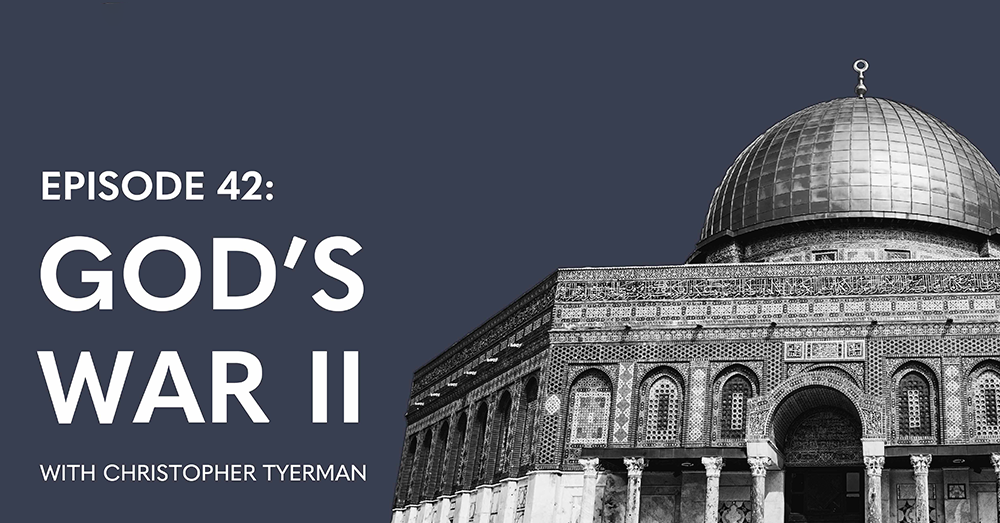
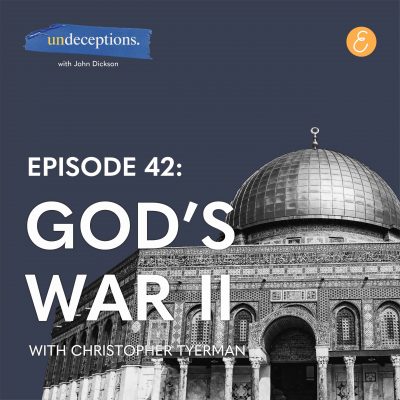
In 2017, I was in Jerusalem filming scenes about the Crusades for a documentary called For The Love of God (there’s a link in the show notes). We were given permission to film at the Al Aqsa Mosque, the third holiest site in Islam, which sits on a massive plaza known as the Haram al-Sharif or Temple Mount. Sharing the plaza is the Dome of the Rock, the beautiful golden dome that appears in every Jerusalem postcard. Almost 30 American football fields would fit into this giant 150,000m2 open-air court. On 15 July 1099, something like 10,000 European Crusaders burst through Jerusalem’s protective walls. Marching through the narrow streets of the city, they fought anyone who resisted. They made their way up to the Haram al-Sharif where they discovered thousands of residents cowering in fear, hoping against hope that their sacred precinct would provide them with protection, practical and divine. But these fighting men, “pilgrims” as they called themselves, had been marching for two years. They had journeyed 2000 miles from France to Jerusalem. They had been besieging the city for a month. They were not about to let a victory go to waste. The Crusaders whipped themselves up into such an unholy frenzy that they slaughtered men, women, and children. They threw some victims over the plaza’s high walls to their deaths three storeys below. They butchered the rest with swords, daggers, fire, arrows, and spears. They even gave chase to those who had climbed the roof of the Al Aqsa Mosque, and had them killed on the spot. The blood reportedly filled the great promenade between the Mosque and the Dome. We have eyewitness accounts of the events. With gruesome glee, and obvious exaggeration, Raymond of Aguilers, a leader of the First Crusade, wrote about this fateful day in the Ides of July: Here’s director Mark putting on his best Raymond:
Reading
But now that our men had possession of the walls and towers, wonderful sights were to be seen. Some of our men cut off the heads of their enemies; others shot them with arrows, so that they fell from the towers; others tortured them longer by casting them into the flames. Piles of heads, hands, and feet were to be seen in the streets of the city. It was necessary to pick one’s way over the bodies of men and horses. …in the temple and porch of Solomon, men rode in blood up to their knees and bridle reins. Indeed, it was a just and splendid judgement of God that this place should be filled with the blood of the unbelievers, since it had suffered so long from their blasphemies.
John Dickson (Studio)
The next day, 16 July 1099, the “pilgrims” held a thanksgiving service in Jerusalem’s Church of the Holy Sepulchre, just 500 metres away from the site of the massacre the day before. Again, Raymond of Aguilers tells us:
Reading
“How they rejoiced and exulted and sang a new song to the Lord! This day, I say, will be famous in all future ages, for it turned our labors and sorrows into joy and exultation.”
John Dickson (Studio)
It is a confronting fact of history that a church originally designed to mark the place of the unjust and brutal crucifixion (and resurrection) of the humble man from Nazareth became the venue of jubilant songs and prayers to celebrate a ruthless military victory in Jesus’ name. I had to stand in the sacred plaza outside the Al Aqsa Mosque retelling these horrible details to the camera – over and over, until I got it right. The brutal slaughter marked the end of the First Crusade. They had recaptured Jerusalem and the Holy Lands. They had regained control and care of The Church of the Holy Sepulchre, probably medieval Christianity’s most sacred site, built over what was believed to be Jesus’ empty tomb. Their job was done and most of the crusaders packed up and went home, bolstered in their belief that God had been with them and seized their victory. Job done! So, why the need for a 2nd Crusade? Or a 3rd, 4th or 5th for that matter? I’m John Dickson and this is Undeceptions.
Undeceptions theme
John Dickson (Studio)
This is the second part of our two-part series on the Crusades, speaking with the inimitable Professor Christopher Tyerman, Professor of the history of the crusades at Herford College, University of Oxford. In the English-speaking world, there’s no more widely recognised expert in this field. If you haven’t listened to the first part, stop now and find part 1 in your podcast app.
Media – King Richard and His Crusaders clip
John Dickson (Studio)
That’s the 1954 epic King Richard and His Crusaders starring Rex Harrison, Virginia Mayo and George Sanders. It’s a terrible film. It’s actually listed in a book called ‘The Fifty Worst Films of All Time’. But, you get the vibe …The third crusade is painted as an adventurous romp, with figures like Richard the Lionheart on one side and Saladin the Magnificent on the other. The second to the fifth crusades take place, on and off, from a generation after the first crusade (1145 to be precise) for about 80 years (until 1229). Despite the legends – especially around King Richard – the crusades were mostly a failure.
JD:
I want to ask you to do the impossible: can you sum up the success or otherwise of the 2nd to 5th crusades?
Christopher Tyerman:
Well, I think the obvious answer in terms of taking, um, Jerusalem or, or achieving, um, military success in the near East, if you look at the up other crusades, it’s, it’s, um, obviously less successful the second crusade, en route some crusaders, uh, take, uh, Lisbon from the Moore in, in, in what’s now Portugal. In the Levant itself, uh, their attempt to, um, take Damascus fails. So in a sense, uh, uh, the, uh, geopolitical balance in the Near East is not influenced by the second crusade. The Third Crusade, um, um, 1188 to 92, um, um, takes place after Jerusalem has been lost to Saladin.
John Dickson (Studio)
Saladin was the most famous of Muslim warrior heroes. He defeated Crusader strongholds, recaptured Jerusalem, and then successfully defended it against the Third Crusade. When he took Jerusalem in 1187, Saladin planned to avenge the slaughter of Muslims back in Jerusalem in 1099. But the Crusaders surrendered, and Saladin spared them.
Christopher Tyerman:
And most, almost all, um, the, um, the Western Christian set saddles in the Levant had, had been overrun, not all, but the vast majority, the third crusade succeeds in reconstituting, a more or less viable, uh, Western enclave, um, in, um, in Palestine and, and Southern Syria. Um, um, it creates a sense a two-state solution to the Palestinian, uh, geographical political position. The coastal ports, um, are largely retaken, uh, small amounts of the, the hinterland. Jerusalem is not. Um, so there is a limited success. However, this enclave does actually survive for another century until 1291. The fourth crusade, um, some of the fourth crusade goes to the Holy Land, and there’s a small campaign in Egypt that doesn’t achieve much. The bulk of the, the crusade goes to Constantinople, where it thought that the Greeks would then subsidize the campaign further on to the Holy land. It doesn’t work out like that.
John Dickson (Studio)
It really doesn’t work out like that!! This fourth Crusade is a debacle. Along the way to the Holy Land, officials decided to attack Constantinople itself. This was a Christian city. This was the city that had asked for help in the first place to get the Crusades going. The Crusaders took the city and plundered it. This was just one of the many shocking departures from the principles of just war that marked the Crusades. Back in the First Crusade, one of the main preachers was a monk known as Peter the Hermit. He rallied thousands of Europeans to head to Jerusalem. But, mostly shockingly, along the way to the holy land, he and his men engaged in wholesale slaughter of European Jewish communities along the Rhineland — partly for their supposed responsibility for the death of Christ centuries earlier, partly for their alleged complicity in Muslim attacks on Christian sites, and perhaps partly for just fighting practice! Anyway, back to the fourth and fifth crusades.
Christopher Tyerman:
So one of the consequences of the fourth crusade at 1202 to 1204 is that, uh, you have, um, uh, French Lords, um, taking possession of estates and regions in, in Greece. Um, and these last for, um, a century or so, um, in, in various forms, Constantinople is held by a Latin emperor from 1204 to 1261. The fifth crusade, uh, 1217 to 1221, um, is a massive affair, um, involving, um, regular detachments going from Western Europe to these, to Mediterranean where they attack the Nile Delta and take, um, uh, the port of Damietta, which they hold for a couple of years. Egypt is seen as the key to the Levant, which is which it is, um, um, it has a population in terms of the economy, in terms of commerce, et cetera, et cetera. Um, without Egypt, you can’t be a hold Southern Palestine. That was the theory. So you have, um, essentially for four years, you have a Western European army in the, in the Nile Delta, but in the end, um, military defeat, um, means that they have to evacuate and therefore it achieves more or less nothing. Um, so you have these repeated failures. How the Western authorities deal with this is of course they say, well, it’s, it’s all because of sin. Um, and failure is because we’re, we aren’t worthy enough. Um, and this sense, uh, allows them to have an explanation, which doesn’t actually suggest that the whole enterprise is worthless.
John Dickson (Studio)
Whether or not the Crusades were worthless, there were critics of the enterprise.
Christopher Tyerman:
Obviously there, there, there were some political critics who said, why are these people leaving home, leaving their wives, child, children, estates, um, um, exposed. Um, there’s a traditional saying that Kings shouldn’t go because for the same reason, um, there’s also within the Christian Church there, there’s also a pacifist tradition that, that continues, and it is the wrong way to do it. How can you justify this sort of violence? And suddenly the thirteenth century, you have a, a number of, of intellectuals, particularly amongst the friars, the Dominicans and the Franciscans who said that actually you’ve got this, the wrong way around that by attacking Islam in this way, or attacking Islam in this particular region, because the crusades are not necessarily against all Islam or they’re against the recapture in the Holy land. Um, they said, well, this is the wrong way to do it because all you’re doing is you’re antagonising … what you do is to convert.
John Dickson (Studio)
Here is when I get to introduce you to Francis of Assisi, the founder of the Franciscan Order and the namesake of the current Pope Francis. Francis was one of the most charismatic and influential clerics of the Middle Ages. He journeyed to Egypt in 1219, warned the crusaders they were destined to fail, and insisted that God wanted to convert the Muslims through his simple persuasion. He somehow convinced crusader authorities to let him venture into enemy territory to “preach the gospel” of Christ’s death and resurrection to sultan Al-Kamil himself. He was mocked by the (Christian) soldiers. And Francis responded by predicting that the crusaders would fail in their campaign to take the Islamic stronghold of Fariskur, 20 miles down the Nile River from the Mediterranean Sea. Whether a lucky guess or something else, he was proved right in August 1219. As a result of his successful “prophecy”, Francis was given permission to cross over into enemy territory and plead with the Islamic forces to become Christians and make peace. The crusader leadership made clear, however, that they were washing their hands of him. Over several days, Francis of Assisi attempted to convert the Muslim army. Sultan al-Malik al-Kamil received Francis cordially at first. He was given a large audience, and Francis made his case—through translators—on behalf of Christianity. The sultan’s religious advisors gave a response, and Francis was invited to embrace Islam. When it became clear that Francis had no intention of becoming a Muslim, and indeed that he was eager to convert them, the sultan’s advisors recommended that Francis (along with the monk colleague he had brought with him) be executed for preaching against Islam. After being “insulted and beaten” and receiving “threats of torture and death”, Francis was dismissed by the sultan, lucky to escape with his life. Like the Crusades themselves, Francis’ attempt at evangelization of the leading Muslim warrior in the world was a failure.
Let’s press pause… I’ve got a five-minute Jesus for you…
“Love your enemies, do good to those who hate you, bless those who curse you, pray for those who abuse you … love your enemies, do good, and lend, expecting nothing in return. Your reward will be great, and you will be children of the Most High; for he is kind to the ungrateful and the wicked. Be merciful, just as your Father is merciful.” (Luke 6:27–36) I regard these words as the most sublime ethical teaching ever given. Perhaps this is just confirmation bias, on my part. But for several years now, I have periodically posted a challenge on social media inviting sceptical friends to find a block of teaching from anywhere in the pre-modern world that matches Christ’s emphasis on love and mercy towards everyone, including enemies. The challenge has not yet been met. Perhaps that is more bias. I am not suggesting Jesus was the only moral teacher from antiquity to put love at the centre of ethics. It certainly wasn’t emphasized by Babylonians, Egyptians, Greeks, or Romans — but love did feature in Jewish ethics. The Jewish Scriptures, or what Christians call the Old Testament, enjoin things like, “love your neighbour as yourself” (Lev 19:18). In context, this instruction is one of 613 commandments of the Old Testament. But one influential teacher from just before Jesus brought love to the fore. Rabbi Hillel (first century BC) characterized his Judaism as “loving peace and pursuing peace, loving people and drawing them near to the Torah [God’s instruction].” A humorous story—admittedly written several centuries after Hillel’s death—is told about a “heathen,” a Greek or Roman, who wanted to become a Jewish “proselyte” or convert. He first went to another famous rabbi of the same period, Shammai, but did not have much luck. So, he went to Hillel, and got a delightful answer: On another occasion it happened that a certain heathen came before Shammai and said to him, “Make me a proselyte on condition that you teach me the whole Torah while I stand on one foot.” Shammai drove him out with the builder’s cubit which was in his hand. When he went before Hillel, he made him a proselyte. He said to him, “What is hateful to you, do not do to your neighbor. That is the whole Torah. The rest is commentary. Go and learn.” Hillel’s “What is hateful to you, do not do to your neighbour” is similar to Jesus’ teaching, “Do unto others as you would have them do to you.” Jesus’ saying seems like an intensification of Hillel’s saying. We don’t just avoid doing what is hateful to others, according to JEsus; we do the good to others that we ourselves would like done for us. The revered Jewish scholar of the life of Jesus, Professor David Flusser of the Hebrew University in Jerusalem, memorably wrote about how Jesus intensified Jewish traditions. “Those who listened to Jesus’ preaching of love,” Flusser writes, “might well have been moved by it. Many in those days would have agreed with him. Nonetheless, in the clear purity of his love they must have detected something very special. Jesus did not accept all that was thought and taught in the Judaism of his time. Although not really a Pharisee himself, he was closest to the Pharisees of the school of Hillel, who preached love, but he pointed the way further to unconditional love—even of one’s enemies and of sinners. This was no sentimental teaching.” Flusser makes the crucial point that Jesus not only intensified an already existing Jewish emphasis on love, but that he presented this intensification as an extension of his own life and mission: Flusser writes, “It was not simply his total way of life that urged Jesus to express loving devotion to sinners; this inclination was deeply linked with the purpose of his message. From the beginning until his death on the cross, the preaching of Jesus was, in turn, linked to his own way of life.” Flusser isn’t doing theology (he was Jewish not Christian). He’s just making an historical observation. Love of enemies was central to Christ’s teaching, not as an arbitrary moral innovation but as a reflection of the entire course of his life. The narrative of all four New Testament Gospels inches inexorably towards Jesus’ self-sacrifice. The arrest, trial, and crucifixion of Jesus get roughly the same space in the Gospels as the Sermon on the Mount (about two thousand words). This is where the “love of enemies” finds its clearest expression. Jesus willingly gave his life on a cross, not as a martyr for a cause but as a Saviour taking the place of sinners. You can press play now.
John Dickson:
One common view is that the Crusades eventually come to an end because Europe became more secular and enlightened, and therefore more peace-loving, once we sidelined religion a little Europe became more peaceful and the crusades disappeared. Is that what accounts for the demise of Crusading, in your view?
Christopher Tyerman:
Well, I think it’s, it’s quite hard to see 16th, 17th, and 18th centuries as time of European peace. I think that, that that’s, uh, enlightenment arguably, you know, um, um, was the French revolutionary wars dependent wars, you know, um, uh, I think that’s a myth let alone the secular 20th century, which, which is the century of mass carnage. So I think one has to discount that, um, uh, view now, I think, I think there are various things that have happened. Of course, there’s another, um, great change, the, um, um, the reformation, um, the reform or forms of the 16th century. Um, one Luther’s great attack on the Roman Catholic churches do the indulgences is to do with the Roman Catholic penitential system at the heart of which is the crusade by the end of the middle ages. Uh, you, you can take the cross, you can redeem it for cash. You can buy a crusade indulgence, some of the earliest printing are indulgence forms, uh, that Gutenberg produced in mind to the 1450s, um, um, that this was big business for the church, the attack on the Roman Catholic penitential system inevitably, uh, attacks indulgences, which are crucial to the religious appeal or the spiritual appeal of the crusades. The crusades are specifically targeted by Protestant apologists. Holy war isn’t, they think, okay, you can fight the Turks and God will be on your side, but, but the actual, the, the ideological underpinning of the Roman Catholic penitential system is critiqued by Protestants, but also by Catholic reformers. Crusades, still continue. The cross you take the cross, uh, some individuals are taking the cross right into the early 18th century, but as, um, a weapon of geopolitics, um, it, it dies out partly because it’s poor business and partly because it’s no longer business.
John Dickson (Studio)
The Crusades didn’t come to an end because the world got more secular and therefore more peaceful. Most certainly not. The appetite for Crusading, for waging war as a way of purchasing forgiveness from God, diminished because Christians themselves began to speak out against it. There was reform within the Church, from the newly formed Protestants, but also by some within Catholicism. As at other moments in history, where the church has committed or has been complicit in atrocities, other Christians rise up to condemn and to change. There has, in history, been a self-reforming spirit within Christianity, I think going back to Jesus’ own warnings against religious hypocrisy and calling for self-assessment.
George Bush ‘War on Terror’ clip
John Dickson (Studio)
That was President George W Bush giving an answer to a journalist question on the South Lawn of the White House on September 16, 2001, just five days after the horrible coordinated terrorist attacks on the United States organised by Al Qaeda. He was heavily criticised for using the term ‘crusade’ – a term which, as the Wall Street Journal put it “is shorthand for something else: a cultural and economic Western invasion that, Muslims fear, could subjugate them and desecrate Islam.”
John Dickson:
What can be said about how the islamic world told the story of the crusades – both back in the time where the crusaders tried and failed, and in the modern world?
Christopher Tyerman:
Well, at the time, um, the, the contemporary Muslim writers, um, so once they had assimilated this with all the different, from their relation to say with the Byzantines, um, um, anger, resentment, fear, um, hostility, um, ideas about jihad, which were dormant were revived in the, in the near East as a way of consolidating, um, political opposition and uniting, um, uh, leaders used the, the jihad against the crusaders as a way of asserting political power. Saladin, a great and powerful usurper legitimised himself by using jihad rhetoric. So you then of course have a, so triumphalism the, the, the that, um, we, we, we threw them out. Um, um, we, we got back the Sharif, we got back Jerusalem. We then a hundred years later finally, um, expelled them from, from, uh, the Daron Islam, um, and th th that, that, uh, story of success and, and triumph. The attitude, of course, that changes where, um, uh, from the 18th century onwards, and particularly in the 19th century Westerners often opponent and all that, um, um, start repenetrating the Eastern Mediterranean.
John Dickson (Studio)
600 years after the last Crusaders were expelled from Palestine, in the late 19th century, the Ottoman Empire (based in Constantinople) faced a revolt from their Balkans territories. They also faced strong pressure from Britain and France to grant independence to Romania, Serbia, and Bulgaria. The Ottoman Empire was an Islamic-run superpower – one of the mightiest and longest-lasting dynasties in history, ruling large swathes of the Middle East, Eastern Europe and North Africa for more than 600 years. But in the 19th century, its power was being rapidly reduced. The response from the Ottoman ruler, Sultan Abdulhamid II, was to declare that Europe had begun a new Crusade against Muslims. A few years later, the first Muslim history of the crusades was written in 1899. The author, Sayyid ‘Ali al-Hariri, cited the Sultan in his introduction: “Our most glorious sultan, Abdulhamid II, has rightly remarked that Europe is now carrying out a crusade against us in the form of a political campaign.” This was something completely new. But the idea caught on. Western bullying of the Islamic world—which has been far more effective in modern times than it was in Crusader times—was now called “crusading”. Here’s the irony: the fact that modern Western bullying of Islamic lands has been pretty successful has created an impression in the modern mind that the actual Crusades centuries ago were some kind of successful campaign to suppress Muslim power. As we’ve heard, they were nothing of the sort. Whatever the Crusades were – whether just wars, attempted just wars, or just stupid wars of bigotry – they were not successful.
Christopher Tyerman:
And so suddenly you, the, the attitude to the crusades becomes more one of reminding people of the insult, the, the intrusion, and, but with a tinge sense of victimhood, instead of triumphalism, you have a sense of victimhood. And if you look at, um, these textbooks, school textbooks, uh, all slightly different in, in the Lebanon or Egypt or Syria or Iraq, you have this discourse or of, of, of insult, uh, victim hood. Um, despite of course also the element of triumphalism and the conundrum is how come?. We won the crusades, how come these bastards are, are back as it were? And the, the, the, the it’s, it’s very salitrary to, um, um, look at, uh, the crusades from modern, um, Egyptian or Syrian academic perspectives, um, um, to, and see how peripheral this was. The, the vast majority of Islam is not included in the crusades. This is a peripheral, um, uh, activity, um, that ultimately failed. So the, the great triumph of the Ottoman empire, um, overshadows it, but nonetheless, um, there is a, a, a modern view that, uh, can’t simply be, we want, but is put as informed by the sense somehow since the eighties and tree they’ve got back at us in a, in a subtler, uh, more sinister way. And so it’s woven into, um, a modern discourse of exploitation and victimhood and resentment. The resentment is in a sense, constant throughout, which is not entirely illegitimate, it seems to me.
John Dickson (Studio)
Most major wars in history leave an indelible mark on the winners and the losers. Resources change hands, ideologies are promoted or quashed, and new borders are drawn up. This cannot really be said of the Eastern Crusades. With the exception of the island of Cyprus, which fell to Richard I in 1191 and has been “western” and “Christian” pretty much ever since, the western crusading in the holy land has left few traces. There are some wonderful archaeological sites to visit (the crusader fortress in Caesarea, Israel, for example), and there is a bitter historical memory about the Al Aqsa Mosque slaughter of 15 July 1099, but there is not much else. Not much else, that is, of the historical significance of the Crusades. How the Crusades are invoked in propaganda for various causes, both East and West, is another matter altogether.
John Dickson:
What lasting impact – if any – did these Crusades have on the world?
Christopher Tyerman:
I think more generally, the crusades have left historical memories, um, historical myths, um, that still exert, um, um, power, um, uh, that the way in which Jihadist groups can talk about, um, the crusaders, uh, as, uh, current Westerners, um, the way that they are ironically, uh, an ahistorically just described the state of Israel as a sense, uh, uh, akin to crusaders, which is obviously, um, um, bizarre. Um, um, so th th there is a present legacy of the crusades, which is why, um, I feel that it’s probably important for, um, um, discussion all of the crusades to be based on historical, um, um, evidence and interpretation rather than, uh, the crude stereotypes of, of populist, um, um, propaganda, um, because, uh, lives matter and people are, are, are, are in a sense, uh, at risk by misunderstanding what the crusades were.
John Dickson (Studio)
This propaganda can be seen in many quarters. In Osama Bin Laden’s declaration of jihad against the United States, when he refers to Americans as “crusaders”. Or the manifesto of the lone gunman who murdered 51 people worshiping at mosques in Christchurch in 2019, which quoted Pope Urban II – the instigator of the first crusade and carried guns daubed with references of crusader battles or the masthead of a prominent white supremacist website, which features a cartoon image of a crusader knight and the prhase ‘Deus Vult’, “God wills it”.
Christopher Tyerman:
The stereotypes either the bad crusaders and the good Muslims, or the, all the bad Muslims and the good, good crusades are, are, are completely misleading and highly damaging if taken seriously. And of course, can’t be whipped up by populists on all sides, whether you have a Jihadist, some on-site or, or, or right-wing evangelicals in the US on the other.
John Dickson (Studio)
The fact is, the Crusades have left a mark that cannot be washed away. The most long-lasting impact of the crusades has little to do with borders, Middle Eastern politics, or the relative size of the world’s two largest religions. The real legacy of the crusades is the way they stand as a symbol of the violent “Dark Ages” and of the Church’s all-too-human capacity for dogma, hatred, and violence towards enemies. I don’t think the Crusades were all bad. I think – at least initially – they were, in large part, about defending other Christians and halting the march of Islam. But no one can deny the Crusades often morphed into debased campaigns of hatred, brutality, and greed. Militarily they were unsuccessful; spiritually they were an abject failure.
Undeceptions theme

The First Crusade ended brutally. But the Crusaders had captured Jerusalem and the Holy Lands. Job done. Most returned home. So why did we have a 2nd, 3rd, 4th and 5th Crusade?
This is the second part of our two-part series on the Crusades. For Part One, God’s War I, click here.
A brutal slaughter at the Al Aqsa Mosque in Jerusalem marked the end of the first crusade. The Crusaders had recaptured Jerusalem and the Holy Lands. They had regained control and care of The Church of the Holy Sepulchre, probably medieval Christianity’s most sacred site, built over what was believed to be Jesus’ empty tomb.
Their job was done and most of the crusaders packed up and went home, bolstered in their belief that God had been with them and seized their victory.
Job done!
So, why the need for a 2nd Crusade? Or a 3rd, 4th or 5th for that matter?
LINKS
Download a transcript of this episode here
- This episode is brought to you by Zondervan’s new book Bullies and Saints: An Honest Look at the Good and Evil of Christian History by John Dickson. There’s plenty more on the Crusades that we couldn’t fit into this episode.
- Meet our distinguished guest, Professor Christopher Tyerman and check out his magnum opus, God’s War : A New History of the Crusades.
- Here’s more on that terrible movie, King Richard and His Crusaders from 1954.
- The 50 Worst Films of All Time, according to Wikipedia.
- Learn more about Saladin, the most famous of Muslim warriors.
- Meet Francis of Assisi, one of the most charismatic and influential clerics of the Middle Ages.
- Here’s some more on Rabbi Hillel, who John quotes from in this episode’s Five Minute Jesus.
- John quotes extensively from David Flusser’s book The Sage of Galilee: Rediscovering Jesus’ Genius, also in this episode’s Five Minute Jesus.
- Watch President George W Bush’s full remarks from 16 September 2001, where he said of the 9/11 terrorist attacks: “This is a new kind of — a new kind of evil. And we understand. And the American people are beginning to understand. This crusade, this war on terrorism is going to take a while.”
- Here’s the Wall Street Journal article, ‘Crusade reference reinforces fears this war on terrorism is against Muslims’
- Read up on the Ottoman Empire here.
- The Crusader City – Caesarea – and its archaelogical ruins make for an interesting travel destination, according to The Washington Post.
- Just one example of the Crusades misinterpreted history: ‘The New Zealand massacre and the weaponisation of history’ from Al Jazeera.
Meet our guests

Christopher Tyerman was educated at New College, Oxford (BA First Class 1974; DPhil 1981), lectured at the University of York (1976-77), holder of Oxford research fellowships at The Queen’s College (1977-82) and Exeter College (1982-87), and winner of the Royal Historical Society’s Alexander Prize Medal (1981). Tyerman joined Hertford College as a lecturer in medieval history in 1979 and has been a fellow since 2006.
His main research interests have related to crusading as a cultural, religious, political and social phenomenon of medieval western Europe between the eleventh and sixteenth centuries.
Want to send John Dickson a question? He loves them. Just click here to provide a query for our next Q and A show!
Undeceptions is part of the Eternity Podcast Network, an audio collection showcasing the seriously good news of faith today.