Skip to content

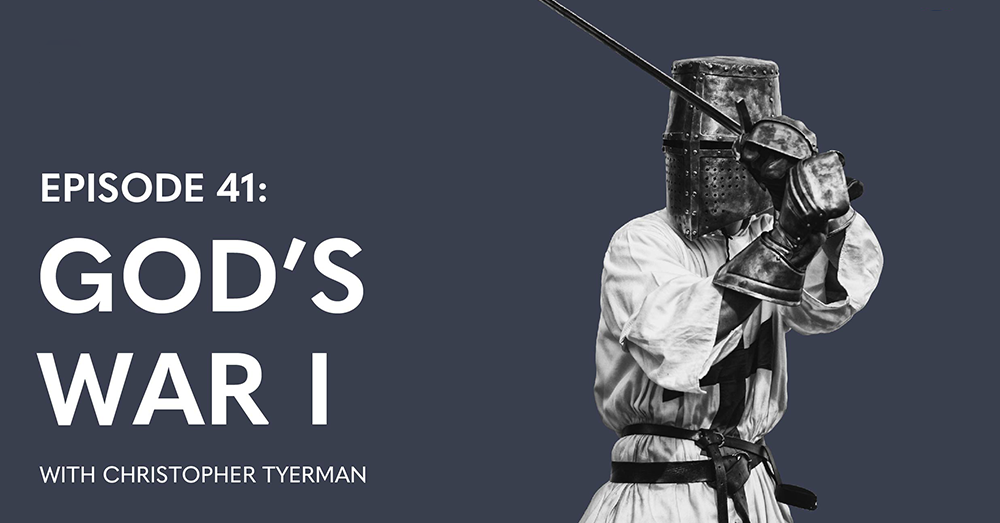
God’s War I

EPISODE: 41

God’s War I

with Christopher Tyerman

Please note that due to software used, not everything in this transcript will be accurate.

God’s War I

John Dickson (Studio)

In October 2020, Samuel Pati, a history teacher in the suburbs of Paris, was decapitated. A month earlier, he’d shown one of his classes an insulting caricature of the prophet Muhammad, published in the French magazine Charlie Hebdo. He was trying to illustrate the type of free speech that is protected in France – in this case, religious satire. But a parent took issue with showing the image. In Islam images of the Prophet are strictly forbidden, as is insulting Muhammad. The dispute became very public, and a radicalised 18-year-old took tragic revenge. In response to the attack, French President Emmanuel Macron announced further crackdowns on Muslims thought to have links to radical groups. In one media interview, Macron called Islam “A religion in crisis”. His comments stoked what was already a simmering feud between France and Muslim majority countries, particularly Turkey. Insults were thrown between Macron and the Turkish President, Erdogan. Erdogan promptly found himself the subject of a Shali Hebdo caricature the next week,

Media – News story 

John Dickson (Studio)

“The West was once again headed to a period of barbarity”, said Erdogan, describing colonial powers as murderers for their record in Africa and the Middle East. “They literally want to relaunch the crusades,” he declared. “Since the crusades, the seeds of evil and hatred have started falling on these Muslim lands, and that’s when peace was disrupted.” 923 years after the launch of the First Crusade, leaders like the Turkish president and others are still invoking the memory of the Crusades to explain ongoing conflict. How plausible is that? What were the crusades? How did they start? What did they achieve? And why did they stop? AND – does their shadow really fall over modern tensions between the West and Muslim lands? All of that across their special two-part episode. I’m John Dickson, and this is Undeceptions.

Undeceptions theme

John Dickson (Studio)

“Religion starts most of the wars of history.” That was the very firm claim of the man sitting opposite me at a sumptuous lunch at a friend’s house overlooking one of Sydney’s lovely harbours. The conversation started as they often do in my life, with my acquaintance asking me what I did for a living. It either kills the conversation or ignites it. I mumbled something about, ‘Oh, I research and lecture about history and religion’. He explained he didn’t have much time for faith, and when I asked him why, he told me plainly, “Religion starts most of the wars of history.” I naturally probed a little, which ones? He paused, thought about it for a moment and said, “Well, there’s the crusades”. Another pause and “The troubles of Northern Ireland too”. These were his only two examples. I’m not sure about The Troubles. Have listened to our single from a little while ago for more on that one. I feel inclined to give him the Crusades, though. They were religious wars, they were Christian wars, and they were pretty awful, as we’ll see. But whether we’re a Christian or sceptical, chances are that much of what we think we know about the Crusades is just wrong. Well, so says my guest today.

John Dickson:
Professor Thyman, you, you’ve written that most of what passes in public as knowledge of the Crusades is either misleading or false. Were you just being provocative or, uh, what are the myths we need to be un deceived about?

Christopher Tyerman:
Well, I think, um, particularly, um the broadest one is that the crusades form part of some eternal clash of civilizations that

John Dickson (Studio)

Christopher Tyerman is Professor of the history of the Crusades at Hereford College, University of Oxford. In the English-speaking world there’s no one more widely recognised in this field. He’s written over eight books on this topic, but perhaps his magnum opus is the thousand plus page God’s War: A New History of the Crusades published by Harvard University Press.

Christopher Tyerman:
Uh, there is some, um, eternal conflict between, um, what some people construct as, um, Western values and what Angeles construct is Eastern values. As soon as you put it in those terms, of course it, it’s meaningless. What is the western, what is the east? But there is a, a, a popular perception in particular, vis-a-vis Christianity and Islam, that the crusades form part of a contest that goes back to the early days of, of Islam in the, uh, seventh and eighth centuries. And, and some people say, continues today. 911, ISIS, et cetera, et cetera. Um, and this of course is totally unhistorical and corrosive in historical terms, although, of course, the perception of this contest informs current, um, emotions and sentiments on both sides if you like, um, Western apologists, um, will say, oh, well, um, um, there’s always this maligned threat to Western values from Islam and, um, in particularly the, the Near East there is the perception that, um, foreigners, particularly from the West, from Europe and now the United States, are constantly trying to take our land, uh, under the bogus pretense of their superior values. So I think that’s a fundamental, um, misunderstanding. We should locate the crusades in their own time, their own place, and their own causation. I suppose there are, there are minor, uh, within that, there are minor misconceptions, um, about motives, um, about the details of campaigns, about, um, portraying some crusade leaders as great heroes or villains. Portraying some, um, opponents of the Crusades as heroes or villains. I think it’s nicely put at the Paris Peace Conference of 1919. Um, and it was pointed out when the French were demanding a mandate in Syria ’cause of their historical links through the Crusades. It was, it was, they were asked, um, just who won the crusades? And they were, they were sort of ignored of course. And, um, um, the rights of the, the local leaders were ignored. Um, so the past has two in sense realities. One is its own reality of the past, and the other is a constructed reality in the present, which shifts and the crusades, of course, have become, since 911 in particular, rather toxic in that context. So I suppose why I made that provocative remark was in a sense to, um, um, remind people that the past is the past. It’s not the present. The past is not defined by the present. Many popular historical works assume the reverse.

John Dickson (Studio)

Tyerman is urging us to take history as history. The Crusades, were not a precursor to modern conflicts in the Middle East. There are parallels, yes, but as Tyerman notes, the point about parallel lines is that they don’t meet. Modern politicians like the Turkish president, Erdogan, just last year, US President George W. Bush after the September 11 attacks, or the French at the Paris Peace Accord following World War I, have all invoked the crusades for their own means, but this often conceals the real, political, economic, and territorial concerns. The real historical crusades have nothing to do with modern politics, but there’s probably no escaping the reputational damage The Crusades have brought upon Christianity, and of course, that does continue today as my lunch companion made clear. But let’s wind back. Where did the Crusades come from? They certainly didn’t pop out of nowhere. Pope Urban II, the instigator of the First Crusade, didn’t wake up one morning and invent the notion of Holy War. Out of whole cloth, there is a tale to tell of compromise and distraction.

John Dickson:
So let’s go back to the 11th century and of course before, what were some of the theoretical precursors to the notion of Christian Holy War? I mean, if some of my listeners have, uh, opened up Matthew chapters five to seven, they don’t see Jesus uh, waxing lyrical on Holy War too much.

Christopher Tyerman:
No, they don’t. There are, I suppose, two strands, uh, intellectual strands that lead to this, uh, development of Holy War. One is the classical tradition. You have, um, Aristotle, for example, the Greek philosopher, um, uh, talking about just war, um, talking about the just end of war. If war is fought to preserve or create peace, that is a justified use of violence. You then have Roman law people like Cicero who add to that the idea of the, just cause that there’s a, just aim was also just cause if you, if you want to assert your rights, um, peace obviously comes from, uh, the, the Latin word for, for doing a deal. So you have a theoretical construct, particularly associated with the state due public authority. Legitimate authority can authorize war for, uh, good reasons, for good ends, for the public good. And it is interesting that the most common Latin translation of the Bible in the Middle Ages, the Vulgate and Jerome’s Vulgate draws a distinction when, um, um, Christ says, forgive your enemies, the Latin word that Jerome uses is animicus, which means a personal enemy, not hostius, which means a public enemy. And there is a, an interesting, uh, intellectual divide. So you have a classical tradition of just war associated with the state. The Christian tradition, of course, uh, takes much of its, uh, impetus from the Old Testament where you have God commanding the Israelites to commit violence. Saul loses favor of God because he does not fully exterminate all the Amalekites. He does not commit genocide. Um, he leaves, some of the animals are alive, shouldn’t have done that. And some of, of the, the, the people, um, Joshua is a hero, um, commits genocide in Canaan. The Book of Maccabees, which although, um, uh, is often placed in the Apocrypha, um, was, was a very popular text in the, um, Middle Ages. There you have perfect examples of legitimate war fought by a religious community for their own religious autonomy and independence, committing violent acts, including, um, mutilating bodies and things like that with the support of God. 

John Dickson (Studio)

Okay, so there are a few Old Testament references to clear up. The account of Saul’s life is in the book of one Samuel in the Old Testament. He was Israel’s first king, and he ruled in the 11th century BC. God tells Saul to completely destroy the Amalekites, one of Israel’s. Enemies. It’s one of the most violent and difficult to read passages in the Bible. Saul doesn’t quite kill everything. He lets some of the animals live, and because of that, he loses God’s favour. The conquest of the Canaanites by Joshua is another really difficult part of the Old Testament. God ordains a Holy War against the Canaanites to turn these Pagan lands into Israel’s promised land. I think there’s probably a whole episode to do on Old Testament violence, so watch this space. Anyway, the third warrior tradition Tyerman and mentions isn’t in the Jewish or Protestant Bible, but it is in the Catholic Old Testament. The books of one and two Maccabees tell how an aristocratic Jewish family named the Hasmoneans organised a rebellion against the Greco-Syrian ruler Antiochus IV Epiphanes. The architect of the Jewish campaign was a priest named Judas, nicknamed Maccabeus, ‘The Hammer’ and his forces, astonishingly beat the Pagans and reconsecrated the temple in Jerusalem, the Jewish Festival of Hanukkah – Dedicatio- comes from all of this. We’ll have links in the show notes for more on all of these difficult things. The point for now is that the Old Testament does have some violent stories that the Crusaders could draw upon.

Christopher Tyerman:
So you have these Old Testament texts, and what’s interesting you find. Whereas in the early days, the old test of the Christian Church, the Old Testament texts are, um, reinterpreted and um, uh, the New Covenant takes these, these texts as metaphors, not literally as models to be followed. Um, but as time goes on, the association with the state, you look at the church fathers, these, um, um, um, the interpretation of these Old Testament texts becomes, um, to some extent more literal so that by the time you get to the 12th century, you have Bernard of Clairvouex, a very influential thinker, taking St. Paul’s text about putting the breastplate of God on and all that in the Letter to the Ephesians, um, um, um, literally and when he writes his text, um, uh, in support of the new military order of the temples.

John Dickson (Studio)

I should probably jump in here and say something about Bernard of Clairveaux, 1090 to 1153. He really was one of the foremost clerics of the age. He helped establish the famous Knights Templar. He was already famous for his preaching and writing about love and devotion to God. Now he proclaimed an extraordinary message of violence on behalf of Jesus Christ. The newly established Knights Templar were a large organisation of devout Christians during the medieval era who carried out an important security mission, we might say, to protect European travellers visiting sites in the Holy Land that had come under the West’s control. They were a wealthy, powerful, and some would say mysterious order that has fascinated historians and the public for centuries. Go and look up the Da Vinci Code to find one of the modern conspiracy theories about them. Anyway, in preparation for the second crusade, Clairveaux told his Knights Templar:

Reading

But now a brave night. Now, a warlike hero here is a battle you may fight without danger to the soul where it is glory to conquer and gain to die. Take the sign of the cross and you shall gain pardon for every sin that you can confess with contrite heart.

John Dickson (Studio)

That was Director Mark’s best Bernard. I’m particularly struck by the way Bernard of VO took New Testament military metaphors and concretised them. In Paul’s letter to the Ephesians, the first-century apostle likens the Christian life to warfare against temptation and persecution. The symbolic nature of the paragraph could hardly be clearer.

Reading

“Therefore, take up the whole armour of God so that you may be able to withstand on that evil day and having done everything to stand firm. Stand therefore, and fasten the belt of truth around your waist, and put on the breastplate of righteousness. As shoes for your feet put on whatever will make you ready to proclaim the gospel of peace.With all of these, take the shield of faith with which you’ll be able to quench all the flaming arrows of the evil one. Take the helmet of salvation and the sword of the spirit, which is the word of God.” Ephesians 6: 10 – 17

John Dickson:

Paul’s armor of God is metaphorical. He even explains each item: The belt is truth, the breastplate is righteousness, and so on. But a thousand years after Paul, Bernard alludes to this same New Testament imagery to endorse actual armor and actual weaponry.

Reading

The Knight who puts the breastplate of faith on his soul in the same way as he puts a breastplate of iron on his body is truly intrepid and safe. From everything so forward in safety Nights and with Undaunted souls drive off the enemies of the cross of Christ, that is, Muslims in the Holy Land.

John Dickson (Studio)

Bernard made an extraordinary interpretive maneuver.

Christopher Tyerman:
So you have a general intellectual development fueled. By first, the association of the Christian Church with political power, the assumption of the church’s role as the official religion of the Roman Empire in the fourth century. And then the context, the political context, um, um, particularly in Western Europe, ruled by a military elite, a military aristocracy, uh, the successors to the Roman Empire, whoes social cultural values are those of warriors. And these become in a sense, uh, Christianized. So you have figures such as Charlemagne who is guarded as a Holy Roman emperor, who fights wars to some extent supported by, to some extent, on behalf of Christianity and his contemporary propagandists, most of whom are clerics, not all, but most are, um, um, portray him in, in that, in that light. So there is a cultural process whereby, uh, justifying war in defence protection and to some extent, furtherance, uh, of the Christian Church becomes respectable, becomes in a sense necessary. And the reason for that is that religion, um, in the Middle Ages, and we, we can see it in various parts of the globe today, religion is bound up intimately with communal identity, social identity. You define yourself, um, as part of a community, or what defines that community? Uh, what defines that community, um, is, uh, shared rituals, shared beliefs, um, a shared religion. And so you can see how, how this process develops. So the texts in the New Testament are interpreted not by everybody, but by authoritative voices, conveniently, you may say, but socially, um, I mean inevitably, um, um, in ways that support, um, just war.

John Dickson (Studio)

Long before Bernard called to his knights, church leaders were devising a distinctively Christian account of violence -that is, state violence. One of the most politically consequential intellectual developments in the first millennium of Christianity came from Saint Augustine in the fifth century, who started to theorise about just war in a Christian context. Emperor Constantine had declared his faith in Christ almost a century earlier, in the early decades of the three hundreds, and over the next few generations, Christianity became not just legal and widespread, but intimately connected with the state. But by the time of Augustine in the early four hundreds, more and more Christians filled administrative positions in the Empire. And more and more bishops gained access to the imperial ear. And conversely, more and more governors and emperors went to Christian intellectuals like Augustine for advice on how to do imperial business, including warfare in a Christian way. How does the religion of the cross, of “Love your enemy”, provide advice to the most successful military machine the world had ever seen? Well, the broad principles of Augustine’s just war theory can be pieced together from both his giant tome, The City of God, and his various letters to Roman officials from around the same time. Here’s the thing, he utterly rejected the usual Roman justifications for war, like enlarging the empire, protecting honour,and  removing hated nations. For much of Roman history peace, the great Pax Romana, was almost defined as subjugation to Roman order. Augustine by contrast, argued that military force can be just when its goal is:

  1. To establish mutual peace.
  2. When it’s waged only in self-defense or to recover stolen property.
  3. When soldiers exercise maximum restraint in hostilities.
  4. When fighting is conducted with such respect for humanity as to leave the opponent without the sense of being humiliated and resentful.
  5. When prisoners of war are preserved, not executed.

That’s what a just war might look like. That’s not exactly what the crusades looked like 600 years later.

Christopher Tyerman:
The crusade, on the other hand, is slightly different because whereas, um, a war, a just war is seen as a, as a necessary. Product of a sinful world, public authorities protect through violence. Um, holy War is different. The Crusades are different from other forms of warfare, um, because they, these are war fought directly at God’s command, not, um, politicians, the leaders of the Crusade Committee fulfilling God’s command and the violence itself is a religious act. And to illustrate that, um, in 1066, the Normans invaded England under a Papal banner. They wore relics run their necks, et cetera. Nonetheless, uh, um, the troops, the Norman troops after Hastings had to do penance, um, for the slaughter. If they, if they could declare that they fought, uh, for the just cause of ridding England of a systematic and perjure, et cetera, et cetera, then they received a lesser penance for, for killing for homicide. 30 years later for the first crusade the killing itself, the warfare itself is the penitential act. You don’t have to do penance for fighting in the crusade itself is a religious penance, but that is a significant, um, conceptual. Um, and this, this comes about in a particular, in a particular context. So the crusade is a just war. It’s also a holy war.

John Dickson (Studio)

The West, of course, wasn’t the only society to develop the concept of a Holy War in the East. Islam had a well-established doctrine of jihad in the way of God – that is fighting unbelievers to spread Islam. More on that after the break.

Break

John Dickson (Studio)

It’s difficult to read the primary sources of the Crusades without being confronted by the strong religious motivations and aims expressed, like the importance of defending fellow Christians elsewhere in the world, upholding the honour of sacred sites and bringing glory to Jesus Christ over the advancing unbelief of Islam. It’s clear the instigator of the Crusades Pope Urban II had a spiritual mission in mind when he officially called for the first crusade. Whatever his political ambitions, whether to exert a unifying force over a fractious Europe or to join together Western and Eastern Christendom, it was a theology that undergirded his thinking. It’s also worth noting what was happening over in the East. Muslim armies had spread throughout the Middle East, Palestine, Egypt, and North Africa, and it looked like they were heading for Europe. By the 1050s, Islamic forces had captured much of the old Byzantine Empire, which was a Christian empire roughly corresponding to Turkey. Within a few decades, they were knocking at the door of Constantinople, the centre of the Eastern Christian kingdom, which had been continuously ruled by Christian emperors for 700 years. The Byzantine Christian Emperor at the time was Alexia I, whose retreating kingdom lay on Islam’s Western front. Alexia sent envoys to the Pope begging for assistance. Surely Western Christianity wouldn’t stand to see the last remaining outpost of Eastern Christianity swept away. Islam from the beginning had a highly developed and successful practice of Holy War or Jihad. Muslim armies sought to spread the teachings of the Prophet Muhammad, and a bit like ancient Rome actually, they saw the establishment of Islamic rule and religion as a kind of peace for the whole world. In a very real sense, the Crusades were a belated defensive war. Much of the Christian world, Syria, Palestine, Egypt, and North Africa had been conquered by Islam in the centuries before, and now Islam was on Europe’s doorstep. In this sense, and perhaps only this sense, the Crusades first developed as a hyper-religious version of just war, but there were also political dimensions.

John Dickson:
Can we talk about the immediate trigger of the first crusade, and in particular, what were Pope Urban’s main motivations so far, as we can tell in calling for the crusade?

Christopher Tyerman:
As you say, as as far as we can tell is, um, a significant detail. We have very little of Urban’s own, um, thoughts to excavate. We have a few of his letters, some of which, um, have clearly been tampered with over time, and so one doesn’t quite know the proximity to, to his own thought processes. However, there are contextual pieces evidence. Urban II was faced with, uh, a, a very tricky position in Western Europe. There was a rival pope supported by the German Emperor, um, who was claiming, um, the legitimacy vis-a-vis Urban. Urban was part of a particular faction in the Catholic church, uh, promoting Papal power and, uh, supremacy. And the first crusade is very much part of this. One of the phrases that the papal reformers of the 11th century use, one of their propaganda phrases was Liberta Ecclesiai, freedom of the Church in Urban’s Letters about the first crusade. He uses that phrase to talk about not merely about the Western Church, but also helping the Eastern Church to free itself from, um, conquest by the Seljuk Turks. So there is a political diplomatic context of helping Byzantium, which has the benefit to. Prove in the West that Urban II is the true pope, is the arbiter of religious policy in the West, not his rival. So there isn’t a sense of twin-track element to that.

John Dickson (Studio)

After a four-month preaching tour throughout France promoting his plan, Pope Urban officially called for the first crusade in a sermon delivered outside the cathedral in Claremont in Central France on the 27th of November 1095. The central theme was clear. With full papal blessing. This war wasn’t sinful, but redemptive, any pilgrim, which is what they call themselves, who was willing to go to the east, fight the Muslims and reclaim Jerusalem for the Lord would receive pardon for sins and the promise of salvation. “Whoever, for devotion alone not to gain honour or mone,y goes to Jerusalem to liberate the Church of God,” he declared “…can substitute this journey for all penance”. Urban writes of how he imposed on the crusaders the obligation to undertake such a military enterprise for the remission of all their sins. Salvation is apparently found in fighting the infidel. Some reports suggest the crowd that first heard Urbans sermon at Clemont responded in unison, perhaps led by the Pope’s assistance. “God wills it”.

Media – The Kingdom of Heaven

John Dickson (Studio)

That’s from the Ridley Scott Crusader epic, Kingdom of Heaven.

John Dickson:
And so can we say anything about the motivations of the crusaders themselves? I mean, yes, if it’s hard even to read, uh, urban, it must be incredibly hard to, uh, read the mind of, um, of a soldier. But, um, were they, can we tell if they were motivated by going and helping our brother Greeks and win back to Jerusalem?Uh, were they taking revenge on Muslims or was it also they actually saw that this was a way of salvation. They actually felt, wow, I, I might be saved through this endeavor.

Christopher Tyerman:
Well, as you say, it’s very difficult to, uh, tell because, um, even where you have personal documents of say, um, crusaders raising money from the church, we have charters, um, recording the reasons they’re doing that, the reason why they’re going crusaders, and they talk in terms of remission of sins, uh, salvation for these, these charters are written by the clerics themselves, the beneficiaries of the grants. I think the answer to your question is in all the things that you, you mentioned, uh, were part of the, the motive. Riches, uh, the word devitae is used in a, um, um, a description of a campaign, war Cry at a, at a battle in, in early of 1097, spring of 1097 in a, a Asia minor, saying that, that, um, we stand fast and defend ourselves of God. Uh, we have the God this day.The standard English translation actually means riches. I think the key is that people go and crusade in search of riches and they, they are spiritual. They’re spiritual rewards. They can also be material rewards, um, but two are not contradictory. If you do something that is good, God will reward you either in this life and or the next life. The crusade decree, promulgated by Urban II talks about going for devotion alone. Not for honor and glory. It doesn’t say you can’t get honor and glory, but your motive has to be correct and that’s the key thing. Um, so yes, I think it’s very clear from all the, the sources that, um, your promised penance, uh, essentially salvation, um, if you follow God’s command, but within that, there is obviously adventure. There’s tourism, there’s escape from, from your particular condition. There is a desire to enhance reputation, which becomes very important. And that, and a lot of crusaders don’t have a choice. If you are, um, a household knight of a Lord who goes on crusade, you’ve gotta follow him. Otherwise, you’re unemployed. The, the, the entourage of the great leaders don’t necessarily have any choice. There are some who go as sort of young men on the make, um, um, who, who will, who see as an opportunity to enhance their social prestige. And in the past, a lot of Histography has argued about, you know, are they motivated by greed? Are they motivated by pietey? It seems to me that this is a false dichotomy that if you ask he, anybody who joins an army. Why do they join the army? They will probably give you some idealistic motive. If you then ask them, well, would you do it for no pay? You might get a rather different answer. That doesn’t make them hypocrites. I think the point about the, the crusades is that, that, as anything else, it’s an obvious thing to say, but often historiography ignores this, it’s an extremely human activity and therefore contradictory, confusing, confused, and uh, mixed in terms of motive.

John Dickson (Studio)

The soldiers’ motives might be mixed, but the religious nature of the First Crusade is clear. It’s underlined by the key piece of theatre performed by all crusading soldiers who took the vow to win back Jerusalem. They each received a piece of cloth in the shape of a cross, and they sewed it into their garments as a sign that they were obeying the words of Christ himself. “Whoever wants to be my disciple must deny themselves and take up their cross and follow me. For whoever wants to save their life will lose it. But whoever loses their life for me and for the gospel will save it.” That’s Mark 8 34 to 35. Any modern reader of the passage is gonna protest that there’s no way Jesus meant this, uh, to be a justification of fighting. It was all about bearing persecution for his cause, all the way to death. It plainly doesn’t mean let’s go and do Holy War, but in France in the 11th century, the key public interpretation of this passage, and it was a favourite passage, was that able-bodied Christian men should bear the cross of fighting against the enemies of Christ. The very word crusade comes from the Latin crux or cross, referring to this ceremony of taking up the sacred emblem. It took the first Crusaders three years to get to Jerusalem. Of the approximately 100,000 men and some women we think, who set off historians estimate that one in 20 crusaders didn’t make it to Jerusalem. Some died in battles along the way. Others simply gave up and went home. It took a month long siege to actually capture Jerusalem, but to the surprise of almost all involved, the first crusaders were victorious, but that’s certainly not the end of the story. There were at least four other crusades that were not as successful. In fact, they were mostly a dismal failure.

Undeceptions theme

God’s War I

This is the first of a two part episode on The Crusades. 

Over nine hundred years after the launch of the first Crusade, world leaders are still invoking their memory to explain ongoing conflict. But how plausible is that?

Chances are, whether you’re a Christian or a skeptic, what you think you know about the Crusades is wrong. Or so says our guest for this episode.

What were the Crusades? How did they start? What did they achieve? Why did they stop?

And does their shadow really fall over modern tensions between the West and Muslim lands?

LINKS

Download a transcript of this episode here

Meet our guest

Tyerman-circle

Christopher Tyerman was educated at New College, Oxford (BA First Class 1974; DPhil 1981), lectured at the University of York (1976-77), holder of Oxford research fellowships at The Queen’s College (1977-82) and Exeter College (1982-87), and winner of the Royal Historical Society’s Alexander Prize Medal (1981). Tyerman joined Hertford College as a lecturer in medieval history in 1979 and has been a fellow since 2006.

His main research interests have related to crusading as a cultural, religious, political and social phenomenon of medieval western Europe between the eleventh and sixteenth centuries.

Want to send John Dickson a question? He loves them. Just click here to provide a query for our next Q and A show!

Undeceptions is part of the Eternity Podcast Network, an audio collection showcasing the seriously good news of faith today.

UN Logo-RGB-enLarged
God’s War I

UNDECEPTIONS SINGLE SERIES

SUBSCRIBE TO UNDECEPTIONS PODCAST

SEND US  A QUESTION

Oh boy, does John love questions. So don’t be afraid to send them in. At the end of each season we dedicate an episode or two for John to answer all your burning questions about Christianity. Want to know something more about a previous episode? Or perhaps you’ve got a question about faith that you’ve been struggling to find an answer for?
Let us know here.

or send us an email

Back To Top
Become an Undeceiver