When it comes to championing evolution as a trump card over religion, British evolutionary biologist Richard Dawkins has led the way.
At the heart of Dawkins’ thinking is the idea that the mutations of genes are random – and therefore, entirely meaningless. There would appear to be no divine hand behind the code of life.
His landmark theory, laid out 50 years ago in his book The Selfish Gene, was conveyed with a powerful metaphor: living things are like survival machines. We live only for the purpose of passing on genes to the next generation.
Genes – or ‘replicators’ – make copies of each other and transmit themselves faithfully from one generation to the next. Their ‘vehicles’ are the organism – a plant or an animal… or humans.
The ‘gene’ is the primary unit of evolution, and genes build organisms and compete to ensure their own survival. Life itself is an automatic and pitiless machine.
The “meaninglessness” of mutation was somewhat accepted by evolutionary experts – for a while.
But things have been quietly shifting for the last decade.
In fact, the latest research into mutation and selection – the evolutionary process – cuts so against the established orthodoxy of “random mutation” that one article in The Guardian posed the question: ‘Do we need a new theory of evolution?’
Mutation with a purpose
Evolution is just ‘change over time’ – and scientists have identified two basic parts in the process.
Part 1 is ‘mutation’ – which gives us the variation – and the differences – we see in individuals.
Part 2 is natural selection. That’s where mutations more conducive to survival get to survive and be passed on to offspring.
It’s part 1 that has come under particular scrutiny of late.
For Ard Louis, Professor of Theoretical Physics at the University of Oxford, the seemingly limited outcomes of genetic mutation are one clue that, when it comes to the theory of it all, something is amiss.
“When mutations happen and are up, only a small number of things actually happen,” he said, speaking on Undeceptions.
“Simon Conway Morris (paleontologist and evolutionary biologist) has been emphasising that actually, certain things evolve again and again and again (in the same way) – and it’s extraordinary.”
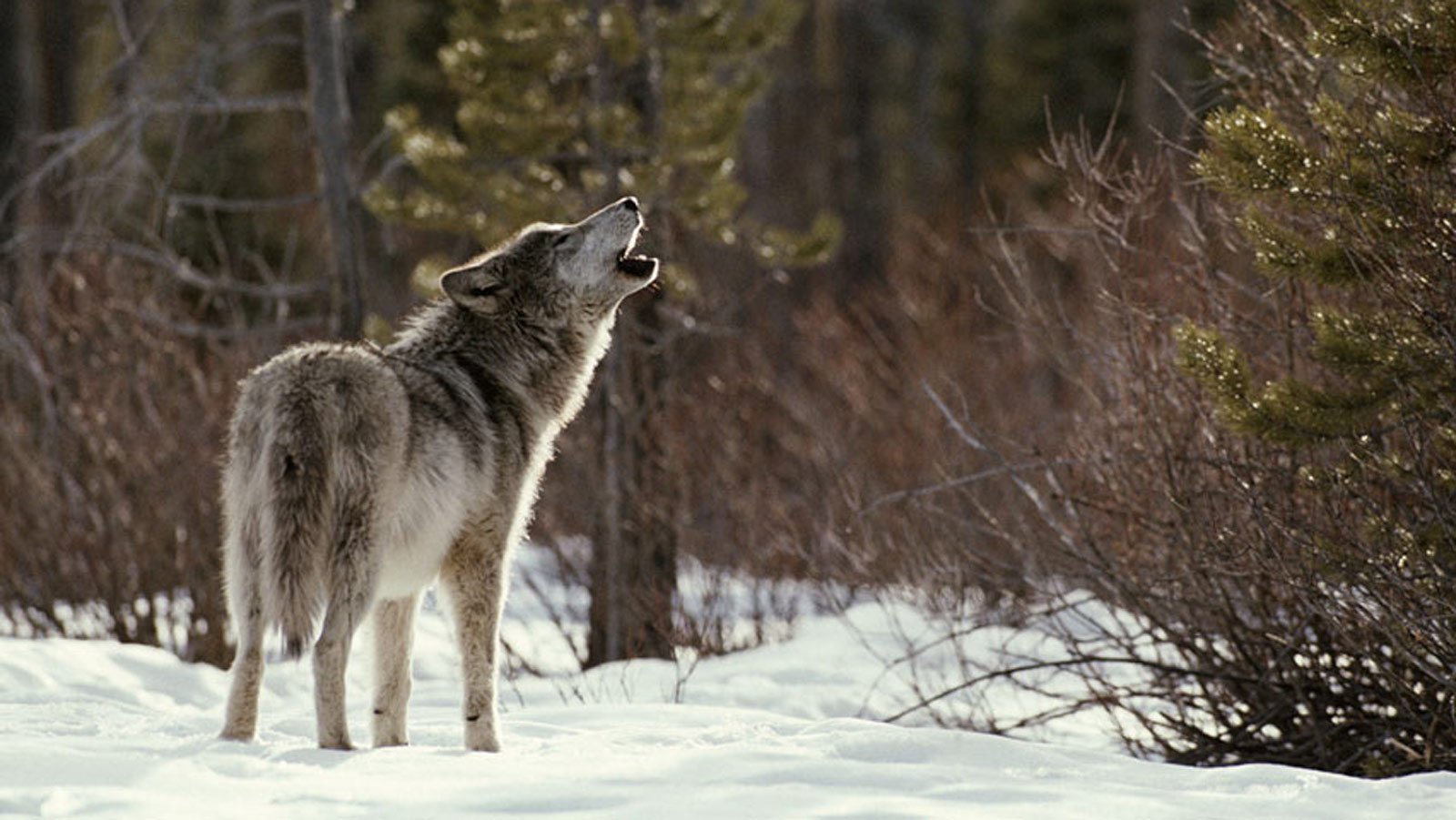
A placental wolf in North America, which happens to be very similar in genetic makeup to the now extinct marsupial wolf in Tasmania, thousands of miles away in Australia
Contrary to the typical claim about evolution (as random and directionless), it turns out that unrelated species independently evolve similar traits when faced with similar environmental pressures.
We might think of mutations, in theory, as a massive smorgasbord of options, and there’s no rhyme or reason why one dish might be served up over another. In truth, it’s more like a narrow menu. The number of dishes – of viable solutions to environmental pressures – is surprisingly small.
This would seem to cut against the standard Neo-Darwinian model, which stipulates that completely random mutations happen, nature allows just a few to survive, and those changes are passed on to the next generation.
So, what’s actually going on?
Understanding randomness
According to Louis, part of the problem is what scientists mean by the word ‘random’.
“Random means purposeless. If we were to use a different word for the kind of randomness we mean in Biology, that word is stochastic. It’s a fancy word that basically meansprocesses that don’t have any memory in them,” he said.
Mutations might not be as random as thought through the last century.
This possibility has led experts to re-examine some long-dismissed ideas suggested by evolution experts in centuries gone by.
One such expert was Jean- Baptiste Lamarck, who offered his own theory of evolution. Speaking about Ggiraffes specifically, he wrote:
“This animal, the largest of the mammals, is known to live in the interior of Africa in places where the earth is nearly always arid and without herbage, obliging it to browse on the leaves of trees and to continually strive to reach up to them. It has resulted from this habit, maintained for a long time by all the individuals of the race, that the forelegs have become longer than the hind legs and its neck has so lengthened itself that the giraffe, without standing on its hind legs, raises its head and reaches a height of six meters (nearly twenty feet).”
In other words, the giraffe genes mutated with the express purpose of allowing the host organism to survive its climate. These mutations were then passed on through giraffe offspring.
It was a ‘use it or lose it’ idea. If the giraffes stopped having to reach for those leaves, over time and many generations, their necks would get shorter.
This idea, though, was widely considered, for a long time, to be wrong. The entrenched view was that an organism couldn’t have any effect on its genes. The genes were the things in the driver’s seat with the organism along for the ride.
Now, we’re not so sure.

Lamarck’s ‘Neck extension theory’ – once discounted, but now being re-evaluated
“People like Dennis Noble are saying ‘Actually, that’s not really true,’” Louis said.
“We’re seeing now that there are things that can happen in your lifetime that can affect your offspring. This is through something called epigenetic changes, where it changes to your genes. What’s not well established is how pervasive this is.”
Evolution remains one of the big mysteries of biology.
What’s clear, though, is that it’s not the final nail in the coffin of religion that some people want it to be.
Intentionality of mutation certainly doesn’t ‘scientifically prove’ God, but what things like epigenetic change can show is that intentionality at a molecular level might not be such a far-fetched proposition.
Theologically speaking, this would make sense if the universe were created to operate under certain principles. That’s a question that goes far beyond the probes of evolutionary theory, though.
“Every biologist would say that we think very differently now (about evolution) than we thought 50 years ago,” Louis concludes.
“I think what you’re watching right now is a turbulent period where a lot of different voices are yelling quite loudly, and the question is, will there be some kind of paradigm shift on this or not? And I think that the jury is out.”
Adapted by Alasdair Belling from Undeceptions episode 170, ‘ Evolution Revolution?’. You can listen to the full episode here.


Want to be further undeceived?
Check out our network of podcasts and articles in the Undeceptions Library.