Transcripts are generated using a combination of speech recognition software and human transcribers, and may contain errors. Please check the corresponding audio before quoting in print.
Transcript coming soon.

What in the world do we do about slavery in the Bible?
We shouldn’t rush to William Wilberforce and the Christian abolitionists so quickly that we gloss over an uncomfortable fact: Christians really did use the Bible to keep slaves in their place.
Secular thinkers defended slavery using science, philosophy, politics, economics, and pragmatism. But there’s no doubt many Christians provided moral cover by quoting passages from the Old Testament that seem to endorse slavery, and passages from the New Testament that, at the very least, seem to put up with it.
Meet our guests

Esau McCaulley, PhD is an author and the Jonathan Blanchard Associate Professor of New Testament and Public Theology at Wheaton College. His writing and speaking focus on New Testament exegesis, African American Biblical interpretation, and public theology. He has authored numerous books including, Reading While Black: African American Biblical Interpretation as an Exercise in Hope and New Testament in Color: A Multi-Ethnic Commentary on the New Testament. Esau’s recent memoir, How Far to the Promised Land, was named by Amazon as a top five non-fiction book of 2023.

Jim Martin is Vice President for Spiritual Formation at International Justice Mission, a global organisation working to eliminate modern slavery.
Show Notes
LINKS
Check out these links to what we discussed on the show.
TO READ
- This is the text of the speech given by Nobel Prize-winning physicist Steven Weinberg, ‘A Designer Universe?’ The majority is behind a paywall, but you can get a sense of the tone even in the first few paragraphs.
- Read Esau McCaulley’s 2023 essay in the New York Times, ‘How the faith that arose from the cotton fields challenges me’.
- Esau McCaulley is teaching a new undergraduate Bible and theology class in 2026 “The Bible, Slavery and Liberation”, aiming to show how greed can influence biblical interpretation and highlight its historical repercussions.
- Check out some of the historical artefacts from ancient Rome that help us understand the institution of slavery in the Roman Empire, from the British Museum.
- In Nahum M. Sarna’s commentary on the book of Exodus, he wrote about Exodus 21:16, which specifically prohibits stealing a person to sell them, and prohibitions against mistreating slaves. “This law – the protection of slaves from maltreatment by their masters – is found nowhere else in the entire existing corpus of ancient Near Eastern legislation,” Sarna wrote.
- Read more about Frederick Douglass, an American abolitionist and leader of the movement for African-American civil rights in the 19th century.
- Read 1 Clement 55:2, which gives us early evidence from AD 96, just after the New Testament, that Christians sometimes sold themselves into slavery to donate the sale price to the destitute: “We know many among ourselves who have given themselves up to bonds, in order that they might ransom others. Many, too, have surrendered themselves to slavery, that with the price which they received for themselves, they might provide food for others.”
- John mentions in the episode that by AD 115, churches were establishing dedicated funds to pay for the manumission of slaves. Our earliest evidence for the church fund to free slaves is Ignatius (AD 115), To Polycarp 4.3. On the church’s “common chest” for manumission, see J. Albert Harril, The Manumission of Slaves in Early Christianity, 129–92.
- Read In the Image of God: Religion, Moral Values, and Our Heritage of Slavery by David Brion Davis, where he points out that abolition in England and the US emerged, at least in part, because of a “revivified sense of the image of God in man”.

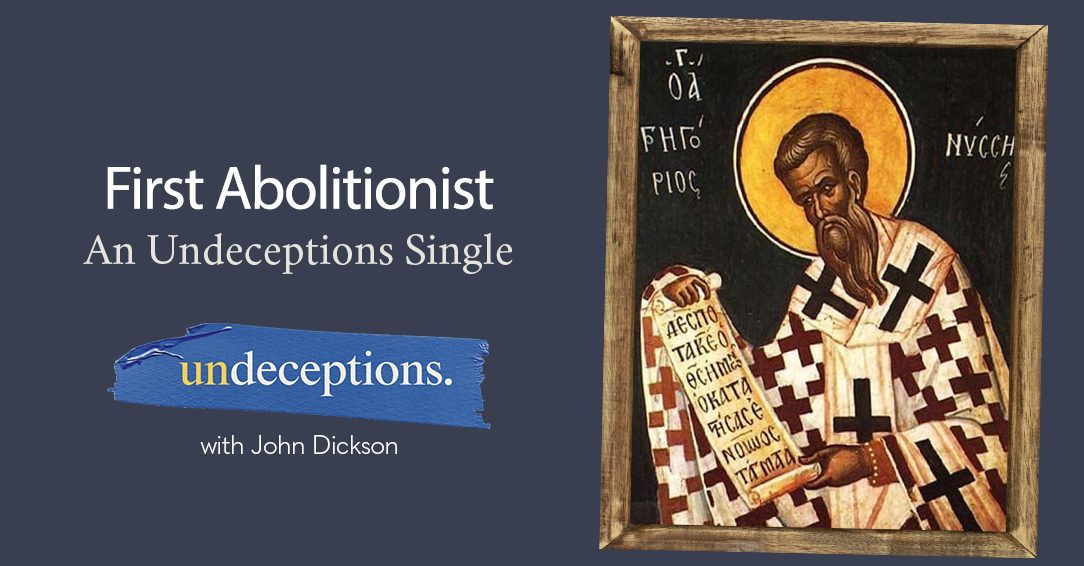
In one example of The Slave Bible’s redactions, the text skips directly from Genesis 45:28 to Exodus 19, so it includes the Ten Commandments (Exodus 20) but “disappears” the first eighteen books of Exodus, in which the Israelites escape slavery in Egypt. - Here’s a digitised version of Gregory of Nyssa’s Homily 4, On Ecclesiastes, where he rails against the evils of slavery in the fourth century! The inspiration behind Gregory’s ideas was that all are made in God’s Image, and therefore equal.
- For more on Bishop Eligius from the 7th Century – who preached throughout France that conversion to Christ must include freeing your slaves (and bought and freed slaves himself at great personal cost)- you can read Dado’s Vita Eligii 1-2. It is printed in the original Latin in Patrologia Latina, ed. J. P. Migne (Paris, 1844–64), 87:479–594. The English translation JD used is by Jo Ann McNamara, the Fordham University Medieval Sourcebook, which you can read online here.
- Read about Drapetomania – the proposed mental illness that was hypothesised as the cause of enslaved Americans fleeing captivity. It was based on the belief that slavery was such an improvement upon the lives of slaves that only those suffering from some form of mental illness would wish to escape. The idea was soon, thankfully, utterly rejected.
- Take a look at The ‘Slave Bible’, a bowdlerised version of the New and Old Testaments printed in England in 1807. The Bible, intended ‘For the Use of the Negro Slaves, in the British West-India Islands’ was carefully edited to remove any mention of being freed from bondage.
- Read Jonathan Blanchard’s A Debate on Slavery, published after his epic debate against slaveholding in 1845.
- Read Frederick Douglass’ letter to William Lloyd Garrison where he writes, that slavery goes against the teachings of Christianity because the Creator loves all those “stamped with the likeness of the eternal God”.
- In 2021, global estimates indicated that 50 million people were living in situations of modern slavery. Nearly one in every 150 people.
- Read more about modern slavery and the recent uptick in human trafficking to scam centres.
- Read this news article from Al Jazeera reporting on the warnings of the UN against human trafficking in scam centres.
- Just this week, Christianity Today ran a story about a Burmese man who helped prosecute the crime syndicate who held him hostage in a cyber scam centre in the Philippines.

TO WATCH
- Watch descendants of Frederick Douglass read his famous ‘What To The Slave Is The Fourth Of July?” speech, from NPR.
- This is The Guardian’s report earlier this year when the UN adopted Ghana’s resolution to class the slave trade as a crime against humanity.
- Here’s former Archbishop of Canterbury Rowan Williams in Centre For Public Christianity’s documentary For the Love of God talking about Christianity and slavery:
TO LISTEN
- Listen to Ep 174 ‘God’s Image’ which really acts as background for the whole Bible-based argument against slavery.
- Listen to David Wengrow on the Empire: World History podcast talk about slavery in the world’s most ancient civilisations.
- The BBC’s In Our Time podcast did this great episode earlier this year on ancient Babylon’s The Code of Hammurabi, one of the first written laws mentioning slavery.
and finally, if you’d like to know more about how to make a difference in the fight against modern slavery, check out International Justice Mission, an organisation that John supports personally (not sponsored).
As an Amazon Associate, Undeceptions earns from qualifying purchases. All proceeds go into helping run the show.

Become an Undeceiver
Undeceptions Plus offers exclusive bonus content to members. By becoming an Undeceiver, you can unlock uncut interviews, extra question and answer sessions, and peeks behind our creative process as we put the shows together. We’d love to have you with us.