Please note that due to the software used, not everything recorded in this transcript will be accurate.
Religious Freedom
John Dickson (Studio)
Imagine if Michelangelo, when commissioned by the Pope to paint ‘The Last Supper’, had decided to express his own religious freedom! You don’t have to imagine it. Monty Python has done it for us.
Media – Monty Python clip
John Dickson (Studio)
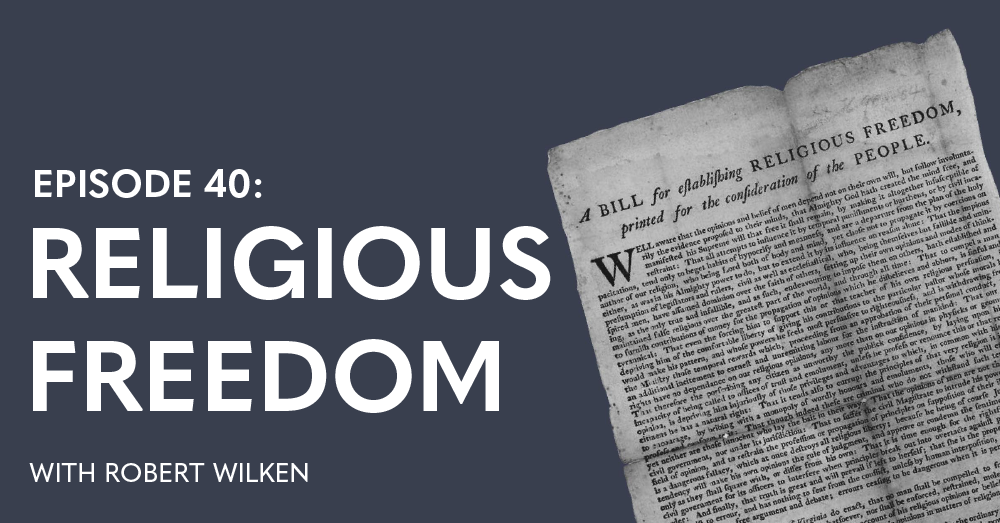
And that’s the problem with religious types, right? No wiggle room. In fact, it’s often said that it was the intolerance of Christians, from the apostle Paul to the Renaissance Popes, that led to the Enlightenment’s secular cry for “freedom of religion” – and even freedom from religion. Religion fosters bigotry and violence toward difference. Enlightened secular thought fosters peace and pluralism. The Church demands conformity. The secular state encourages diversity. And few Enlightenment thinkers put it more forcefully than Thomas Jefferson, the Third President of the United States, and an avowed critic of religious intolerance: “Be it enacted by the General Assembly,” he wrote in Virginia Statute for Religious Freedom, passed on the 16th Jan 1786, “that no man shall be compelled to frequent or support any religious worship … nor shall he otherwise suffer on account of his religious opinions or belief; but that all men shall be free to profess, and by argument to maintain, their opinion in matters of religion.” It’s a wonderful statement. And it was the basis (five years later) of the US Constitution’s First Amendment, which famously guaranteed “freedom” of the press, freedom of speech, freedom of protest, and freedom of religion. These things are now the common assumption of all Western democracies – a modern secular Aussie or Brit is just as well versed in the importance of “freedom” in matters of religion and irreligion as any citizen of the “land of the free”. Less well known is where these ideas first came from. Today, I’m going to introduce you to some very ancient Christian theologians, whose ideas became much more famous than their names. And, thanks to a recent discovery, we now know that even the very secular Jefferson knew full well the religious origins of religious freedom. I’m John Dickson and this is Undeceptions.
Undeceptions theme
Robert Wilken:
In antiquity and in the cities of the Roman empire, religion was an affair of the community as a whole, which meant that any religious rights or ceremonies or practices were understood to be the responsibility of all the citizens. The whole idea that developed in early modern times, that you would have religious communities who were independent of the religion of the city was quite foreign.
John Dickson (Studio)
That’s Professor Robert Louis Wilken. He’s Professor Emeritus of the History of Christianity at the University of Virginia (a very good place to be to study the origins of religious freedom). His many books include The First Thousand Years, The Spirit of Early Christian Thought, and The Christians as the Romans Saw Them. Most recently, he wrote Liberty In The Things Of God: The Christian Origins Of Religious Freedom. The evidence is clear, he says: whatever the multiple failings of Christians to tolerate difference through history, it would be wrong to think of “liberty in religious matters” as a secular discovery. The real story is much more complicated. He spoke to me from his home in Virginia.
Robert Wilken:
In the cities of the Roman world, especially in Asia Minor, many Jews had settled in the years, hundreds of years before the rise of Christianity. And because their way of life was so distinctive, they worked out an arrangement with the city officials that they could keep their own way and practice what they believed and would not be disturbed at least most of the time, but Christians were not so tell me, given that privilege.
John Dickson:
I want to ask then why did the Romans persecute the Christians and in particular, I’m thinking of the great persecution at the dawn of the fourth century.
Robert Wilken:
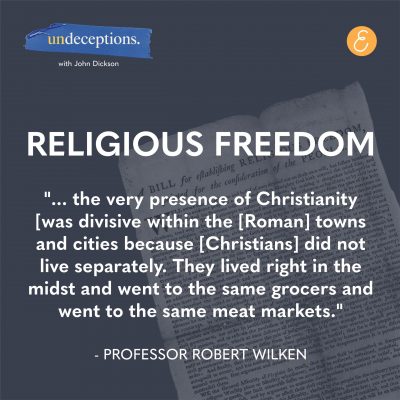
Religious festival would come around and Christians would not participate. It was clear to their neighbors. And so they were offended. And some of the stories that we have, which are really accounts of the martyrs, the governor of the province, or the chief official, then the city said, why don’t you keep our ways we are religious people. Why do you have to follow your own way? And they found that of course offensive. So it was, it was a simple matter of, uh, not, uh, not following, not respecting, not honoring the religious rites, which were part of everybody’s experience. And they stood out and we, we have a fairly extensive what are called the acts of the martyrs. And these are in many cases, firsthand accounts. Why can’t you follow our way? If you want to live among us why don’t you follow what we do? Now, the Christians of course claimed that they were a people who would, who were worshiping a God who was the God for all. So they were seeking converts. And so they were in essence divisive. They were not happy simply to be among their own tribe as were, the Jews. And so the very presence of Christianity was divisive within the towns and cities because they did not live separately. They lived right in the midst and went to the same grocers and went to the same meat markets. You know, they went to the same barber and must remember that in the Mediterranean world, life was lived outside.
John Dickson (Studio)
Christianity was an affront to Roman sensibilities. Throughout the empire, religion was a important civic activity – and often a function of the state – and so Christians’ refusal to take part in the pagan rituals (not to mention their claim to follow a Lord above all lords) came across as disloyal to the emperor, and a threat to social cohesion. Famous philosophers like Porphyry (234 to 305) started to denounce Christians as cultural traitors. “How can these people be thought worthy of our patience?,” he wrote. “They have turned away from those things divine. To what sort of penalties might they not justly be subjected!” The argument was clear: the gods had protected Rome since the dawn of time; anyone who abandoned the gods forfeited the right to imperial protection. And so on the 23 Feb AD 303, Emperor Diocletian issued the first of four decrees against the Christians, ordering the destruction or seizure of church properties, the burning of Christian Scriptures, the sacking of all Christians in government and academia, and, eventually, the execution of any who would not offer sacrifices to the traditional Greek and Roman gods. Many Christians died in this 8 year period, as various emperors and co-emperors maintained the policy. And then – out of nowhere it seemed – something truly earth-shaking happened – Emperor Constantine declared himself a Christian. That story deserves a whole episode – if I can convince Director Mark and Producer Kaley to do so. (Feel free to write in with support for the idea!!). Anyway, Constantine declared his allegiance to Jesus Christ and suddenly put an end to all persecution of the Christians. And, of course, he did what any self-respecting emperor might do. He coerced everyone to follow his religion, just as previous emperors had done for the pagan gods.
… Actually, he did nothing of the sort …
Instead, he issued an edict – well, really it was just a published letter. But it is called the Edict of Milan. And it is an extraordinary document in the history of ideas. It guarantees ‘libertas’ in matters of religion.
Reading
“Freedom and full liberty has been granted in accordance with the peace of our times, to exercise free choice in worshipping as each one has seen fit. This has been done by us so that nothing may seem to be taken away from anyone’s honour or from any religion whatsoever.”
Robert Wilken:
It was a letter. But it had came to be called an edict and it didn’t spring out of the blue. Several Christian writers Tertulian who lived around theair beginning of the third century in North Africa, in Carthage. And then during the early fourth century, Lactantius, another writer, had written treatises in one case, um, to another Roman governor and another case, a more general treatise in which they had argued that religion was a matter of internal inner convictions conviction. And, and therefore it couldn’t be coerced.
John Dickson (Studio)
‘Religion can’t be coerced.’ It can’t be forced on anyone. I thought I’d just break in for a moment to say keep an ear out for that phrase as we go through this episode. It’s going to be an important one. Tertullian (the great third-century Christian theologian and public advocate for the faith) wrote these words in a letter to the Roman governor Scapula:
Reading
“It is a fundamental human right, a privilege of nature, that every man should worship according to his own convictions: one man’s religion neither harms nor helps another man. It is assuredly no part of religion to compel religion – to which free-will and not force should lead us.”
Tertullian’s language of a “right” to “free” worship sounds very modern, but it is ancient and Christian. And then there’s Lactantius, a Christian professor of rhetoric, who lost his job in the Great persecution. He’s particularly important because we know he had direct contact with Constantine. In fact, Constantine immediately employed Lactantius as a private family tutor. Anyway, Lactantius wrote:
Reading
“There is no need for violence and brutality: worship cannot be forced; it is something to be achieved by talk rather than blows, so that there is free will in it … There is nothing that is so much a matter of willingness as religion.”
Robert Wilken:
Now Lactantius, who lived at the time of Constantine actually was the tutor to Constantine son. So there’s a kind of a direct link there. And so what happened was Constantine realised that the persecutions had not worked and that something had to be done to change the political and social environment. And so he persuades his fellow emperor Lisinious to, to write this letter, which is then sent out to various parts of the Roman world in which he says that religion should be not coerced, and he’s not talking just about Christians. He says, everyone should be free to practice the religion that they wish. And this, then, becomes the kind of principle that is going to be remembered, though, not actually observed that’s that’s the sad part. And so by the end of the fourth century and the, uh, reign of emperor Theodotious, he proclaims that the religion of all people in the empire should be the religion of Christianity. And by that, he means, of course, the nice seen creed. And he even mentions the Bishop of Rome as a kind of a marker of that.
John Dickson (Studio)
It’s important to catch that timeline. For two generations after Constantine, there was an official Christian policy of toleration in matters of religion. That’s roughly the timespan from the Second World War to today! …. But it didn’t last.
Robert Wilken:
What happened then in the course of two generations where the Christianity basically falls into the pattern, which had existed before the rise of Christianity, but now it was not Roman gods, but it was the Christian God. And that then extended right on through the Middle Ages. And the one exception would be the Jews, but even with the Jews, Christians did not observe what they said they should observe, namely they should be right to practice their own religion.
John Dickson:
Thinking of the results of the Christian faith, where does this intolerance stream come from? Is it born of Christian doctrines? Uh, or is it as perhaps you hinted a second ago, more a reversion to what was the ancient way of thinking of religion as a societal, as a civic good?
Robert Wilken:
Well, I think it certainly is the latter that it was religion was something that was to be observed by all people in the city. But of course, um, those people who did not practice the religion of the larger society and believed other things where you use a theological term were not Orthodox, they were heretics. They believed things that were contrary to the scriptures and contrary to Christian doctrine. So there was a reason why they should be excluded or mistreated. And that comes up again and again, and again and again, even though there are voices that, that, um, defend the ancient principle, but it’s, it’s both, um, societal matter and, um, and a theological matter, um, that you can’t have people who deny the divinity of Christ. They’re not the kind of people you’re going to have. Um, do you want to have living in your community.
John Dickson (Studio)
And that’s exactly the response many forms of Christianity took in the coming centuries. Not all of them. Probably not as many as you think. But there were enough Christian bullies through the centuries for me to know that Christians should never feel smug about these things. There is disturbing evidence of Christians persecuting Jews, executing pagans, and torturing heretics. I’ve just written my biggest book ever on the topic of the bullies and saints of Christian history. More about that some other time. My point is that even though this notion of religious liberty was never wholly lost in the church – even in the so called Dark Ages (there’s another episode!!) – it is true that the church frequently reverted to the old imperial ways, where ‘coercion’ in religion seemed perfectly sensible, for the stability of the state and the cohesion of society.
John Dickson:
I’d like to race forward to the time of the reformation, uh, where it was proposed, that there were two kingdoms, two realms, a religious and a secular, um, what is the significance of that idea? And did it work?
Robert Wilken:
Well, it’s working now has been working for centuries. Um, one of the most, you know, when you write a book like this, part of the satisfaction is just turning up unexpected writings and texts opinions. And in my case, because I was basically had spent my life working in the early church and to a certain extent in the medieval, the reformation and the modern period was, was really pretty, uh, fresh territory. And of all the things that I turned up there was one, this was in France around 1560. I remember that, uh, the reformation came to France 1540, 1550, um, largely through Calvinists not Lutherans, Calvinists.
John Dickson (Studio)
Just a note in case you’re not familiar with Calvinists. They were the followers of John Calvin, one of the leaders of the reformation movement that challenged the orthodoxy of the Roman Catholic Church. The reformers’ call for a return to the Bible and protest against Catholic teachings is what led to them being called Protestants.
Robert Wilken:
Calvin was, of course a Frenchman spoke French wrote in French. Um, and, um, around 1560, um, of Frenchmen wrote to a friend of his, and he said, could you believe when we were younger, that there could be two religions practiced in one city and even in the capital of France Paris, I think that says everything. The assumption up until the mid to late 16th century and then the 17th century was that every community practiced one religion. And so that’s why religious differences conflict were so destructive for the well-being of society. Everyone thought that you couldn’t really have a safe and peaceful society if people didn’t hold the same religion. And that’s really what the reformation led to. And I mean, when you think about it, I mean, most people don’t think about it. It would be very nice. Wouldn’t it? If all your neighbors went to the same church that you did, I think that’d be very nice. I’m sure a lot of people would think that’s heretical to say that, but when you realize the division in our country or your country where everything is divided up, sometime you’re in for those days, but any case they are long gone. And that’s why religious freedom is so necessary because they’re always going to be some who are in power, who are not pleased with, uh, um, the dissenters, because religion is not a matter of doctrine. You know, it’s, it’s a matter of education. That’s where a lot of the issues have fought out today. What are you going to teach kids in the schools? I have a chapter on the Netherlands. And what I learned there of course is that, um, if the Catholics were in power in a certain city, they would then persecute the Calvinists and vice versa. And what happened eventually was that, um, the country was divided, uh, and the Southern part, which became Belgium, became Catholic and the Northern part became, um, reformed. Uh, so the Netherlands a very, very interesting, very significant.
John Dickson (Studio)
And so the history of religious freedom looks pretty dismal at this point. Whole countries are being divided on the basis of different versions of the same faith. Not much tolerance there. So, how is religious tolerance and freedom reborn in the world? As with so many things like this, the story is mixed. There are modern secular champions. And there are religious ones. But they all stand on the shoulders of giants. More after the break.
Media – Religious freedom news clip
John Dickson (Studio)
Religious freedom has been a hot topic in my home country in recent times. For many countries, in fact. This most recent public struggle began with the international movement to legalise same-sex marriage. That seems like old news now. But the implications for our topic are still with us. The ‘marriage debate’ became a ‘freedom of religion debate’, as some groups tried to stake out their own claim to a protected viewpoint (the old traditional viewpoint), and others insisted that on a matter of justice there should be no freedom to be a bigot. Could a Christian cake shop owner refuse to make a gay wedding cake? Could a Christian church refuse to rent their premises to a transgender dance group? Could a Christian preacher even preach the old view without stepping over into ‘hate speech’. Believers and doubters are suddenly interested again in the nature and limits of religious liberty. That’s where a little more – recent – history helps.
John Dickson:
Can we talk about an Englishman who became an important American named Roger Williams? Uh, why is he significant to this story, particularly the American story of religious Liberty, Liberty of conscience?
Robert Wilken:
Well, Roger Williams lived flourished in the early part of the 17th century, just as the time when the Anabaptist, which then became the Baptists were beginning to gain strength. They began to form their own communities, which meant that they engage their own clergy. So they created social units that were independent of the larger unit of the city. So when he comes to North America and the Boston area, he’s a very disruptive figure.
John Dickson (Studio)
Roger Williams arrived in Boston, Massachusetts as a Puritan, but quickly found himself at odds with the powerful colony leaders – also Puritans – who were already there. Eventually, Williams’ anti-establishment preaching gets him banished from the colony, and he establishes his own settlement. He calls it Providence, the city now the capital of the state of Rhode Island. Providence becomes somewhat of a haven for other religious outcasts.
Robert Wilken:
And he can’t abide by the restrictions, which really meant that there was one religion in Boston form of reform religion, but nevertheless one. So he’s constantly pushing against that. And the man that he, uh, engaged with John Cotton, who was a kind of the premier, um, religious, and in some ways political figure in the community, and he then begins to write against him. And what Roger Williams then saw was that there was no way in which you could defend the freedom to practice your own religion without making a clean break between religious authority and political authority. And Cotton deeply, deeply opposed that because he thought that without the two being interwoven, you would have no peace in society. This is Tertullian: “In a privilege inherent in human nature, that every person should be able to worship according to his own convictions, for one person’s religion neither harms nor hurts another. Coercion has no place in religious devotion.” And cotton took that passage from Tertullian to mean that there would be no public expression of religious differences, only private. And Williams said it can’t mean then. And of course he was right. He can’t mean that. So he develops his arguments and because he was a very flamboyant personality, he, um, he founded a community in Rhode Island. So Roger Williams, um, and his ideas were censured by the English parliament because there, you had an established religion, but he’s probably the most, uh, not the most original. He he’s the most influential of the, the early writers.
John Dickson (Studio)
Just to navigate us all on the timescale. Roger Williams is active from the 1650s – decades before John Locke (the father of liberalism) and more than a century before the great Thomas Jefferson. There’s another clergyman, even before Roger Williams, who advocated very similar views about liberty in matters of conscience!
Robert Wilken:
But there was another writer just at the same time named Thomas Helwys who nobody knows anything about. He wrote a book called the mystery of iniquity and Hellwith following the basic principles. That religion is a matter of individual choice and conscience took the step and said, he hated the Catholics. He said they should be allowed freedom to, but then he went on to say, even the Jews and Muslims. Extraordinary! This is early 17th century. So you got to give a lot of credit to these Baptists, these Anabaptists. I don’t think that they are the ones whose ideas were the basis, but they knew how to make them work and they did.
John Dickson (Studio)
Helwys and Williams are hardly talked about today. They certainly rarely get credit for the modern emergence of “freedom” in matters of religion. The biggest name, of course, was from a century or more after these theologians. And it’s his more secular rendition of religious liberty – codified in the First Amendment of the American Constitution – that most of us recall. Thomas Jefferson was a founding father of the United States, and its 3rd president from 1801 to 1809. (He’s also a character in a certain musical showing in Sydney at the moment!!!)
Media – John has a phone conversation with his daughter Josie about Hamilton
Media – ‘What Did I Miss’
Jefferson possessed a giant intellect and authored many philosophical and political documents, including the original draft of the Declaration of Independence and the American Bill of Rights. But it was his work on the Virginia Statute for Religious Freedom that he thought was among his greatest achievements, for which he, “most wished to be remembered.” In it, he laid out his grounds for religious freedom, based on the freedom of the human mind – more on that later. Jefferson was not particularly religious, and he certainly wasn’t a Christian. He famously created his own Bible – the Jefferson Bible – which excluded all the miracles and just kept the moral teachings of Jesus! That didn’t stop him, though, from thinking and engaging deeply with the issue of religious freedom in the state of Virginia. He described it as the most severe contest in which he had ever been involved. And today there are many other good secular minds that are passionate about the issue. Time to phone another friend!
John Dickson:
Hi Tim … thanks for taking this call.
Tim Wilson:
Sorry I was a bit late …
John Dickson (Studio)
That’s Tim Wilson, an Australian politician and member of the Liberal Party. He served as Australia’s Human Rights Commissioner from 2014 to 2016 and, while not a religious man himself, has been a vocal advocate of religious freedom in this country.
Phone conversation between John Dickson and Tim Wilson
John Dickson:
From your perspective, is it really a secularist enlightenment development that insisted on Liberty? Um, in other words, does, does one need this secular tradition in order to sustain a notion of religious Liberty? Um, or does religion have its own resources?
Robert Wilken:
About the time that the book was published, a, a very distinguished political commentator, uh, wrote an op-ed in the Washington post in which he said precisely what you just said, that it was because of the religious Wars that religious toleration was necessary. And so it came in because of these, uh, people who were more reasonable than the Christians, but I think that’s false. I think that the ideas that you find in the enlightenment thinkers, and the one, of course, who’s most important, it’s John Locke, and it’s in his essay on toleration in religion or his letter on toleration and religion.
John Dickson (Studio)
John Locke (whom I mentioned a moment ago) was an English philosopher and one of the leading voices of the Enlightenment. He lived in the aftermath of the European wars of religion that had ravaged the continent for decades. (They weren’t really wars of religion, but that’s maybe for another episode). Locke wrote what’s become a classic three-part reasoning for religious tolerance: Firstly, it has to be accepted that human beings can’t generally evaluate the truth claims of competing religions. Secondly, even if they could, enforcing a single ‘true religion’ would fail because belief can’t be compelled by force. And thirdly, attempts to coerce religious uniformity would lead to more social disorder.
Robert Wilken:
And Locke says two things I would say, almost could come straight out of Roger Williams or other writers, one religion, as a matter of private conviction, therefore you can’t coerce it. And that there are two realms that have different ends – the realm of politics, society at large, and the realm of religion. And it’s not possible to explain how Locke said that without going back to the earliest Christian sources, there simply is no basis to claim anything else.
John Dickson (Studio)
Let’s press pause… I’ve got a five-minute Jesus for you. It’s obvious to anyone who reads the gospels that Jesus only ever sought to persuade people, he never coerced. And he certainly never advocated violence on behalf of the truth. More than that, he demanded a policy of loving enemies, accepting persecution cheerfully, and even praying for those who violently disagree. Consider these few statements. Luke 6, but to you who are listening I say love your enemies, do good to those who hate you, bless those who curse you, pray for those who mistreat you. Or Matthew 11, blessed are you when people insult you, persecute you, and falsely say all kinds of evil against you because of me, rejoice and be glad. More than that, Jesus seems to have publicly implied a kind of separation between the realm of the state and the realm of Christian practice. He was once asked whether it’s right to pay the imperial tax to Caesar. This was a hot topic for Jews in the period. Should we pay our invaders attacks? And Jesus says, “Well, bring me a coin.” They bring him a denarius and then he holds it up or someone holds it up in front of him. And he says, “Whose image is on this coin?” And they say, “Caesar” (meaning Caesar Tiberius, the son of Augustus). And then Jesus makes this famous statement, “Give back to Caesar what is Caesars and to God what is God’s.” Now, I don’t want to overplay this and suggest that Jesus had a full blown doctrine of religious liberty and the separation of church and the state. It was much later Christians who developed those ideas, Tertullian, Lactantius, Pierre Bayle, Roger Williams and so on. But certainly the seeds of this thought are planted right here in this passage, it’s in Mark 12 if you want to look it up. Jesus felt it was right to pay honor to the state as a separate field of moral obligation from one’s devotion to God. In his first century context the one current view was that everything belonged to the state that is to Caesar. And so cooperation with state taxes and other state honours was absolutely mandatory. The other common view was that of the revolutionaries. The revolutionaries in Jesus day believed that God’s kingdom ruled over all earthly kingdoms and so we should stop paying taxes to Caesar and establish a theocracy for God’s glory. Jesus deftly avoids both political extremes. He makes clear on the one hand that it’s right and good to acknowledge the reign of Caesar, the state, even when that state is not just secular, but pagan, in the case of the Roman state. At the same time, a Christian bears an obligation to God above all. Jesus says, “Give to God what is God’s.” These two obligations can and should coexist according to Jesus. But where they clash, obviously, the Christian will of course obey God first and cheerfully accept the punishment and ridicule that goes with being out of step with the state authorities. So Jesus didn’t envisage complete acquiescence to the secular state, but nor did he envisage a kind of theocracy where our devotion to God permits us to force others by state power to join in our devotion. So it is almost unthinkable that Christians in the centuries that followed him could imagine that Jesus’ Lordship meant that you could force people to convert at the point of a sword. And that is what happened in say the eighth century when Charles the Great (Charlemagne), the ruler of Europe, attempted to force the Saxons, the original Germans, to convert to Christianity. He waged what one scholar famously called a “Christian Jihad”. Charlemagne’s policy was effectively baptism or the sword but that isn’t to say they weren’t devout Christians at the very time, urging Charlemagne to do the right thing and adopt the much older, original Christian policy of gentle persuasion rather than coercion. One of Charlemagne’s key advisors was a man called Alcuin of York. And he insisted, “A person can be drawn to the faith, but they cannot be forced into the faith. They need to be fed on gentler teaching as babes on milk.” And astonishingly, the year after Alcuin wrote this letter, the year 797, Charlemagne actually changed his brutal policy toward pagans in his realm. There were, of course, other church rulers who departed from the way of Christ and adopted Christian Jihad. But as with so much of Christian history, there were always reformers who called the church back to its original policies. Give back to Caesar what is Caesars and to God what is God’s, love your enemy, do good to those who hate you, bless those who mistreat you. Boy oh boy, do we need all that today.
You can press play now.
John Dickson:
So I want to talk briefly about Thomas Jefferson, who was a famous, uh, secular champion for religious Liberty and, uh, you know, went into debates about it in the, um, Virginia state house. And so on. What about his influences? Were his influences wholly secular, or was he in any way influenced by these Baptists that you’re talking about or the Christian tradition?
Robert Wilken:
Well, my reading of Jefferson is that he is sharing in drawing on the same tradition that influenced Locke and Furnough, uh, who wrote a couple of generations who was actually a contemporary of Jefferson and the way he puts things, make it very clear that he’s thinking along the same lines. So when it comes to religious freedoms, the origins of missing, and one way to put it as this, um, we have to keep in mind that there’s a difference between toleration and religious freedom and the way it came to be understood by the Christian writers was that it was a right. It was a privilege toleration ism means of accommodation of people you don’t like, but who were riding in the midst of you. So there’s, there’s not an in principle argument for that. You can make space for them and then the generation passes. And of course then you, you find them very offensive, troubling, but Jefferson has an in principle argument that it really is a right.
John Dickson:
I want you please to tell my listeners, the delightful story, uh, told in the appendix of your book, but I just want you to tell the story to my listeners of the quotation scribbled into Jefferson’s private notes and what you found when you personally inspected Jefferson’s private collection a few years ago.
Robert Wilken:
Right? Well, this of course was the kind of thing that you spent, you spent your life, uh, uh, not hoping for, but when it happened, I knew that Jefferson wrote a book called notes on the state of Virginia. And that was written before he was president, uh, probably in the 1770s, 1780s. And he has a chapter on religion in that book, small little book. And, um, and, and he talks about how in colonial Virginia, that Anglicanism was the established religion. And so there was no space for other religious groups. And in this case, would’ve meant primarily the Baptist. And, um, in that chapter, in which he talks about religious freedom, he makes the statement that one person’s religion cannot harm another. If you pick my pocket, that will hurt me if you hit me or some other way, but if I practice one religion, you practice another religion. That’s not going to harm me in any way. And that’s what Jefferson writes. Well, it turns out that that’s precisely what Tertullian said Tertullian said one person’s religion, neither harms nor hurts another. Well, it’s very unlikely when Jefferson wrote the notes on the state of Virginia, that he knew about this Tertullian passage. I’m sure if he had, he would have included it, but his language is very similar. In fact, um, I wrote a number of the top Jefferson scholars, uh, and I asked them, where did Jefferson learn about that passage? And none of them knew, none of them were really very interested either. I discovered. So anyway, um, Jefferson, apparently after writing the book had learned about this passage from Tertullian, how maybe from some Baptist preacher and several decades after he published the book, he saw that there was some books of Tertullian that were being sold by a former professor in Richmond. And one of them had several writings of Tertullian. So he wrote, and he bought them books. And one of them had the treatus to Scopula, which is where the passenger car Scott put. It was a local governor and he gets the book. And that’s apparently how he was at. I, I actually went to the university of Virginia rare book library and saw the place where he copied out in his own hand, the passage, but I was still puzzled, you know, was how he knew about it. I went to the library of Congress and sure enough, I knew they had some of Jefferson’s volumes of Tertullian and spoke to the librarian and called up the book. So he brings it up as a small leather bound book, 17th century in Latin, two treatises of Tertullian, one to Scopula. And I turned the pages and I’ll be darned if, when I turn to the passage in chapter two Jefferson and underlined it and put a big X in the margin. It’s kind of thing, you spend your life looking for. So I had, I had, you know, something very, very delicious, but I wanted to be very scrupulous. I could not establish that he knew that passage before he wrote what he said on religious freedom, but it indicates that there was a set of ideas there. And then when he saw them, he said, I can use this. So he writes it at the bottom of the page where he says, you can’t, you can’t force a people person to believe something. And on, in Latin it says I’m Scopp alum. And, um, so that was, uh, for me, uh, a thrilling moment. So Jefferson, I think, is working with ideas that go back deep into the Western Western Christian history. And, um, so,
John Dickson:
So just not only did Jefferson underline and place an X in his private copy of Tertullian in his own copy of his notes on the debate about religion, he scribbled out in his own hand, uh, in this published work, the Latin because Jefferson knew Latin, the Latin of Tertullian. And I’m going to ask you if you wouldn’t mind to read out in Latin those scribbled words, which Jefferson got from to Tertullian,
Robert Wilken:
I’d love to Tom Mann, who Moni Urus at naturalists Putin status as only qui clay quote put Tavarez coloring NEC Ali II or best out protest I’ll terriers religio said neck, religion, Jonas [inaudible] on him, quite spawn tastes of shipping, Debbie yacht, non V comment, hostile of anema animo. The benty ex post to lend to – “It is only just and a privilege and heroines in human nature that every person should be able to worship according to his own convictions, but one person’s religion, either harms or hurts another. Coercion has no place in a religious devotion for is by free choice, not coercion that we should be led to religion, offering a sacrifice must spring from a willing mind. It cannot be forced.”
John Dickson( Studio)
I love it. After almost 250 years, we now know that the father of the American tradition of religious liberty and the separation of church and state knew full well that his ideas, while sounding secular, were first articulated by Christian theologians many centuries earlier.
John Dickson:
So I conclude from that, that, um, there is the lion symbol. All right, I’m sorry for the delay between us, but what a delightful symbol of the secular inheritance from a deep and ancient Christian tradition.
Robert Wilken:
I think so.
Undeceptions theme

It’s often said that it was the intolerance of Christians, from the apostle Paul to the Renaissance Popes, that led to the Enlightenment’s secular cry for “freedom of religion” – and even freedom from religion.
Religion fosters bigotry and violence toward difference. Enlightened secular thought fosters peace and pluralism. Right?
But did you know there are religious origins to religious freedom?
LINKS
Download a transcript of this episode here
- This episode is sponsored by Zondervan’s new book, The Problem of Jesus by Mark Clark
- Read Robert Wilken’s latest book Liberty in the Things of God: The Christian Origins of Religious Freedom
- More on the Edict of Milan, in which Constantine declared: “Freedom and full liberty has been granted in accordance with the peace of our times to exercise free choice in worshipping as each one has seen fit. This has been done by us so that nothing may seem to be taken away from anyone’s honour or from any religion whatsoever.”
- More on Roger Williams
- Find out more about Thomas Jefferson and religious freedom.
- Our ‘Phone a Friend’ guest this episode was Tim Wilson, an Australian Liberal MP and former Human Rights Commissioner. Watch a talk Tim gave on religious freedom to the Centre For Independent Studies here.
Meet our guest

Robert Louis Wilken is an elected fellow of the American Academy of Arts and Sciences, past president of the American Academy of Religion, the North American Patristics Society, and the Academy of Catholic Theology. He is chairman of the board of the Institute on Religion and Public Life, the publisher of First Things. Among his numerous publications are The First Thousand Years: A Global History of Christianity (2013), The Spirit of Early Christian Thought: Seeking the Face of God (2003), The Christians as the Romans Saw Them (1984/2003), and Remembering the Christian Past (1995). He has taught at Fordham University, the University of Notre Dame, the Institutum Patristicum (Augustinianum) in Rome, the Gregorian University in Rome, and Providence College.
Want to send John Dickson a question? He loves them. Just click here to provide a query for our next Q and A show!
Undeceptions is part of the Eternity Podcast Network, an audio collection showcasing the seriously good news of faith today.