A popular conspiracy theory surrounding Christianity is that the Emperor Constantine moulded the religion to suit his imperial purposes at the Council of Nicaea in AD 325. The ‘Constantine’s Christianity’ motif has appeared everywhere – from Hollywood, to Reddit, and even the occasional academic. Admittedly, when one examines the reason for – and the process of – the First Council of Nicaea, it is hard to escape the shadow of the Emperor.
The Council was chiefly focused on who Jesus was – and who he wasn’t – and it was ordered by Constantine, who had an eye for Imperial unity. Former Archbishop of Canterbury Rowan Williams admits that the Emperor “had a pretty heavy thumb in the scales” with the final result.
“Constantine had recently converted to Christianity and gathered together bishops from all over the empire to settle a dispute about Christian teaching that had arisen”, he said, speaking on Undeceptions.
“He was a bit disappointed when he discovered that the Christian Church that he’d begun to patronise was divided very deeply over doctrine. It was a matter of urgency to him then to get that division sorted.”
That division chiefly centred around the nature of Jesus. On one side was the idea of ‘Arianism’, championed by a Greek-speaking Egyptian named Arius. Arius’s concern was to protect God the Father’s glory. So the idea of Jesus as fully divine (or fully God) blurred the distinction between Creator and creature. After all, Jesus got hungry, tired, and emotionally distressed. How could someone so changeable share the exact nature as the unchanging God? So Arius concluded: Jesus must be a created being; “Once he was not”.
On the other hand, though, there was the view championed by Alexander, the bishop of Alexandria. According to him (and his supporters), Jesus wasn’t subordinate to the Father, but rather equal. “The Father and I are One,” John tells us, and “If you have seen me, you have seen the Father” (John 10:30;14:9). Adding to the complexity of all this was that the Empire itself was knewly unified under Constantine (it had previously been split into East and West). It was therefore crucial to the Emperor that the church – the most significant religious body in his vast Empire – agreed on exactly who this first-century Galilean at the centre of it all was. The church’s unity ran in parallel with the Empire’s unity.
But while Constantine wanted the church to agree on doctrine, it’s hard to gauge which specific ideas or influences he had at the council itself.
“He turned up at the council and presided at the opening session, and he was very visible in some sessions”, Williams said. “He sat on a little stool for some of the sessions just to show he was a humble layperson, not taking over, but I have a shrewd suspicion that people noticed he was there.”
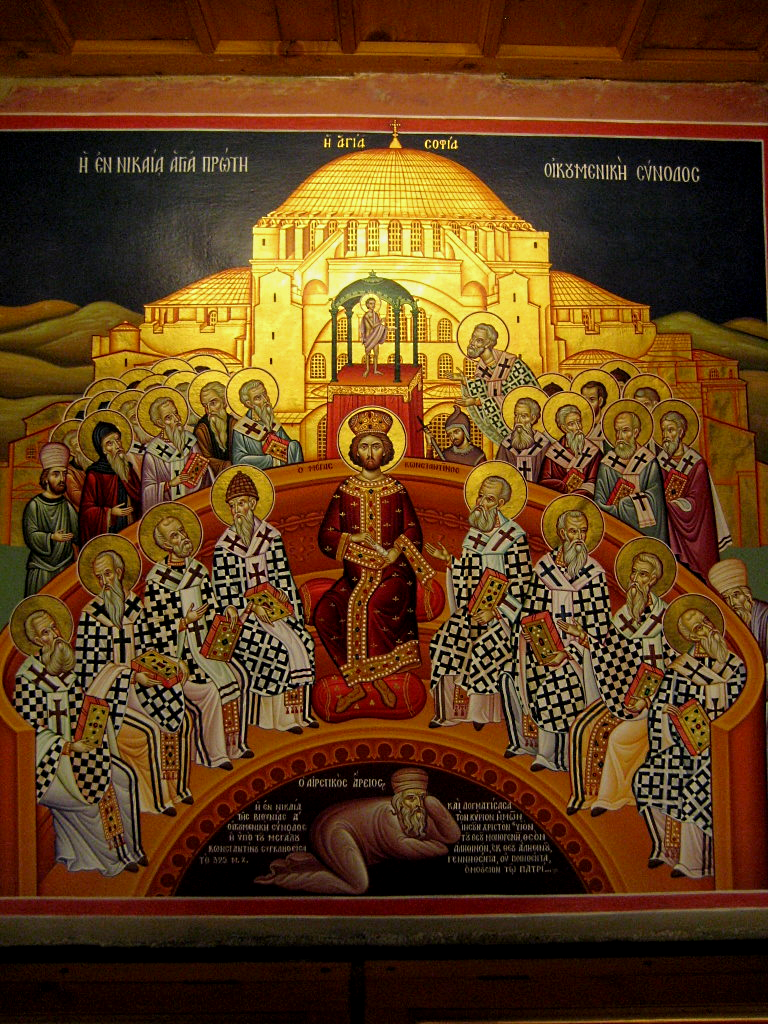
The Council of Nicaea, depicted here with a very holy-looking Constantine looming over a grovelling Arius.
When it came to the final text of the Creed, Williams notes that “in the cold light of day one wouldn’t think it was in (Constantine’s) best interests”.
“Constantine clearly wanted the Christian churches to be swinging in behind him in the name of Imperial Unity and harmony and all the rest of it, as well as his own view of his own divinely appointed status. He believed he’d be chosen by whatever supreme God there was to sort out the Roman Empire. So a theology that said God delegates power downwards to the monarch suited Constantine quite nicely. The odd thing is that that’s not quite what the council settled for.”
Instead, the council settled for a creed that affirmed Jesus would return “to judge the living and the dead”, and whose kingdom “shall have no end”. The Creed also affirmed that Jesus was divine – “of one substance with the Father” – a knockout blow for Arius and his supporters. It ended by affirming that the future Kingdom of God – not the Roman Empire – would “have no end”.
Constantine certainly loomed over the First Council of Nicaea, but the resulting Nicene Creed did not suit the agenda of an Emperor looking for a divine mandate. Instead, it led to the widespread acceptance of a doctrine already firmly established in scripture, albeit one that had proved challenging for some to grasp in the Greco-Roman world.
Explaining Jesus to Greeks and Romans had been tough. They struggled to see how infinity could become finite, and how spirit could take on flesh. It’s to the credit of the bishops at Nicaea that when it came down to it, they weren’t willing to bend Christian beliefs just to make them palatable. They stuck with the old, hard idea: God himself had actually entered the world in the form of Jesus, a man who ruled with authority over everyone – including Constantine himself.
Adapted by Alasdair Belling from Undeceptions episode 167 ‘Nicene Creed’. Listen here.


Want to be further undeceived?
Check out our network of podcasts and articles in the Undeceptions Library.