Anthropology has a reputation for being the most “godless” of the scientific disciplines.
The study of human societies, cultures, and their overall development is surprisingly dismissive of that one thing found right throughout the history of our species: spiritual belief.
That reputation perhaps stems from the ‘Father of Anthropology’, Sir Edward Tylor, who saw religion as something “savage”, a primitive attempt to explain natural phenomena that had become a “survival” from a past age.
However, historian Tim Larsen, author of The Slain God: Anthropologists and the Christian Faith (2016), believes this is an increasingly “discredited way of thinking”.
In fact, he goes as far as to call it “racist and colonial”.
But why did this idea of religion develop in the first place – and what might be causing anthropologists to take another look at theism tentatively?
A Victorian Hangover
The idea that religion is something outdated for humans to move “beyond” has persisted within some anthropological circles since the 19th century.
Speaking on Undeceptions, Tim Larsen believes this was partly a way for European powers – especially the British – to assert power over indigenous groups in their colonies.
“The British ruling class thought ‘We need to understand these people that we’re trying to control, so can somebody give us an insight into how they think, how they’re motivated, how they behave?’”
That’s where Tylor comes in.
His seminal works, Primitive Culture (1871) and Anthropology (1881), arrived in a context in which many viewed evolution as the primary goal of humanity.
“In his time, there was a huge assumption of progress,” Larsen said.
“People thought of history in terms of progress, and they thought of the white European as the apex of progress … that this is where humanity has been heading, and we’re at the top of it.”
Tylor split people into three groups: the savage, the barbaric, and the civilised.
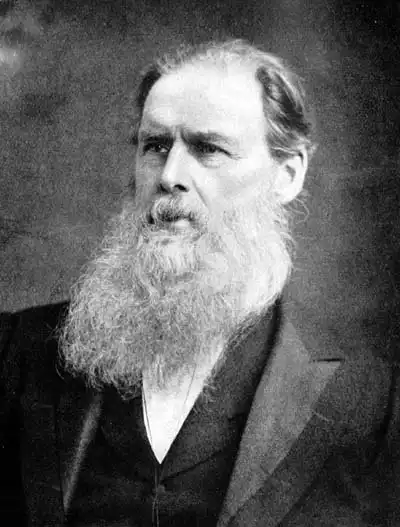
Tylor’s ideas about religion continue to influence anthropology. Sadly, his facial hairstyle is far less in vogue nowadays.
“Of course, (Tylor) represents the civilised, but there are people who are barbaric and savage around the world, and he imagines that they will tell us about the origins of human thinking and some of the problems that we have today, because we have lingering savage holdovers that we need to deal with.”
Religion, of course, was one of them.
Tylor’s views on religion became somewhat orthodox in his field.
Around the same time, another Anthropologist, Sir James Frazer, wrote his famous work The Golden Bough (1880), which explored the world of comparative religion.
Frazer proposed that human societies develop through stages: first a reliance on the magical, then the religious, and finally on the scientific.
He saw Christianity as just a more civilised refinement of the primitive pagan religions that predate it.
His book was a hit at the time and is still fairly popular today.
However, Frazer had never actually never visited the countries or witnessed the rituals he had described.
The culture of field work didn’t exist in anthropology,
Then along came Sir Edward Evan Evans-Pritchard – a man who would change the field forever.
The Field of (Scientific) Dreams
E.E. Evans-Pritchard was one of the first anthropologists to actually spend time among the people he was studying – in his case, the Azande people of Central Africa, with whom he lived alongside in the 1920s.

E.E. Evans-Pritchard pictured with the Azande (it’s pretty obvious which one he is)
The result of this stint yielded the book Witchcraft, Oracles, and Magic Among the Azande (1937), which is now considered one of the most important texts for social anthropology.
However, unlike many of his predecessors, he not only saw a place for faith in society; he also converted to Catholicism.
By the end of his career, he wasn’t the only “God-bothering” anthropologist going around.
Following in his footsteps was Mary Douglas, the famed 20th-century British intellectual and anthropologist, who also held a deep Christian faith.
Of her own approach to faith and science, she once said:
“I don’t feel God needs to be defended as much as many do; I don’t feel we need to look after God and protect him in various ways, and I feel the benefit of doing anthropology and having faith is that you can relax and let Him look after Himself and go and do the questions, holding in suspense any particular commitments, but feeling, in the end, they would be to the greater glory of God, the results. Or at least trusting Him to make it come out alright.”
Victor and Edith Turner were yet more examples of anthropologists setting out to do fieldwork in Africa and eventually converting to Christianity.
For the Turners, they saw first-hand the importance of ritual in daily life – and it set them on a journey to faith that Larsen believes “surprised them”.
“They would be the first ones to say that studying African ritual very closely reawakened them to the reality of the spiritual world, which then set them on a spiritual journey that landed them in the Christian faith.”
What is Truth?
Of course, these are unique examples.
Anthropology is still as secular as ever, but attitudes toward religion have softened over time.
However, even a tentative, newfound appreciation for spirituality can bring obstacles to personal belief.
Anthropologist Christine Jeske points out that many anthropologists now adopt a view of cultural relativism – “that you need to understand someone else’s view from their own viewpoint” – but this can sometimes lead to intellectual paralysis.
“Anthropology includes many different theories, and there are internal debates about these kinds of questions like ‘Is there an absolute truth? Is there not? What is objective? What is subjective?’ This is a constant question in anthropology.
“We would say that many things are subjective – probably more things than we realise- but does that mean there’s nothing objective?”
For Christine (herself that rare breed of a Christian anthropologist), the answer is “no” – if there is a creator of all things, then of course there are objective behaviours and beliefs!
It’s here, in this murky territory, that Christianity can – and has – helped the field.
“What are we pro? What are we trying to accomplish? (These questions) are actually where I see Christianity having a lot to offer, for me anyway, as a Christian anthropologist,” Jeske said.
“We imagine a different way of living in the world, and we have something we’re seeking after – we move towards something, not just away from something or just critiquing something.
“As a Christian, if we are pursuing the kingdom of God, and a better way of life in the world, we need to see both of those levels, not just everyday life, but also what is shaping us at a larger level.”
Like Christine, E. E. Evans-Pritchard, Mary Douglas, and Victor and Edith Turner saw what was shaping the world at a more significant level.
With the field now more open to at least the idea of the spiritual, it’s not unlikely that more anthropologists in the 21st century will also discover this wonderful truth.
Adapted by Alasdair Belling from Undeceptions episode 148 ‘The Anthropologists’. Listen here


Want to be further undeceived?
Check out our network of podcasts and articles in the Undeceptions Library.