Please note that due to software, not everything in this transcript will be accurate.
Wes Huff
Media – MythVision
John Dickson (Studio)
The number one Christian expert. Yikes. What a title. What pressure. That’s Derek Lambert on the MythVision podcast a few weeks ago, gearing up to respond to a YouTube video. Which feels like half of YouTube these days. People responding to things they saw on YouTube. Anyway, he’s reacting to an interview on The Diary of a CEO, one of the biggest podcasts in the world, hosted by Steven Bartlett. Steven sat down with Canadian scholar Wes Huff. For two and a half hours, he fired questions at Wes about the historical Jesus and the case for Christianity. It racked up more than 3.6 million views in just two weeks. But that’s nothing compared to Wes’ appearance on The Joe Rogan Experience in 2025. Joe Rogan hosts the biggest podcast in the world. And for another three hours, Wes fielded questions about Christianity, biblical history, ancient manuscripts, the evidence for Jesus, and the reliability of the Gospels.
Media – Joe Rogan
John Dickson (Studio)
I reckon it’s fair to say that those combined 5 and a half hours on Joe Rogan and the Diary of a CEO are some of the most influential hours of public Christianity in the last decade. And it’s also fair to say: Wes Huff is having a bit of a moment – though I’m sure he hates the tag no.1 Christianity expert. So, I wanted to sit down with Wes ask him: Is all this big-name podcast interest in Christianity evidence of something deeper than a passing fad? Is Christianity having more than just a moment? And, of course, I wanted to ask him about paratextual scribal practices in ancient manuscripts! Who doesn’t want more paratextual scribal practices in their life!! I’m John Dickson, and this is Undeceptions.
Undeceptions theme
John Dickson:
Yeah. Okay, mate. Um, tell me about your PhD research as nerdy as you like. Tell us what your focus is.
Wes Huff:
Okay. So I study ancient scribal habits. So if you’ve ever heard of textual criticism that deals with the intricacies of the text; of tracing the original readings back. I do a lot of stuff that crosses over into fields like textual criticism, but I’m not actually looking at the text …
John Dickson (Studio)
By the way, if you hear some eating of sandwiches in this recording, it’s because Wes and I snuck away to a quiet room to eat and chat during a conference we were both speaking at in Vancouver!
Wes Huff:
But I’m not actually looking at the text. I’m looking at everything other than the text. So we use terms like para-textual features or reader’s aids. So spacing between words, margin size. Things like indentation, out-dentation and what eventually develops into what we would kind of compare to verse divisions or um, uh, paragraphing. All of those things are the things that I am tabulating. And then in the process of that, looking at manuscripts within the second and third centuries in this kind of was kind of wild west of early Christian manuscript production.
John Dickson (Studio)
You might wonder how much you can really learn from margins and spacing. But when it comes to ancient copies of Scripture, there’s a lot to go on. More than for almost any other literature from the ancient world. We’ve talked before about how there are WAY more ancient manuscript copies of the New Testament than of Plato, Homer, or Cicero. From tiny scraps to whole books to the complete New Testaments. Enough to keep someone like Wes busy for a lifetime. Three of the most famous complete manuscripts are Codex Sinaiticus, Alexandrinus, and Vaticanus, from the fourth and fifth centuries. Sinaiticus is the oldest, from around AD 350. You’ll hear us mention it later. But as Wes says, the first two hundred years after Jesus were more of a “wild west” for New Testament manuscripts. We have fewer texts from that period – partly because we know the Romans confiscated and destroyed a ton – and they’re often fragmentary and worn. Some of the oldest surviving pieces are also the most famous. For example, P. Oxy. 5345 (known to biblical scholars as P.137) a papyrus fragment of the Gospel of Mark (chapter 1) dating to the 100s or 200s AD. It was found, by the way, in Oxyrhynchus Egypt where the First Hymn P. Oxy. 1786 was found. Then there’s another amazing Egyptian papyrus, P46, the earliest manuscript copy of the earliest New Testament texts – the letters of Paul. The copy dates to about the year 200. Here’s a quick clip of me chatting about it a few weeks ago with my friend Andy Stanley at North Point Community Church in Atlanta.
Media – John talking at North Point Community Church
I got this museum-grade replica (printed on actual ancient papyrus) from the ManuscriptShop, by the way. They do amazing work. No. This is not a commercial. They’re not a sponsor. But they do amazing work for nerds of the ancient world … Like Wes … who has a cool section of his website doing deep-dives on these early fragments; we’ll link it in the show notes. One reason these early fragments are so rare is simply age. The older a text is, the less likely it is to survive. But likely the biggest factor was persecution in the second to early fourth centuries. Things reached a brutal peak under Emperor Diocletian in AD 303. We did a whole episode on persecution. So you can get the details at episode 162 persecution complex!! Undeceptions house historian Eusebius – who lived through the great Persecution – tells us:
“We saw with our own eyes the houses of prayer thrown down to the very foundations, and the Divine and Sacred Scriptures committed to the flames in the midst of the market-places”.
We even have a Roman transcript of interviews with Church officials of this time. The Romans were going door to door demanding manuscripts. Some handed them over (for burning), others didn’t and were arrested and worse! It was a bad time for believers. Until, unexpectedly, Emperor Constantine the Great changed his allegiance … to Christianity … in late 312. Everything changes in the fourth century when Christianity is decriminalised.
John Dickson:
Because you then have the elite professional scribes who compare Sineticus to say P46, and there’s a different skill in the handwriting itself.
Wes Huff:
Yeah, yeah, definitely. So I’m looking at ancient handwriting, and I’m looking at documents that are produced for public use in the liturgical setting, versus if we even just have a small scrap of paper and it has writing on it. Is there any way from the actual writing that’s on the page was extensive, what survived to say this was produced as a private copy for an – this is someone’s private copy of the Gospel of John … looking at something like the famous John Rylands 457 – P52. It’s just the size of a credit card.
John Dickson (Studio)
Wes is talking about P.52, the John Rylands fragment – it’s the oldest fragment of a Gospel we have. It contains just seven lines from John chapter 18 and dates to around 125 – 150. If John’s Gospel was written around the year 90, as most scholars agree (personally I think it’s earlier, but let’s go with 90), that means this copy of John’s work was made perhaps only 30 years later. I got to view this fragment for The Life of Jesus documentary:
Media – ‘The Life of Jesus’
John Dickson (Studio)
Al’s also put a picture of it in the show notes.
Wes Huff:
But what I do is I do codicological reconstruction, which simply means from that scrap can I, looking at the spacing between the letters and maybe what margin may or may not be left that we can compare, and in, uh, in a kind of extrapolating of the possible dates that that falls within and comparing it to more substantial manuscripts of similar origin and size and type, can I then produce what the actual size of the document would look like and that can lead to a lot of information in saying, you know, you’re probably not producing a small pocket-sized gospel of John, for the public reading within the church community. You could be. But it’s very unlikely probabilistically that that’s what’s going on. So, um, I’m in kind of a weird space where I, I, I go into the areas of textual criticism and paleography and papyrology. But I’m not necessarily any one of those things in my expertise.
John Dickson (Studio)
But Wes does have a gift for bringing biblical scholarship to a wider audience. This used to be confined to universities, where experts wrote for other experts. Now, millions are taking an interest. We’ve often talked about the cultural reassessment of Christianity in recent years. But along with that–by necessity–people also want to stress-test its historical claims. Good on them. Christianity doesn’t just say ethereal things like, “God loves you and has a wonderful plan for your life. It says, our master was executed by crucifixion by the 5th governor of Judaea.” People interested in the content of Christianity are going to ask about the evidence for the content. The fact is: there are differences between the copies of the manuscripts. They’re not big but they’re real. Papyrus 46, the collection of Paul’s letters I mentioned earlier, provides some good examples. In this text (and not in some others) you find contractions of sacred words like “God,” “Spirit,” and “Jesus Christ,” reduced to a few letters with a line over them. Then there are sentence differences too. Near the end of Romans, most Bibles read, “The grace of the Lord Jesus Christ be with you.” But in P46, it’s simply, “The grace of the Lord Jesus be with you.” The word “Christ” is missing. It would be just like some half-baked internet sceptic to say, “Aha, this earliest copy of Romans didn’t believe Jesus was the Messiah, the Christ, because it’s missing!!” Of course that would be nuts, given the word “Christ” appears in over 100 other places in this very manuscript! Oh, and another strange difference is that a paragraph you’ll find at the end of chapter 16 in modern Bibles (“Now to God who is able to strengthen you according to my gospel and the proclamation of Jesus Christ …” and so on) doesn’t appear in chapter 16 in P46. Weirdly, it appears a few paragraphs earlier at the end of chapter 15 — and then we get 16 without that paragraph. Differences these are common, especially in those early “wild west” years.
John Dickson:
What do you think you’ve discovered? Like what’s the, you know, can you put your finger on a cool thing that you’ve found?
Wes Huff:
Yeah. What’s really interesting, especially when you look at these manuscripts, then you do look at the, the bigger ones that we’re talking about, the Codex Sinaiticus and Codex Vaticanus and Codex Alexandrinus… These, these documents that are produced after the decriminalization of Christianity in 312 and the formal production of them. And especially when you see the Christians come out of the woodwork and professional non-Christian scribes, look at what Christians have been doing in the production of making reading publicly easier, and they start to adopt those things. So Christians are not inventing the punctuation that eventually gets integrated into languages like Greek and Coptic and Latin, but they are heavily influencing it because of just what the product of the production of scripture is.
John Dickson:
A bit like the, um, what scholars say about the book form the codex. Christians didn’t invent it, but boy did they supercharge it.
Wes Huff:
They they popularize it and they kind of fine tune how those things are being produced for a number reasons.
John Dickson:
I remember there’s an amazing, um, transcript of a trial of Christians in Kirta in North Africa, and in the transcript the Roman asks one of the deacons or sub deacons, what’s that in your hand? And he says it’s a book of letters from a wise man called Paul and you just think, wow, he was just walking around with a little book. Mm-hmm. Of Paul’s letters. In what, 305?
John Dickson (Studio)
Just Dickson chiming in to correct Dickson here. This didn’t happen in Kirta in 305. I was remembering another Roman transcript, where the Romans took off with over 20 books of the NT. The actual source is a Roman transcript from a 120 years earlier, in Scillita North Africa. A whole bunch of Christians are interviewed. Their replies are all entered into the Roman records Here’s the relevant portion, concerning a Christian called Speratus:
Reading
Saturninus the proconsul said to Speratus, “Do you persist in remaining a Christian?” Speratus replied, “I am a Christian,” and all the others agreed with him. The proconsul said, “Do you wish time for consideration?” Speratus answered, “In so just a matter there is no need for consideration.” Saturninus then asked, “What have you in your case?” Speratus said, “Books, and the letters of a just man named Paul.” The proconsul said, “You are granted thirty days to reconsider.” Once again Speratus said, “I am a Christian,” and with him all the others agreed. Then Saturninus read his decision from a tablet: “Whereas Speratus, Nartzalus, Cittinus, Donata, Vestia, Secunda, and the others have confessed that they have been living according to the rites of the Christians, and whereas, though given the opportunity to return to the customs of the Romans, they have persisted in their obstinacy, they are hereby condemned to be executed by the sword.” Speratus said, “We thank God.”
Wes Huff:
And what’s fascinating about the early Christians is, um, they really want this stuff to get out. Hmm. So they’re, they’re prolific. They’re tenacious. And where we see, if you kind of compare it to the Jewish scribal culture, that’s also coming out of, after 80-70, Jerusalem is destroyed. You know, Trajan marches in and, uh, the temple is levelled. And so you have the two kind of Jewish offshoots: One, believing Jesus is the Messiah and the other developing into what eventually becomes rabbinical Judaism outside of the Pharisaical tradition. And the scribal traditions. Also kind of take different branches, whereas the Jews are very careful. There’s a carefulness to the preservation of what they do. And ironically, there’s an aspect of the lack of carefulness in the Christian traditions where they’re so eager. You want to copy of this famous Paul? We’re gonna get it to you.
John Dickson:
But it’s a superpower nonetheless. And it’s a weakness and a superpower.
Wes Huff:
Definitely results in all sorts of mistakes and spelling errors. And we even have some copies where you can see that whoever’s copying this did not know how to read because of the mistakes that they make. And ironically, they’re so prolific. That the mistakes become the obvious thing. Because you have copies that are mm-hmm. Spreading out, you know, within 200 years, getting out to Britannia, getting out to parts of Asia, North Africa, all over the Middle East. And it’s the mistakes ironically, that allow us now in what I referred to before, the art and science of something like textural criticism.To compare and contrast and actually be able to trace the text back.
John Dickson:
And It seems that Christians didn’t even try and do anything about all the different versions that are out there. It’s not like they collected ones they didn’t like and burnt them. Which has happened in other traditions, right? Christians just went, ah, look at that there. There’s different lines there or different words there. And someone like Origen actually expertly noted the differences in manuscripts.
Wes Huff:
Yeah. And discussing, you know, some of my copies say this, some of my copies say that, and here’s why I think, even though maybe even the majority of the copies that I’m looking at have this particular reading, this is the one that makes sense. So yeah, Christians are just a very interesting group. As much as they’re a religious group, they’re also a literary group, insofar as they are, you know, the later designation by Muslims of the people of the book, the Jews and the Christians, we can own that. Yeah. And we see that tradition going back into
John Dickson:
Yeah. Even though they weren’t elites, they, they were non-elites attracted to bookish culture.
Wes Huff:
Yeah. Yeah. Bookishness in the ancient world is a very unusual subject in that you have one category of very well-educated elites, and also things like slave women who are trained to copy documents within like Egypt in places like the Fayutima and Oxyrhynchus and, and so there’s like these dichotomies and then Christians kind of span the middle of the gray area. It’s, you have rich people who are clearly getting things done professionally. And then you have some people who are, that they don’t have any formal training. They’re trying to do their best. And they even make decent copies and then go back and are constantly correcting them. But yeah, I think what I’m constantly just fascinated with is Christians were, they just wanted this to get out.
John Dickson (Studio)
Wes is part of this long tradition of wanting to get the word out – and he’s had some amazing opportunities of late! His ‘cultural moment’ began when he appeared on a podcast in 2024 with culture warrior and author Billy Carson to debate the historicity of the Bible. It went viral, and in January 2025, Wes appeared on the Joe Rogan Experience. We’ll get into that – after the break.
Break 1
Media – Joe Rogan
John Dickson (Studio)
That’s another clip from Wes’s appearance on the Joe Rogan Experience. The show has between 15 and 24 million monthly downloads, and each episode runs for about three hours. When Wes went on it, Wes’ own YouTube subscribers went from just over 1000 to nearly half a million in just a month! Some commentators have since suggested that the episode was “the single widest-reaching broadcast of the gospel message in history”. Wes gave me a more detailed explanation of how it all came about – but that’s just for PLUS subscribers. Don’t blame me. Producer Kaley makes those calls! You can can complain by writing to complaintsforkaley@undeceptions.com …. For the rest of us, I asked Wes what he makes of the fact that he was invited onto Rogan—what does it say about our cultural moment.
John Dickson:
The question I’m interested in is whether the very fact that a Christian like you who’s like, a normal, traditional believer who believes all the traditional things and B, who’s a pretty serious scholarly mind, um, being invited onto Rogan. Do you think it indicates a mood shift?
Wes Huff:
Yeah, I, I, I definitely think it, it does. I think, and I’ve talked about this elsewhere in that I, up in my teen years, in the middle of new atheism, in the early two thousands Dawkins, Sam Harris, Daniel Dennet, Chris Hitchens, and their popularity and, uh, just how influential and well known they were and the arguments that I think worked a lot better on paper than they did in practicality, but we’re popular nonetheless. And seeing a very clear shift in people’s perceptions on how that actually played out. I think a lot of people realised that it’s maybe very philosophically interesting to talk about religion in these disparaging ways, but when you really try to remove that type of understanding of the transcendence or morality or accountability from society in general, but in particular people’s lives, you don’t end up with a whole lot of hope and meaning and purpose. And it does kind of very negative things to identity.
Media – Diary of a CEO
John Dickson (Studio)
That’s Wes in his recent appearance on the Diary of A CEO podcast, with Steven Bartlett. Bartlett talked at length about being a New Atheist when he was younger. But he – like a whole generation of people – is slowly deconstructing the value of militant unbelief. That’s giving people like Wes an opportunity to make the case for Christianity on a scale that would have seemed unthinkable a decade ago.
Wes Huff:
And So I saw a shift when I was exiting high school, going into university for my undergraduate studies of, you still had a few stragglers, but more and more people were identifying less as atheists and more spiritual, but not religious. And that, I think has just grown. And I, I, I’ve, I’ve heard and seen that as I’ve travelled outside of Canada and United States and, and Europe, Australia and New Zealand, places like that, where. I think people were very interested and enamoured with the new atheism, but when push came to shove and they actually wanted to find something that gave their life purpose, they weren’t really satisfied being told that they were a product of time Plus matter Plus chance. And, and it’s been interesting to see, mean, I think my kind of movement into this space, I can’t chalk up to too much other than the Holy Spirit working. I mean, I’ve had opportunities to speak on panels of very popular comedians and describe what the Septuagint is, the Greek translation of the Old Testament. And after we’re just kind of gone, ‘What, what, what just happened’? You know, what? A relatively niche, nerdy topic, and I’m talking with comedians on platforms that have audiences of millions. And that feeling very strange, but also very exciting. Yeah, I think more and more people are interested. I think we’re seeing such a proliferation of information and people’s trust in just what’s being put before them getting lower and lower and lower, that they’re curious and they want to know what has happened over the millennia, but they also have a genuine distrust on the information that’s put out in the public squares and the, the marketplace of ideas. Because they, at some degree or another, whether it’s fully comprehended or not, don’t know how to methodologically sift through what is good information, what is an accurate source, what is maybe playing fast and loose with the data, and I think Billy Carson and, and kind of that TikTok esque. Stuff is a testimony to that.
John Dickson:
You, you have a great knack, and I think this is the edge that you, that you have, if you don’t mind my saying is, um, explaining how we know the thing that you then say we know. Whereas, so what often happens is people just say, did you know that the New Testament was decided at the Council of Nicaea? It’s just a proclamation, right? And, but, but then you actually say, uh, not just that, that’s not true. You say how we know that’s not true because here are texts that mention the four gospels early on. Like, and, and I think people are listening going, oh, okay. I’ve never heard that there’s a way, you know, this stuff. It’s not just you read it in a book and proclaim it. But I wanted to ask, a lot of the Rogan questions were history-style questions. Um, do you think that’s simply because that’s your specialty or do you think this remains a sticking point? For thoughtful people, when they think about Christianity.
Wes Huff:
I think people are curious about what happened in the past in general. I think, I think more and more people understand that understanding where we’re going as a society and where we are right now has a direct correlation to where we’ve been and no person, culture, philosopher, ideology, religion exists in a vacuum. It all comes from somewhere there. There’s a downstream effect and we happen to be standing on third base and the convenience of being able to do that. And so how did we get that? Because we didn’t, we weren’t born on third base in, in one sense we were right, but how did, how did our culture, our thought process, our assumptions presuppositions, how did we get to that place on the baseball diamond and. I, I think people are genuinely interested in that. And curious, curious about the past that simultaneously seems very, um, very, you know, uh, like, like, uh, mystifying, but also there are things like archeological artifacts. So there’s kind of tangible physical artifacts that follow up these stories of, you know, whether it’s the emperors or the Babylonian Kings or, um, seeing something like the pyramids.
John Dickson (Studio)
Archaeologists have unearthed some pretty cool Biblical tangible artefacts in recent years. One example was the discovery of the Tel Dan Stele inscription in 1993. The broken and fragmentary inscription is on a piece of stone, commemorating the victory of an Aramean king over his two southern neighbours, including over the “House of David”. It’s the first mention outside of the Bible of the “House of King David”. The Aramean king boasts that he vanquished his enemies. This king might be Hazael of Damascus, who ruled in the 9th century BC. You can read about him in the book of 2 Kings. We’ve put a picture of the artifact in the show notes. Also – make sure you check out our ‘Really Old’ single, with Undeceptions frequent flyer George Athas. He literally wrote the book on the stele – it’s awesome. The point is, we’re finding fingerprints of biblical characters and places all the time. 25 years ago, some scholars were saying, “Where are all the synagogues the Gospels say Jesus preached in around Galilee?” Up to that point, no one had been found. Well, in the last 25 years, they’ve found over 10 synagogues from the time of Jesus. The funnest ones are in Magdala, the town of Mary Magdalene. They found one back in 2009, I think. Then they found a second, just in 2021. Two synagogues in one Galilean town from the time of Jesus. It’s almost like the Gospels knew what they were talking about after all!!
John Dickson:
What do you think is the most compelling or couple of compelling things about the history of Christianity? Uh, you know, what can you put your finger on as a, you know, I would say this is historically the most significant thing.
Wes Huff:
I mean, I think it’s Christianity is a religion that hinges on a very tangible, historical reality in that it has to be Jesus. It has to be. In, in other philosophies, it could be other people. You could have, uh, a philosopher came up with similar ideas as Confucius and communicated them in ways that would actually maybe be caught something else, but it would be Confucianism. Or similar, you know, uh, gut, Thomas Siddhartha, the Buddha, someone else could have come up with those paths and philosophies that lead to enlightenment. Uh, the God of Islam could have used another prophet to communicate to eventually get out the Quran. Now, I think Confucianists, Buddhists and Muslims will be very clear. It was these particular people, but in a hypothetical universe, it could have been someone else, and that’s not true of Christianity. It really does swing. The door swings on the hinge of this first-century Jewish itinerant Rabbi who walked the dusty streets of first-century Palestine, who lived this particular life, had this very specific birth and went to the cross to do something that even our comprehension can’t fully grasp and then predicted his own death and resurrection. And did it. And so people who rise from the dead have more credibility and authority than people who don’t rise from the dead. And so that means something. Right? And so I think the historiography question about Christianity, I think just rings the tune of it is slightly different than what you get in other worldview perspectives.
Media Tom Holland
John Dickson (Studio)
That’s author and host of The Rest is History, Tom Holland, speaking at a live event moderated by friend of the pod, Justin Brierley, and also featuring former Undeceptions guest Peter Williams. Since releasing his book Dominion in 2019, Holland has become something of a champion for cultural Christianity. His thesis – that the secular West is fundamentally shaped by Christian belief and ethics – is pretty convincing. But – going off that clip – Holland doesn’t appear to buy the central claim of Christianity: Jesus’ Resurrection. He poses a question: if Jesus really did rise from the dead, why were there so few Christians initially?
John Dickson:
Someone like Tom Holland, um, whom we all respect and he’s doing wonderful stuff for him.
Wes Huff:
I love his Spider-Man movies.
John Dickson:
For him as a thoughtful. Hmm. Borderline Christian, uh, ethically Christian, maybe not theologically. Mm-hmm. He has raised the question, if Jesus really rose again, why aren’t there more witnesses? Why didn’t it lead to more conversions instantly of people saying, I saw him too.
Wes Huff:
I think. I think there are probably two things going on there. I think historically, we often assume that people should be writing down more than they actually were in the ancient world, especially in somewhere like Judea, the literacy levels as at least as as far as the data shows, we’re pretty low. The fact that we have 27 documents that we refer to as the New Testament is kind of phenomenal in and of itself. That is very surprising. Four biographies of Jesus. We really have very few comparators. A Tiberius would be a close one.
John Dickson (Studio)
That’s the Roman Emperor Tiberius, who ruled during Jesus’ adult life.
Wes Huff:
Um, he has, uh, serus, uh, he has Tacitus, Suetonius and Cassiodius.. Um, we have, uh, Socrates. Who has, uh, uh, Xenophon um, Plato and, uh, there’s another …, Aristophanes. Um, but so it’s very, it’s very few people in the ancient world who have these kind of corresponding numerous people writing about them, never mind biographical sources. So I think that’s a factor. I think also we just have lost most of the stuff from history in general. We’re really only operating on about 1% of anything.
John Dickson:
I often remind students we don’t have a single letter from Pontius Pilate to Tiberius. When there must have been hundreds Yeah. Over the, over the 10 years that he was governor. Yeah. Not a single statement.
Wes Huff:
Yeah. Even archeological data. There’s this, whether it’s written documentation or it’s archeological data, we just, we don’t have much to go on. So I think that’s part of the conversation too.
John Dickson (Studio)
But intellectual things can’t explain the whole thing — ancient and modern people don’t always follow the evidence.
Wes Huff:
I also think people rarely make decisions on evidence alone. One of the things that I always think about is, I had a very close friend growing up whose father was a, was a chain smoker. And eventually, uh, got cancer in his mouth and they had to remove his tongue and they took a, they removed his physical tongue, they took a piece of his thigh and they basically recreated him a new tongue out of the meat of his leg in order for him to simply do things like speak properly. Well, years later, that particular friend and his brother picked up smoking. Now you would think to see the raw data of the consequences of a particular action and the, the pain, the physical pain and struggle that that caused for a very close person in your life, if anything would dissuade you from something like smoking it would be that. And yet, it’s, it’s not always about the, the raw hard facts. You know, this is, what in, um, you know, individuals, even the, the, the, the classical philosophers would talk about in terms of pathos, ethos, and logos, right? It’s your communities, it’s your, the personal experiences you have, and it’s the data. It’s a number of these things. And we even get in Matthew’s gospel, in his biography of Jesus, he’s appearing to the disciples, he’s appearing to these groups, and it says, some worship, him and others doubt it.
Reading
“Now the eleven disciples went to Galilee, to the mountain to which Jesus had directed them. When they saw him, they worshipped him, but they doubted.” – Matthew, Chapter 28
Wes Huff:
And it’s like, okay, what’s going on there? The risen Jesus, publicly executed, is standing before you. He’s proclaiming the good news of the kingdom. Nothing could be more tangible, and they doubt it. And I think it’s always a testimony to me that, you know, faith is a gift. There’s something about it that is not just input. No, we’re not robots. And so why didn’t more people believe? Well, I think … in some ways, a heck of a lot of people did believe. Right. If, if we’re taking one Corinthians 15 seriously, and Paul is saying 500 people all at once. Right. There’s a good number. You know, the church grew
John Dickson:
And then 3000 at the very first sermon. Exactly. Yeah, exactly. Yeah.
Wes Huff:
Yeah. Yeah. If we want to talk about megachurches in the world, world, you know, clear example.
John Dickson (Studio)
Let’s press pause; I’ve got a Five Minute Jesus for you. For me, the most important archaeological discoveries aren’t the fun ones that confirm this or that detail mentioned in the Gospels—the pool of Bethesda with 5 rows of columns, mentioned in John 6, discovered in 1967; the pool of Siloam, mentioned in John 9, discovered in 2004; the numerous synagogues of Galilee Jesus preached in, now over ten have been found. And there will be more. These are fun, but not deeply significant–apart from anything, most neutral historians already knew that the Gospels likely had details that were real but just haven’t been confirmed yet. With only about 1% of the evidence surviving, we should never imagine that absence of evidence is evidence of absence. It’s just a basic logical mistake. Most historians don’t make it. These happy discoveries are really only exciting or annoying for Christian apologists and anti-Christian sceptics. But for me, there’s a far more significant set of archaeological discoveries that answer a really basic historical and cultural question about early Christianity. Jesus was a Jew, teaching in Aramaic. So why are the accounts of his life written not in Aramaic or Hebrew, but in the Greek of the wider, pagan world? Perhaps that suggests a large cultural distance between Jesus and the Gospels? For a long time, some people thought so—including one of my favourite scholars, now passed, Geza Vermes, Professor of Jewish Studies at Oxford for decades. But archaeology has helped frame this better. Beginning with the great German scholar Martin Hengel, we’ve come to see just how widely Greek was used in first-century Jewish Israel. Inscriptions and papyri suggest that a significant portion of the population, perhaps even 15% in Jerusalem, spoke Greek as a first language. And many more must have had Greek as a second language. We now also have evidence of a Greek-speaking synagogue right near the temple in Jerusalem. An inscription found just south of the Temple Mount was part of a synagogue. It reads in part: Theodotos son of Vettenos, priest and synagogue leader [archisynagogos] … built the synagogue for the reading of the Law and teaching of the Commandments. But it’s all in Greek. It’s a Greek synagogue in the shadow of the temple. Then there are the burial inscriptions. Jewish burial practice often involved placing bones in stone boxes, ossuaries, and many of these are inscribed. What’s striking is how often we find people with both Jewish and Greek names. “Judah” and “Jason.” “Mara” and “Alexas.” Sometimes the same name appears twice, once in Aramaic or Hebrew, and once in Greek. Other ossuaries, “Shalom wife of Kunoros” (Aramaic and Greek); “Yehuda the beautiful” (Aramaic and Greek), and so on. I counted all the inscriptions one day about 20% contained Greek. In other words, for many Jews, Greek wasn’t foreign. It was one of their heart-languages—languages they literally took to the grave! Which makes sense of something else. Two of Jesus’ own disciples are known to us by their Greek names: Andrew and Philip. These are Galilean Jews, who worked with Jesus, no doubt conversing with him in Aramaic, but their families have enough Greek to want to name their boys with Greek names. All of this matters for history. It means we can’t really imagine a big time- or culture- gap between an Aramaic-speaking Jesus and Greek-speaking Gospel writers decades later. The world of Jesus was already bilingual, even multilingual. So when the stories of Jesus began to circulate, they didn’t have to wait generations to be translated into Greek. They were very likely being retold in Greek by eyewitnesses (like Philip and Andrew) in Jerusalem within weeks of the events themselves. We can draw a pretty straight line from the Aramaic Jesus to the Greek Gospels. You can press PLAY now.
Break
Media – Alex O’Connor
John Dickson (Studio)
That’s Alex O’Connor — the hugely popular YouTuber, also known as The Cosmic Skeptic — speaking on the Re-Enchanting podcast with Belle Tindall and Justin Brierley. Justin, by the way, is a friend of Undeceptions. You can catch him on episode 125, “Christianity’s Comeback.” Anyway, O’Connor is probably the most prominent sceptic online right now. But there’s been a bit of a vibe-shift in recent years. Less combative, more curious. His videos get hundreds of thousands of views, and he’s interviewed, or been interviewed by, just about everyone in the field. A lot of his content explores whether the modern West really does owe as much to Christianity as people claim. It’s fair to say he’s having a bit of a moment. So I was keen to hear what Wes makes of him.
John Dickson:
Another public questioner of Christianity is Alex O’Connor. Mm-hmm. And, um. He, he’s, he’s a lovely example of someone who will acknowledge, on the one hand, Christianity gave us a whole bunch of really good things, social virtues and so on, but that is no indication it’s true. Mm.
Wes Huff:
Yeah. I mean, this, this, this came up even when I was talking to Joe Rogan where he said, you know, he sees the influence that Christianity has on people. And so he said, in one way it is true.
Media – Joe Rogan
Wes Huff:
And afterwards I thought, you know, what I should have said is, Joe, is it true because it works, or does it work because it’s true? Those aren’t the same thing necessarily. Like a convenient lie is still a lie. A convenient falsehood. There’s still not … it still doesn’t get you to an actual moment of capital T truth. And I think there are, there’s the, the downstream effect of it’s not just a useful fiction because it has fundamentally changed the world. And there still needs to be an explanation for why a bunch of scared men in an upper room go from trembling and thinking that the movement is over. Right? They weren’t the, Jesus wasn’t the first Messianic movement in the ancient world. There were others, and the disciples of Jesus may very well have known of others.
John Dickson (Studio)
One of these “others” was Simon bar Giora, a military and would-be prophetic leader from around the time of Jesus. He proclaimed liberty for slaves and the oppressed, drawing on language from the Old Testament to frame his message. When revolt broke out, he became one of the main leaders of the Jewish rebels. His followers called him King, Josephus tells us—which may indeed be a messianic reference. But… when the city fell to Rome in AD 70, he was captured, taken to Rome, paraded around, and executed. You can read all about him in Josephus, Jewish War, Book 4.
Wes Huff:
But when those particular characters die, when Simon Bar Giora dies in antiquity, the movement of Simon Bar Giora dies with him. And we don’t have followers of Simon Bar Giora, at least that I’m aware of today. And so, you know, I think it was Fleming Rutledge who said, you know, one of the best evidences for the resurrection of Jesus is that we still today are continually talking about it. And I think that needs an explanation And the impact of the waters that we swim in, what, you know, a mutual friend of ours, Glenn Scribner, talks about the air we breathe of justice and meaning and morality and consent. Um, those aren’t by accident. It’s, it’s the Christian presupposition that we have. Then even something in society that’s so unchristian, like abortion still is operating on the principles of choice being a good thing for all people in society. Well, where do you get that from? You don’t get it from ancient Rome. You don’t get it from a barbarian Europe. You don’t get it from the east. You get it from Christianity. And so it’s, it’s almost so pervasive that we don’t even realize that that is, it’s the particles that we’re breathing in because we just assume all people have worth and dignity by nature of being humans. Well, if you study ancient history, that wasn’t a given.
Media – 12 Angry Men
John Dickson (Studio)
“He can’t hear you. He never will!” That’s a clip from the 1957 film 12 Angry Men, starring Henry Fonda. Good find, Research Al! The film is shot almost entirely in one room. It follows a jury slowly persuaded by Juror #8, played by Fonda, to acquit an accused murderer. In that scene, Juror #7 storms out after Juror #9 wavers and changes his vote to “not guilty”, because he’s not 100% sure of guilt. Fonda’s line — “he can’t hear you, he never will” — captures something important. Juror #7 (the one who storms out) isn’t really weighing the evidence. He’s already decided. He does eventually change his mind. But it takes more than just the facts. You’ll have to watch the film to see how that happens. But this is a point made brilliantly by Jonathan Haidt, in one of my all-time favourite books, The Righteous Mind. He lays out the social and psychological evidence that while we like to think we’re all guided by reasons, often it’s our intuition, our gut, that’s driving. Our gut is an elephant, in Haidt’s analogy, and our rider (rationality/reason) has a difficult time controlling that big stubborn elephant. What ends up happening, a lot, is that our reason follows our intuition and works out ways to rationalise what we already feel. Here’s how Jonathan Haidt puts it:
Reading:
“Reasoning can take us to almost any conclusion we want to reach, because we ask “Can I believe it?” when we want to believe something, but “Must I believe it?” when we don’t want to believe. The answer is almost always yes to the first question and no to the second.” (107)
“If you want to change someone’s mind about a moral or political issue, talk to the elephant first. If you ask people to believe something that violates their intuitions, they will devote their efforts to finding an escape hatch—a reason to doubt your argument or conclusion. They will almost always succeed.”
John Dickson (Studio)
Man, I’d love to get Jonathan Haidt on the show one day to talk us through this. He reckons this problem affects not just conservatives, the religious, and low-educated people. He shows that progressives, atheists, and the hyper-intelligent are also — just as much — driven by gut more than reason. Anyway, I closed my chat with Wes by asking him what he reckons Christianity has going for it, other than just a lot of old papers from centuries past.
John Dickson:
Finally, um, especially for my doubters in the audience, um. You, you rightly pointed out that people don’t make up their minds based only on the facts of the case, and it’s psychologist Jonathan Haidt, who has done wonderful work in the righteous mind showing this to be the case. What would you say is – taken all together – Intellectual, emotional, social, whatever – the most compelling thing about Christianity?
Wes Huff:
I think a God of the highest high stepping into the lowest lows should move us in the way that it communicates who God is and who we are. You know, to also paraphrase Glenn Scribner once again, when he, he talks about all worldviews being some form of survival of the fittest, and whether that’s Neo Darwinian evolutionary models where it literally is, you know, a tangible physical survival of the fittest, but even a lot of these other religious worldviews, it’s about, you know, how best you can think, how best you can do, and how best you can feel, and you want to be climbing that ladder. You want to be the best at knowing the facts or being the best at doing the religious practices, or being the most spiritually open, the guru-est you possibly could Guru. And Christianity, in that narrative, the fittest steps down and sacrifices himself for the survival of the weakest and how much that subverts the expectations of what we think life should operate on. You know, a God who comes down, steps down from his throne in heaven where his, his, the world is described as his footstool and then washes his disciples’ feet. That I think should profoundly move us, and I think that’s what sets it apart, the concept of grace. Now, I see a lot of, when I study world religions, I see a lot of mercy in not getting what you do deserve. I see a lot of justice in getting what you do deserve, but mercy and justice are not the same thing as grace. Grace is getting what you don’t deserve. And when we look at what happens with Jesus on the cross, God’s justice is fulfilled. His law isn’t just winked at in order to forgive us. It’s not just pushed aside. God’s law means something, and that’s actually paid for. And because of that, mercy is enacted, we don’t get that punishment that we do deserve. But more than that, now we get what we don’t deserve. We’re adopted as sons and daughters of the most high. I can’t think of a more beautiful message that has all of this historical backing to it. I genuinely believe that. I genuinely believe that you can look at the historical data for something like reportage models and the gospels. You’ve talked to so many people about all this stuff, John. It’s, it’s, I think, you know, we can look at the historiography and the archeology and the philosophy and the psychology and that’s all there. But when push comes to shove, to know Christ crucified. And what that means when I wake up in the morning and decide to live a life in a world that is profoundly beautiful, yet so profoundly broken, I think it changes the way that I operate and that that should just be this atomic bomb that sets off and it has a blast radius that should affect everybody around me. First and foremost, myself, but then how I live my life, how I work, how I play, how my free time is operated, how I pour into my wife and my children and everything else myself.
John Dickson:
Wes Huff, thank you so much.
Wes Huff:
Yeah, it’s been a pleasure.
John Dickson:
You can eat your sandwich now.
Undeceptions theme

Wes Huff has made the historical case for Christianity to an audience of millions on some of the biggest podcasts in the world, including the Joe Rogan Experience and Diary of a CEO. It’s fair to say he’s having a bit of a moment.
But is all this big-name podcast interest in Christianity evidence of something deeper? Is Christianity itself having more than just a moment?
Meet our guests

Wesley Huff is a theologian and public speaker, specialising in the history of ancient biblical manuscripts.
He’s currently the Vice President for Apologetics Canada and has been a guest on a variety of the world’s largest public platforms, including the Joe Rogan Experience, Diary of a CEO, and Piers Morgan Uncensored.
He’s currently completing a PhD in New Testament at the University of Toronto’s Wycliffe College.
Episode Sponsor
Special thanks to our season sponsor, Zondervan Academic. Get discounts on MasterLectures video courses and exclusive samples of their books at zondervanacademic.com/undeceptions
Our sponsors in Anglican Aid are currently running an appeal for those affected by food insecurity in Burundi. Head here if you would like to donate.
Head here to become an Undeceptions PLUS member, which gets you longer episodes and access to special events with John.
Show Notes
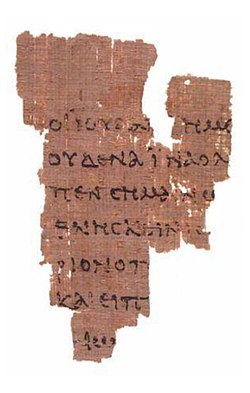
The P52 fragment – a scrap of papyrus with a sliver of John’s gospel on it, dating to the early 2nd century.

The Tel Dan Stele is the first piece of archaeological evidence that mentions the ‘House of David’.
LINKS
Check out these links to what we discussed on the show!
To Read
- Wes’ website is an amazing resource for anyone wanting to explore the historicity of Christianity. Here it is.
- Here’s Undeceptions house historian Eusebius’ account of the great persecution of Christians in the early 4th century, which resulted in the loss of thousands of scriptural texts.
- Here’s a digital copy of the section of The Acts of the Scillitan Martyrs we featured in this episode; it’s a transcript of a trial from the second century AD, in which Christians are being questioned about their faith by a Roman provincial governor.
- Check out the clip of 12 Angry Men we featured in this episode here.
- We spoke about the work of Jonathan Haidt in this episode. John’s a big fan. Here’s an essay he wrote about the complexity of trying to get someone to change their mind about moral issues.
To Watch
- Make sure you check out Wes’ YouTube page, which has loads of videos about apologetics, biblical studies, and more!
- If you don’t have a spare three hours, here’s just 15 minutes of Wes’ apperance on the Joe Rogan Experience.
- Here’s the clip we featured of John talking about P46 – one of the oldest New Testament manuscripts.
- We featured a clip of a discussion between Tom Holland and Peter Williams on the resurrection – check it out here.
- We also played a clip featuring Alex O’Connor – the Cosmic Skeptic – talking about his hang-ups with Christianity. Here it is.
To Listen
- Check out Wes’ episode of the ˆJoe Rogan Experience here (or wherever else you get your podcasts).
- Listen to his episode of Diary of a CEO here.
- We spoke a lot about the New Testament in this episode. Check out our episode on how it all came together, ‘Canon Fodder’, here.
- Episode 7, ‘Gospel Truth’, with Peter Williams, is also a great episode to check out if you want to learn more about New Testament textual studies. Here it is.
- A big part of this episode was wondering what the uptick of interest in Christianity means for the faith in the long term. Episode 125, ‘Christianity’s Comeback’, with Justin Brierley, also focuses on this.
- Make sure you listen to our ‘Really Old?’ single with George Athas. Here it is.
… and finally
- Wes’ appearances on some of the world’s biggest podcasts have irked a few people. Here’s an episode of the MythVision podcast, which took aim at some of his claims.
- And here’s the viral debate with Billy Carson that started it all!

Become an Undeceiver
Undeceptions Plus offers exclusive bonus content to members. By becoming an Undeceiver, you can unlock uncut interviews, extra question and answer sessions, and peeks behind our creative process as we put the shows together. We’d love to have you with us.