Remembering Women
Please note that due to software used, not everything in this transcript will be accurate.
Reading
At the foot of Mount Taurus, 120 miles from the Mediterranean, a first-century noblewoman named Thecla lived in Iconium, in a region of what we know today as Turkey. The Apostle Paul spent quite a bit of time in Iconium. Standing by her window one day, Thecla overheard Paul preaching. She was so engrossed by Paul’s words that she didn’t eat or drink for three days. She became a Christian and her life changed forever. One of the messages she heard from Paul was on chastity: “Blessed are they that keep the flesh chaste, for they shall become the temple of God.” Thecla vowed to remain celibate, a commitment that didn’t go down well with her fiancee. Nor did it please her family, who expected her to marry and have children as all noblewomen were meant to do. Seen as a rebel, Thecla was persecuted for her new-found faith. After visiting Paul in prison, she too was thrown into prison and condemned to burn at the stake. But, miraculously, the flames did not touch her and she was released. Thecla followed Paul to Antioch. There, one of the city’s leaders fell in love with her. After she rejected him, he appealed to the Governor, who sentenced her to be thrown to wild beasts. But in the arena, she remained unharmed, and was once again freed to go in search of Paul. When they met again, Paul urged Thecla to spread the good news of Jesus Christ. She travelled to Seleucia – in South East Turkey – lived in a cave, taught the gospel and healed people in the name of the Lord. Thecla conducted so many healings that there wasn’t anything for the doctors to do. They grew angry and sent a mob to the cave to attack her. When Thecla prayed to God for protection, an opening in the rock appeared. Thecla went through the opening and it closed behind her. She was never seen again.
John Dickson – Studio:
If you were a second or third century Christian you would have been very familiar with the story of Thecla. Nowadays not so much – unless you are part of the eastern church tradition, where she is remembered as a minor saint with her own feast day 24 September. Her story is in the Acts of Paul and Thecla, one of the writings of the New Testament Apocrypha – writings of ancient Christians that were not accepted into the New Testament, partly because they had dodgy ideas and partly because they were written too long after the apostolic period. This document comes from the mid to late second century. And yet, scholars like Alister McGrath (who we spoke to in episode 19) consider the story of Thecla as “one of the most remarkable witnesses to the aspirations of women in the early church”. She defied the expectations of a woman of her time. She was a rebel. Her decision to follow Jesus was considered dangerous to society. Much of her story is legendary, no doubt. But the traditions about her – the core of which is probably historical – certainly tell us something about how early Christians could imagine a woman having an impact for Christ in the Roman world. This week, we’ll be zooming in on some other early Christian women, for whom we have good evidence, who had a profound impact on the church and its teaching in their time. I’m John Dickson and this is Undeceptions …
Undeceptions theme
John Dickson – Studio:
Ever tried walking on snow? It can be pretty difficult. The traction you have on other surfaces just isn’t there. You find yourself using more energy than you would on a firm surface as you try to keep yourself stable. The topic of women and their place in the church can feel a bit like walking through snow. It takes up a lot of energy within the church – and outside of it. Constant arguments. Persistent accusations. Professor Lynn Cohick came across these accusations – that Christianity is unfriendly – even hostile – to women early on in her studies at university. So she wrote some books to explore the topic. Lynn has written several in fact, including Christian Women in the Patristic World: Their Influence, Authority, and Legacy in the Second through the Fifth Centuries (co-authored with Amy Brown Hughes) and Women in the World of the Earliest Christians. I caught up with Lynn in Denver, Colorado in the US, where she is Provost and Dean, as well as Professor of New Testament at Denver Seminary. It was freezing there. And, yes, we did actually have to walk through snow together. I asked Lynn to paint me a picture of what life in ancient Rome might have been like for the first women to hear the gospel.
Lynn Cohick:
A Greek woman or a Roman woman, they would be part of the Roman empire. Um, and it varied depending on how much money you had. So you might want to think that, uh, most people had enough money that they could last two or three days without getting more money to, you know, tell them so they weren’t subsisting day to day, like on handouts. Uh, but everyone was working hard. So I think that’s one of the pictures you want to have. They were either out in the fields or tending flocks if they were more rural or they were shopkeepers or they were artisans. We know women who made jewelry, uh, certainly were part of the clothing industry. So everyone was working. So I think that’s one image you want to have. You did have some, maybe a seven to 10% who were quite wealthy. They had a lot of leisure time, but everybody else, they, they were working hard. And then of course, you did have the, those who were terribly impoverished, uh, and they might make up 20% or something like that. Some women were slaves.
John Dickson:
Can we say generally that women in this period – whether Greek, Roman or Jewish, were oppressed?
Lynn Cohick:
You could say women were oppressed at this time. If you use modern standards, if, if we assume that women should have the right to vote, then yes, they were oppressed core, so are men. They were really, it was a very different governance system back then. So I think from having legal rights, if that’s the standard, then again I would say yes, probably you could say that women were oppressed in as much as women could not by themselves go into court and represent themselves. They needed a male guardian. They would need a male guardian to sign off on if they bought or sold a piece of land so they could buy and sell. They could own property, they, they could have their control of their own wealth, but they couldn’t distribute it in legal ways without having a man sign for it.
John Dickson – Studio:
Lynn is hinting at something that a lot of scholars note today. Women were sidelined by men in a range of ways in the ancient world. But we are probably wrong to imagine a kind of Handmaid’s Tale of subjugation and reproduction. They could speak up for themselves. They could buy and sell. They could sometimes even divorce their husbands at will. But they weren’t at the centre of political life, that’s for sure. They lacked access to the wheels of power. So it’s mixed. We have to be cautious, and not read our modern agendas into ancient evidence. And the same is true when we come to the topic of Jesus and women. Our modern, pro-women intuitions shouldn’t be allowed to run amok with the historical evidence. Nor should we let modern Church debates about women’s ordination muddy the waters of a discussion about what was going on in the first century. Let’s get back to Lynn, who is the consummate careful scholar on this stuff.
Lynn Cohick:
We have a community that left scrolls, call them the dead sea scrolls that, uh, they, um, is it, it’s a deposit of scrolls left near the dead sea at a place called Camron. And the community that is described there seems to have allowed for women to be full members, maybe not with the same level of authority, but nevertheless full members. We know of women who would self identify as pharisees. Um, it, it, there, there are, there are ways that Jewish women could participate in the life of first century Judaism, even in these smaller groups like Jesus followers or pharisees or something like that. And so in that sense, Jesus wasn’t unique in inviting women into his, his circle of disciples.
John Dickson – Studio:
Just a quick explainer here: A Pharisee was a member of a Jewish sect that kept strict observance of religious ceremonies and practices and adherence to oral laws and traditions. It’s not a job, like priest or scribe. It’s just a faction, like saying Protestant. Anyway, Pharisees thought of themselves as the most pure – the word Pharisee probably comes from the Hebrew word for ‘purity’. Some women identified with their version of Judaism, rather than say the traditions of the Sadducees or Essenes or any of the other factions.
John Dickson:
So there was nothing different about Jesus?
Lynn Cohick:
Well, the, what he was saying in the midst of these disciples was different. I think that there would, so what Jesus said there, there was some content distinction which then probably led to the way in which the men and women who followed him interacted themselves. So in that, what I mean by that is it appears that women and men, if they had gifting and capabilities led together, it would not be surprising to have women who held positions of responsibility in the, in the community because of how Jesus was organizing their, their communities.
John Dickson – Studio:
I’ve often heard it said – in fact, I think I’ve said it myself a few times too – that it is striking that Jesus chooses to place women at the centre of some of his parables – the stories he used to illustrate a moral or spiritual lesson. Lynn says – sure, Jesus uses women. But not just women.
Lynn Cohick:
He also would put front and center the Samaritan. And the Samaritan was seen as someone you wouldn’t want to emulate. Uh, I don’t know if I would say he was an arch enemy of the Jew, but those two didn’t get along, even though they were neighbors and they didn’t get along. Um, and, and so I think given the fact that women wouldn’t have the same level of opportunities, daughters wouldn’t have the same level of opportunities as sons – that stood out as an, in certain ways they could be marginal, right. And Jesus’ message was inclusive even of those on the margins. So those who were not Jews, but were Gentiles interested in the Jewish way or in the Jewish God who called out to Jesus, the woman whose daughter needed healing. And Jesus, uh, after, uh, a somewhat odd conversation, this is in the gospel of Mark, in the gospel of Matthew says to the woman, your faith has made your daughter well, and, and so he’s, that’s not, it’s not just, he was talking to a woman. This was also a non-Jewish woman, and that fit his overall message. And so that’s where I would say we, we can talk about how Jesus’ message was so affirming to women when, when we think about it in the overall context, that it’s affirming for everyone and that, uh, that that was the specialness, I think that drew many people to him.
John Dickson:
Yeah. So you’re sort of saying, eh, it’s not that we’re casting Jesus as the feminist. He was the inclusivist.
John Dickson – Studio:
That’s the song ‘I don’t know how to love him’ from the Andrew Lloyd Webber musical Jesus Christ Superstar. It’s from a 2012 arena production where Mel C (yes — the Sporty Spice Girl) played Mary Magdalene, and sings to Jesus, admitting that she has fallen in love with him. It’s one of the more controversial takes on the figure of Mary Magdalene – though certainly Andrew Lloyd Webber is not the first – or the last – to suggest a physical relationship between Jesus and this Mary. It’s a theory that is rolled out pretty frequently through popular culture. Like in Dan Brown’s bestselling book The Da Vinci Code, where Mary Magdalene is depicted as Jesus’ wife. In a documentary I was part of a while back called The Christ Files, I visited Cairo and got to see the original text of The Gospel of Philip, which is where the whole idea that Jesus had a girlfriend came from… here’s a little bit of what young John Dickson found.
Media – The Christ Files
John Dickson – Studio:
Mary Magdalene has been labelled many things: sex worker, saint, sinner, witness, wife. So much has been written about her it might seem impossible to get the real answer to the question … Who was she, really? You might say she’s the Bible’s most mysterious woman.
Lynn Cohick:
Mary comes from a town that had decent trade at the time, and I think she’s a businesswoman. And she has some resources. She also falls ill with some sort of disease that Jesus heals. And that that really is kind of the baseline for who she is. And after she is healed, like others whom Jesus heals, she becomes a devout follower and, and she stays at his side up through the end. Um, but she gets her story, which is, um, she’s introduced in the gospel of Luke at the end of chapter seven. Uh, she gets conflated and I’m sorry, not the end of seven. Uh, but the, it’s, should I just start over my sentence there? Um, Mary Magdalene’s is introduced in the gospel of Luke, um, at the beginning of chapter eight. Uh, just a little bit of information we get about her, but then the early church, um, tries to fill out that information begins to conflate her story with some other stories. And that’s where you get the notion that, well, her sickness had to do with her being, uh, a sinner. And, uh, and then she had so much to repent of. And there’s beautiful artwork that’s created, uh, that shows a very penitent Christian. And th they’re very, it’s very powerful artwork, but I don’t think it actually represents who she is. Um, and her, when you, when you do that, when you make her something that she’s not you, you lose who she really was. And, and she can be a wonderful role model for today. A person, a woman who is, you know, kind of just your, your average working woman who has a business who travels, you know, from town to town perhaps with, with her business there around the sea of Galilee and contracts, a horrible illness. And like many people today, when you get ill, you begin asking all kinds of questions that if things are all going well you don’t necessarily focus on. And when her questions about what happens next were answered by Jesus with his healing and, and his whole message that he gave her, she became a disciple and an ardent one, one who stayed with him even at his time in the cross.
John Dickson:
How much do you make of, you know, her being a witness to the resurrection and being sent to tell the other disciples? Do you think that’s just a, an accidental element of history or do you think that the writers of the gospels are actually trying to highlight her role as an important disciple and witness?
Lynn Cohick:
I think it’s the latter. They are trying to emphasize her voice. They … at that time you wouldn’t necessarily put your foundational beliefs in the mouth of a woman. It, it wouldn’t carry the same sort of weight as if it was in the mouth of a man. Uh, although maybe not a slave man. Right. I mean, class would also come into play here, but uh, it, it’s not, it’s not so much that women weren’t trusted in and of not necessarily, uh, individually. Right? Like, I think, you know, people trust sons trusted their moms and you know, I mean, there was a respect there for your elders and, and so in that, I don’t want, I don’t want to create a picture like everyone thought all women were stupid. It’s not the case. But as a group, they were seen as more gullible or less reliable, more um, taken to imagination. And so when, when she comes back saying, I, I’ve seen the risen Lord I, and that’s a pretty amazing statement. And, and a lot of the disciples say, ‘I’ve got to see this for myself’. And I think they don’t completely dismiss it out of hand because they know her, but they also think I’m not going to take it just at face value. I got to see it myself. So I think the, the, if the church could have said Peter saw the empty tomb and he was raised, they would have done it. Don’t think they would have tried to create this story of women seeing the tomb, uh, as, as a way to reinforce belief in this story. Uh, they would’ve, they would’ve made up a different story. So that suggests to me that in fact, Mary Magdalene really was the person who came back to the group, uh, and, and spoke the words.
John Dickson – Studio:
Let’s press pause, I’ve got a 5-minute Jesus for you. One of the little known facts about Jesus’ life is that it was women who bankrolled his mission. You have probably never stopped to wonder how much it might have cost to travel throughout Galilee and Judaea—as a party of thirteen—over a 2-3 year period. Jesus and his disciples no doubt enjoyed generous hospitality in many of the towns and villages they visited, but this can’t have provided all of the food, lodging and taxes needed for the team. A modest meal in a traveller’s inn was about a quarter of a denarius. A denarius was a day’s wages for an average day labourer in the fields or mines or whatever. So a quarter of your daily income each day could be spent on just one average meal in an inn. To put it in average terms: if a day labourer gets about $200 a day, that means $50 would be spent on your evening meal. All this got you in the first century was a sizeable piece of bread, a bowl of lentils, two pieces of meat, and 2 glasses of wine. Seriously—people have actually studied this stuff. A loaf of bread on its own was about a one-twelfth of a denarius (or $16.50). A cluster of grapes or 10 figs set you back an eighth of a denarius ($25). Simple clothing (uncoloured) set you back about four denarii (AUD $800). Then there were the various Jewish and Roman taxes due each year to the authorities. Even assuming Jesus and his disciples lived modestly—a fair assumption—the bill for this 2-3 year preaching tour would have been massive. Where did the money come from? Tucked away in the Gospel of Luke, chapter 8, is the answer:
After this, Jesus traveled about from one town and village to another, proclaiming the good news of the kingdom of God. The Twelve were with him, and also some women who had been cured of evil spirits and diseases: Mary (called Magdalene) from whom seven demons had come out; Joanna the wife of Chuza, the manager of Herod’s household; Susanna; and many others. These women were helping to support them out of their own means.
The words “helping to” in the last line are not in the original Greek. The passage literally reads, “These women were providing for them out of their own means.” The point is significant. As Professor John Meier (University of Notre Dame) notes, this passage “preserves a valuable historical memory … certain devoted women followers accompanied Jesus on his journeys around Galilee and finally up to Jerusalem and actually supported him and his entourage with their own money, food, or property”. Such a passing and uncontrived detail, one that was also potentially off-putting to ancient male readers, has a strong claim to historicity, as scholars usually observe. James Dunn of Durham University writes, “Such uncontrived detail indicates good tradition; Luke evidently had access here to first-hand recollections”. Taking on the role of benefactors, these women were almost certainly wealthy. Joanna, described as the wife of a senior royal official, will have been especially so. She belonged to the upper echelons of Galileean society. In a period when the gap between rich and poor was very pronounced, a woman like this would have seemed ‘aristocratic’ to many disciples. Jesus was known to have oriented his ministry to the ‘poor’ – or at least what we would call the ‘working class’ – but he didn’t do so to the exclusion of the rich. Anyway, my simple point is: Humanly speaking, we have a group of financially savvy and well-resourced women to thank for the entire 3-year mission of Jesus and the apostles recorded in the Gospels. You can press play now.
John Dickson – Studio:
Jesus might not have been the feminist some want him to be, but in his inclusivity and emphasis on those on the margins, women were brought into his fold in pivotal ways. So… it’s after Jesus that things go pear-shaped for women in Christianity, right? We’re about to talk about the Apostle Paul, one of the leaders of the first generation of Christians, and considered the most important Christian figure after Jesus himself. But he gets a bad rap, according to Lynn. The writings of Paul have been used to prevent women attaining positions of leadership within the church, even today. You remember the snow? It’ll be getting chilly in here … after the break.
John Dickson:
What did women experience when they came into contact, uh, with Paul and his churches that he’s starting in the decades after Jesus? I mean, the story is, the perception is that’s when they started to be oppressed.
Lynn Cohick:
I think Paul would be very surprised and saddened to know that that’s a legacy that is imputed to him. Um, I think what he would say is, ah, I, ‘I enjoyed working with the women’ that, uh, that he mentioned. So for example, at the end of the book of Romans, or in Philippians or in Colossians … I can name so many of his letters where he talks about women who he worked with and he calls them coworkers. He describes them in the same way that he does his male coworkers. So I think he would be surprised that people would think he wasn’t seeing women disciples as having the same, uh, level of possible level of understanding of the gospel and ability to, uh, to, to preach it, to live it, to do it. Um, so I think that Paul’s misunderstood in, in some ways. Having said all of that, I think it’s also really important that we don’t bring our 21st century mindset back into the first century. The first century was a patriarchal world and everybody operated on, on that. That was just kind of what people thought. And so the, if that’s what you’re up against, how do you preach the gospel that, that certainly cuts away at patriarchy but yet also make sense of, of their lives. So I think that was the challenge that Paul had. He had to, to explain the gospel to them in their moment, in a moment when women couldn’t go to court on their own. If, if a woman wanted to separate from her husband what we might call divorce, she could, uh, do so only if she had, uh, a male guardian, uh, maybe a family member or friend represent her also in the court. Right? That, that’s the reality that Paul had to deal with as he then tried to shape his churches.
John Dickson:
So when you pick up Paul’s letters, you know, as an expert in this area, you don’t feel any sense that you as an accomplished woman are being shut down.
Lynn Cohick:
No, I don’t feel that I’m being shut out and thank you for saying that I’m accomplished. I appreciate that. I don’t know. That would really, anyway, thank you. Yeah. Um, but I, I think that um, Paul was intense. You certainly get that, uh, from his letters or I get that from his letters. He’s a man driven by a mission and he doesn’t, he has to though, give this gospel at a time when there is extreme hierarchy in the Greco Roman world, everyone’s trying to fit in their rung of the ladder. That’s just the reality. Now the gospel comes breaking into that and says that all are equal, we might say, at the foot of the cross, right? All are one in Christ. All have the spirit, all have, I mean, and, and you serve each other. That’s an amazing statement to make in a culture that is so hierarchical and, and has a lot of rules that say around meals.And then, and then you come in and you say, let me tell you about the meal that Jesus started with his disciples and that we’re to do, uh, at on a regular basis, and we share the bread and the wine, so to speak. Okay. Well, in Paul’s culture, uh, that if you had someone who owned slaves, they, they would never dream of sitting or having the slave recline at the table and giving them something,
John Dickson:
Except for one or two days a year. Right?
Lynn Cohick:
Right. Yes. And the festival, that crazy festival time when you get down, that’s right. And it, and it only works because the rest of the time it’s quote unquote right side up. Exactly. Right.
John Dickson – Studio:
The festival we’re talking about here is called Saturnalia – the most popular of Roman festivals, falling on 17 December (but it sort of went for a week). It was dedicated to the Roman god, Saturn. And, frankly, no one knows its origins. Basically, all work and business was suspended for the week of the festivities, and the most striking thing about it was that slaves were given temporary freedom to say and do what they liked. They could sit at the table with their masters, and even talk back to them without getting into trouble. The world was turned upside down … For a week. And then everything went back to normal. Weird.
Lynn Cohick:
So all of a sudden now you have on a regular basis, this kind of upside downness and, and Paul really, uh, pushes that. But he, he in, he has to keep reminding them that, um, of, of this upside down this, and you know, it, but he also, he wants them to know that the gospel can be lived out even in an imperfect culture.
John Dickson – Studio:
Look, there is so much more debate on the place of women in leadership in the church. But, frankly, it’s a little ‘insider baseball’ to tackle on a podcast like this. Some church authorities say yes. Some say no. Some in between. I say … let’s cut each other slack across the divide. But regardless of the endless Church debates, there still remains this truth: the early Christian church was not a hostile place for women. In fact, there were some seriously impressive women, particularly in the second and third centuries, who we should really know much more about.
Lynn Cohick:
There’s, uh, two famous, uh, women Perpetua and Felicitas Perpetua they, they, they lived about very, very early in the two hundreds. 203 is their martyr date. Their birthday is sometimes how it’s called. Perpetua is from a fairly wealthy family. They live in North Africa and, uh, she becomes a Christian and keeps a diary while she’s imprisoned after she, uh, is, um, put in this prison she continues to have conversation, some conversations with her family and those are talked about in this, uh, diary. She has some visions. Those are also described in the diary. And then the, the final day when she’s in the arena and she and the small group of Christians around her are condemned to the beasts and, and die horrible dramatic deaths, uh, alongside her story, which takes up most of this, is another story about a female slave who’s pregnant and she gives birth a bit early. So in her eighth month, um, so that she, and, and they pray that this will happen so that she could be part of this group as a Christian martyr also. So she has her baby. The baby is, um, is born, uh, within 24 hours or so of when the rest of the group is going to go into the arena. And so she’s able to join them. And it’s, it’s a fascinating story of how she thinks about her own giving birth to this daughter and how she herself is a daughter of God and how Christ is living in her, even as her daughter lived in her. It’s just a fascinating way of thinking about and what the, uh, thinking about childbirth, about Perpetua talks about nursing, her son, there’s all kinds of female imagery, well, you know, biological female imagery that is also put to theological use, theological reflection. And I point that out because I think we have a sense that women were completely silent as the church was doing theology. That’s not the case. Women were thinking theologically and they were also thinking about their own experiences that the typical experiences of having a baby, nursing a baby, what does that mean for theological? And the rest of the church picked that up. Perpetua and Felicitas were celebrated each year by the, by the church as martyrs. So it, it’s important, I think as we reflect back on what was happening in the early church, we don’t just imagine there were a bunch of bishops sitting around ma male Bishop sitting around coming up with these abstract crates. There was a lot of action and women were a part of that.
John Dickson – Studio:
Another woman who was revered is Macrina, the sister of Gregory of Nyssa – a church father who lived in the 4th century and made significant contributions of the doctrine of the trinity (the idea that God is one God in three persons – Father, Son and Holy Spirit). He was one of the biggest name intellectuals of the period. Anyway, that’s Gregory. But what of his sister, Macrina?
Lynn Cohick:
Right. Macrina uh, is the sister of Gregory of Nyssa who is a famous church father and theologians. Yes, yes. And she lived, probably was born about 327, died around 379. She comes from a very wealthy family. Um, her parents are Christian, um, and, and then through a series of events, uh, they decide that they will live a much more aesthetically. And she, she invites the slaves that they had had or the workers that, that were on the estate to, uh, live in what we would call today, like a monastic kind of rhythm. And, and so that’s, that’s what she set up. Um, but her, there’s a book that her brother writes called the life of Macrina. It’s probably written around 380. So shortly after she died. And then he writes another volume called on the soul and the resurrection, which also, uh, has a lot of reflection on her death, very similar to his work, uh, Life of Macrina. And he, he is drawn to his sister as one who teaches him. He saw her as, if you will, the smart one. She was the philosopher. He, he was led by her and when he finds out that she’s ill and potentially gonna die, and he travels to be at her side at different points in this journey as he goes, he has this vision that he’s trying to understand. So he’s thinking about it, thinking about it when he comes to her side and, and she passes on. He then realizes what this vision was telling him. It was telling him that his sister who died in her bed, his sister should be understood as a martyr. Now, there’s no martyred martyrs anymore at this time in 380. It’s now … Christianity is a licit religion. But, but Gregory sees her testimony and her life as so given to God. And I think one of the interesting things for Gregory here as he understands his, his sister as a martyr, another piece of this is that when she was born, her mother received a vision that this daughter should have a secret name. And that secret name was Thekla who is the first martyr. So I, I, I want to trace through the centuries the importance of the idea of martyrdom. The idea of living in an ascetic life. And when I say an ascetic, what I mean is people who are trying to have both their body and their mind, uh, in such order and under control to a purpose that they value. So it may mean that you abstain from sexual relations, and both Thekla and Macrina were virgins, but so were a lot of men at this time. Celibacy was a, a practice at this time that people felt would help you to order your life. Not everyone was a celibate, but some were. And that was that it for that purpose. Macrina demonstrates not just this ordering of body and mind for now, for today, but she was driven by this desire for the resurrection of the body and this eternal love that awaited her. And so that, that was sort of in a nutshell what her philosophy and her way of life or that was so compelling to her brother. And when you think about it, I mean, here’s a man who writes about theology. He’s one of the great theologians of the church, and when he wants to think about the soul and the resurrection, he thinks about his sister and her life and her teachings.
John Dickson – Studio:
One of my favourite little details in the second century is buried in a letter from Pliny the Younger to the Emperor Trajan. Pliny was the governor of Bithynia – modern day Turkey – where he had a number of Christians presented to him in court. It’s not clear what they were charged with – even Pliny wasn’t sure. That’s why he wrote to the Emperor. But even though Pliny reckons they were harmless idiots, he came to the conclusion that they should be tortured and killed if they wouldn’t recant their faith:
Reading
“I dismissed any who denied that they were Christians when they had repeated after me a formula calling upon our gods and made offerings of wine and incense to your statue, and furthermore had reviled the name of Christ: none of which things, I understand, any genuine Christian can be induced to do. If they persist, I order them to be led away for execution; for, whatever the nature of their admission, I am convinced that their stubbornness and unshakeable obstinacy ought not to go unpunished. ”
John Dickson – Studio:
Pliny goes on to talk about the things he has discovered about this sect – these ‘Christians’ and their practices, including that they meet before the sun rises and sing a hymn to Christ, and share a meal together.
Reading
“I tried to extract the truth by torture from two slave-women, whom they call deaconesses. I found nothing but a degenerate sort of cult. I therefore postponed the investigation and hastened to consult you. For the matter seemed to me to warrant consulting you, especially because of the number involved. For many persons of every age, every rank, and also of both sexes are and will be endangered. For the contagion of this superstition has spread not only to the cities but also to the villages and farms.”
John Dickson – Studio:
Perhaps you missed my favourite bit. “These deaconnesses”. In trying to get the bottom of what Christianity is all about, Pliny decides to torture two slaves. And these slaves were women, and they had the title ‘Deaconnesses’. It’s odd. Why would Pliny go to women for this?
Lynn Cohick:
Well, I think because these women, he felt had, uh, had information about how the, the church was run and sadly, whether they were women or men, he would have tortured them to get answers. Cause that just is how they felt. The system needed to work. You weren’t going to get the truth unless you tortured the fact that they were slaves. I think signals for us the reality that Christianity for a while, this is now early second century. Um, I had more members that were of the lower levels of society rather than the upper crust. Uh, that, that just simply, um, variety of evidence leads us to that. So we shouldn’t necessarily be surprised that you have women who are slaves who are also in some way representative of the churches leadership that they can speak somehow for the church. That’s what Pliny assumes. And, and I think you know that, that’s probably correct.
John Dickson:
What’s your hunch, uh, of what that title meant? I mean, obviously plenty of people got that title from them or from the church whom they call deaconnesses. He probably has no idea what that means, but he’s just relaying it as a, as a title. What do you think they were doing?
Lynn Cohick:
Oh boy. Yeah. Boy, that’s, that’s a, that’s a very interesting, uh, and hard to answer question because we don’t really know enough to know exactly what they, what they were doing in some way. They, I would imagine that if they had leadership roles in the church, it would also involve serving in some way. And the, the, the language around, uh, leadership in the new Testament is connected with serving others. That’s even a self designation. Some of the apostles will talk about themselves as a slave of Christ. So, um, while they are leaders, I also want to emphasize one of the amazing things that church doesn’t get right all the time, but what they aspire to is leadership that thinks of the other first. That’s not a power push. Once you recognize that that’s the, at least the goal of leadership within the church, then it shouldn’t be terribly surprising that you could have slaves functioning in, in that role. Just like you could have, um, women and men have a higher class functioning as leaders because of the way leadership was understood, which I, uh, best I can tell is a different way of understanding leadership, then the Romans would have, would have understood it. I also, it is also possible that these slaves, these female slaves did have some education. It’s, it’s possible. It’s more likely that male slaves would have been educated. But I also just want to, uh, to note that when they say slave, it doesn’t necessarily mean that someone has no education and, uh, is doing hard labor out in the field. This would be, uh, a slave that lived in the household and, and may have been trained, uh, by the, by the owners for particular tasks that could involve being educated.
John Dickson – Studio:
On a topic that we can tend to find ourselves knee deep in snow, sometimes it’s good to dust ourselves off and go back to the beginning. To hear from the women who knew Jesus and those who came soon after him — how were those women treated in the church? What influence did they have? What legacy did they leave? The church in the ancient world showed women a new way of being. The gospel offered freedom they had never experienced before. And some were incredibly courageous in going against the grain, pushing against their culture. All this to follow Jesus, a man who positioned himself in the margins to speak to those without a voice.
Lynn Cohick:
Remembering is important. I think it’s very important that we know that there were women who used their money to support like a Jerome or a Chris system or other church fathers. It’s important to know that Gregory of Nyssa didn’t think about his great theological thoughts on his own, but he was greatly informed by his sister. And those, we need to hear women’s voices and their actions more. So that’s the remembering part, but we don’t want to either put them on some kind of pedestal that is unrealistic or fail to acknowledge that the church also acted at times in, in patriarchal ways like it, it, uh, was part of its time, right? It was a creature of its age. So it had blind spots that maybe now we are more aware of. We of course, in our culture today have our own blind spots and hopefully future generations will be generous, uh, towards our failings, um, even as they also tell the truth. So I think that responsible remembering is choosing to remember and, and doing so in a way that gives full voice to the women without creating, um, a woman that, that it’s not real flesh and blood cause that separates them again from us.
Undeceptions theme

This episode, we’ll be zooming in on the early Christian women, for whom we have good evidence, and who had a profound impact on the church and its teaching in their time.
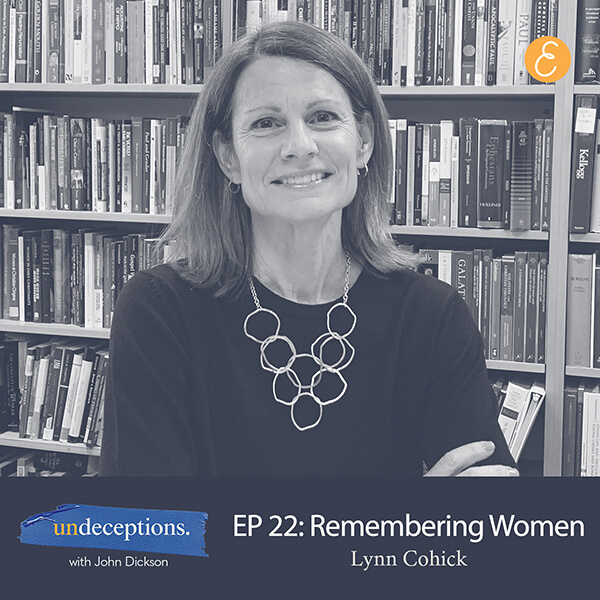
Our guide is Dr. Lynn Cohick, who’s written books on the topic, including Christian Women in the Patristic World: Their Influence, Authority, and Legacy in the Second through the Fifth Centuries (co-authored with Amy Brown Hughes) and Women in the World of the Earliest Christians.
She paints a vivid picture for us of what life in ancient Rome might have been like for the first women to hear the gospel.
LINKS
- For more on Dr. Lynn Cohick, check out her web site.
- And while you’re clicking, have a look at the Undeceptions web site for all sorts of cool stuff related to undeceiving the world
- Special thanks to Zondervan Academic, our show sponsor
- Ridley College, where John lectures in Public Christianity
- You can click here to sign up for the With All Due Respect podcast with Michael Jensen and Megan Powell du Toit
- Want to send John Dickson a question? He loves them. Just click here to provide a query for our next Q and A show!
- Undeceptions is part of the Eternity Podcast Network, an audio collection showcasing the seriously good news of faith today.
Get to know our guest
Dr. Lynn Cohick received her bachelor’s degree from Messiah College in Grantham, PA, and her Ph.D. in New Testament and Christian Origins from the University of Pennsylvania in Philadelphia, PA. After 18 years as professor of New Testament and Biblical Studies at Wheaton College (serving as department chair and dean toward the end of my time there), she accepted the invitation to join Denver Seminary as their Provost / Dean. Lynn also taught at Messiah College (Grantham, PA), and Nairobi Evangelical Graduate School of Theology (Nairobi, Kenya) in the 80s and 90s, respectively.
Cohick presently serves as Provost and Dean of Academic Affairs of Northern Seminary in Lisle, Illinois [NB: as of August 2025 Lynn is a Distinguished Professor of New Testament at Houston Christian University]. She also teaches New Testament and leading the development of DMin and MA programs in women’s studies, and the Women’s Center for Leadership at Northern Seminary. [source]