Please note that due to the software used, not everything in this transcript will be accurate.
God’s Image
John (Studio)
Listen to this remarkable little letter, penned by a Roman soldier named Hilarion to his wife Alis, dated 17 June, 29th year of Augustus (1 BC):
Reading
“Know that I am still in Alexandria; and do not worry if the army wholly sets out, I am staying in Alexandria. I ask you and entreat you, take care of the child, and if I receive my pay soon, I will send it up to you. Above all, if you bear a child and it is male, let it be; if it is female, cast it out. You have told Aphrodisias, “Do not forget me.” But how can I forget you? Thus, I’m asking you not to worry.
John (Studio)
Discarding a child at birth—as a throw-away line in an otherwise affectionate personal letter. To us … Shocking … Immoral … Illegal … At the time, it was none of the above. Hilarion and Alis were operating with a different idea of what it means to be a ‘human being’. Ponder this statement from Paris, 10 December 1948.
Reading
THE GENERAL ASSEMBLY proclaims … All human beings are born free and equal in dignity and rights. They are endowed with reason and conscience and should act towards one another in a spirit of brotherhood.
John (Studio)
Or the American Declaration of Independence:
“We hold these truths to be self-evident, that all men are created equal, that they are endowed by their Creator with certain unalienable Rights …”
Ancient Hilarion would find our Universal Declaration of Human Rights … and the Declaration of Independence just as illogical as we find his letter obscene. How could it possibly be—he might ask us—that every human being, regardless of their capacities or usefulness, is equally valuable? On what basis can we make such an arbitrary claim? Are all animals in the sale yard equally valuable? Is all art equally valuable? Are all tools or weapons, or food, equally valuable? For what other feature of earthly life would we say that items in the same general class share the same value when they obviously have different capacities and usefulness? Nature herself has made some people smarter, stronger, better … and therefore more useful. The more useful, the more valuable. The logic is almost irresistible. We should prefer the strong and useful, and let Nature take care of the rest. Only when we feel the force of this cold pagan logic are we in a position to see how Christianity – building on its Jewish origins – repudiated the ancient view of the human being, and laid the foundation of the modern “recognition of the inherent dignity and of the equal and inalienable rights of all members of the human family”. We’re talking about what it means to say that human beings are “the image of God”. It’s not just some throwaway line at the front of the Bible. Atheists like the German political philosopher Jürgen Habermas have spotted the significance of all this:
Reading
“Egalitarian universalism, from which sprang the ideas of freedom, human rights and democracy, is the direct heir to the Judaic ethic of justice and the Christian ethic of love. To this day, there is no alternative to it.”
John (Studio)
It’s a big call. But I think we can show it to be the case.
I’m John Dickson, and this is Undeceptions
Undeceptions theme
Reading
When the heavens above did not exist,
And earth beneath had not come into being —
There was Apsû, the first in order, their begetter,
And demiurge Tia-mat, who gave birth to them all;
They had mingled their waters together
Before meadow-land had coalesced and reed-bed was to he found —
When not one of the gods had been formed
Or had come into being, when no destinies had been decreed,
The gods were created within them.
John (Studio)
In order to see the significance of the Judeo-Christian view of humanity… we first have to think like an ancient pagan. What we just heard were the opening lines of the Enuma Elish – the Babylonian creation myth found on seven stone tablets dating to around 1200 BC, though scholars believe the myth itself dates long before that. It likely predates the Jewish creation story contained in the book Genesis by centuries. The Babylonian myth tells the story of the great god Marduk’s rise to power and eventual victory over the forces of chaos, to establish order at the creation of the world.
John Dickson:
Can you tell us, um. Enuma Elish’s view of the human being. We will have our voice actor read out the tablet six portion that has the creation of humans. But just like, tell us just in broad terms, uh, what that pagan myth tells us about humanity from the Babylonian perspective.
Carmen Imes:
So in the Enuma Elish, the, the creation of humans is portrayed as the result, the end result of a massive conflict between the gods in which Tiamat is killed. Her body is cut in two, and then, uh, part of her body, half of her body creates, becomes the sky and the other half of her body becomes the earth.
John (Studio)
That’s Carmen Joy Imes, associate professor of Old Testament at the Talbot School of Theology, Biola University, in Southern California. She got her PhD here at Wheaton College, and is the author of several books, including Bearing God’s Name: Why Sinai Still Matters and Being God’s Image: Why Creation Still Matters.
Carmen Imes:
And then human beings are made as this idea for doing, getting the god’s labor done so that they can just take a rest.
John (Studio)
After the war of the gods, the losing gods had to serve the winning gods. Marduk ruled over all. The loser gods complained to Marduk about all the work they had to do. And they asked him for a new creature to be a slave of the gods:
Reading
“When Marduk heard the complaints of the gods, he said: ‘I will establish a savage, ‘man’ shall be his name. He shall be charged with the service of the gods, that they might be at ease!’ Out of Kingu’s blood they fashioned mankind. Marduk imposed the service on mankind and let free the gods.”
Carmen Imes:
So the main purpose for humanity is to serve the gods so that they can be at ease. And so humans are basically slave labor.And, and the, the humankind in the Enuma Elish is created out of the blood of the dead God.
John Dickson:
Yeah, the loser Quingu.
Carmen Imes:
The loser. Right. And so, so out of his blood, they fashioned humankind and he imposed the service and let free the gods.
John (Studio)
We think Enuma Elish was read aloud to the Babylonians every year in a New Year festival. When you heard this story, you knew your place in the universe—an afterthought, a slave to the gods, the product of the blood of the losing God Kinju. The contrast with Gen 1 couldn’t be greater. Gen 1:26-27 declares that every human being—regardless of capacity or usefulness—is “the image of God.” But before we unpack that, it’s worth noting the buildup to this statement.
Carmen Imes:
And I’ve just actually, this morning, been reading creation narratives from Mesopotamia in prep for a class this afternoon. And so I’ve been rereading the Baal Epic and the Enuma Elish and, you know, other, other epics. And it’s just fascinating to me how the Bible presents creation over and against these other myths in ways that show both similarities and differences. Right? There’s a similar concept that God made the world, but while these other myths have such a chaotic and violent and, you know, scrappy account of creation, we have in the Bible a well-ordered, calm and organised creation.
Reading
When God began to create the heavens and the earth, the earth was complete chaos, and darkness covered the face of the deep, while a wind from God swept over the face of the waters.
John (Studio)
Then begins a kind of choreographed dance through each stage of creation — there’s a divine command, the fulfilment of the command, an elaboration, and a closing day formula … repeated through the whole chapter … One, two, three, four … One, two, three, four …One, two, three, four …One, two, three, four …One, two, three, four …
Reading
Then God said, “Let there be light,” and there was light. And God saw that the light was good, and God separated the light from the darkness. God called the light Day, and the darkness he called Night. And there was evening, and there was morning, the first day.
John Dickson:
In your book you talk about how it’s almost like a canvas and a work of art. So day one is like a canvas, and that corresponds to day four, where the things are painted onto the canvas. Day two is the canvas, and then day five, is the painting on the canvas. It’s delightful.
Reading
And God said, “Let there be lights in the dome of the sky to separate the day from the night, and let them be for signs and for seasons and for days and years, and let them be lights in the dome of the sky to give light upon the earth.” And it was so. God made the two great lights—the greater light to rule the day and the lesser light to rule the night—and the stars. God set them in the dome of the sky to give light upon the earth, to rule over the day and over the night, and to separate the light from the darkness. And God saw that it was good. And there was evening and there was morning, the fourth day.
Carmen Imes:
Yes, and I had been a Christian for a very long time and I had gone to church very religiously and been through Bible college before I even noticed the symmetry between days one and four, three and five, or sorry, two and five, three and six. And I, I hadn’t realized, I just had been told so many times that creation is where God made stuff. That I didn’t notice the days one, two, and three, he’s not actually making stuff as much as he’s creating domains that he will later populate. And then days four, five, and six are the population of those domains. So you have the creation of light and dark on day one, but then those realms, those two realms are populated by the sun, moon, and stars on day four. And I hadn’t realized that those two match. And then on day two, God is creating sky and water. So he creates an envelope of air into which something might be able to breathe, and then on day five, he creates birds to fly in that air and fish to swim in the sea. And it isn’t until day three that you get dry land, which is the preparation for day six, the residents of day six, which are the animals and the humans. So it’s really remarkable how well-organised the days of creation are and how they prepare us to see God as creator in a – I wanna say in a liturgical light – that this chapter is celebrating the work of God as creator in a very ordered way.
John Dickson:
Yeah. When I was, um, a teenager, Carmen, you won’t believe this, in English class, I was that annoying kid who used to say to the teacher, Shakespeare’s stupid.
Carmen Imes:
I’m shocked, John. This is shocking to me.
John Dickson:
Yeah. And, um, she just smiled at me and I never really knew what the smile meant until I began to learn about Shakespeare and realized how incredible that literature is. And it’s the same with the Bible, you know, I was also the kid in, in at 16 who said The Bible’s stupid. Uh, but actually it’s a pretty sophisticated text.
John (Studio)
Think back to that carefully choreographed structure I mentioned … God speaks a command, the command is fulfilled, he elaborates by naming or separating, and then the day comes peacefully to an end … well, in day 6 the pattern breaks down. We’d expect the scene to begin, “Let there be mankind”, just as we’ve heard “Let there be light, “let there be plants”, etc. But there’s no command. The whole thing pauses … and (no disrespect to the Almighty) God talks to himself:
Reading
Then God said, “Let us make humans in our image, according to our likeness, and let them have dominion over the fish of the sea and over the birds of the air and over the cattle and over all the wild animals of the earth and over every creeping thing that creeps upon the earth.”
So God created humans in his image,
in the image of God he created them;
male and female he created them.
God blessed them, and God said to them, “Be fruitful and multiply and fill the earth and subdue it and have dominion over the fish of the sea and over the birds of the air and over every living thing that moves upon the earth.”
John (Studio)
Not “let there be” but “Let us make …” It’s a literary break, a reflective pause. In songwriting terms, it’s a key change or a mid-8. It’s designed to emphasise the uniqueness of the creation of humans. In Enuma Elish, humans were the last thing made because they were an afterthought. In Genesis it’s because they’re the climax. In Enuma Elish, humans were created for servitude–to provide food for the gods. In Genesis they’re made to “rule” on God’s behalf–and, indeed, God provides food for them! In Enuma Elish humans are made out of the blood of a losing deity (Kinju). In Genesis they’re made as the ‘image’ of the one God. Even if we didn’t know exactly what the expression “Image of God” meant, we know Gen 1 is saying there’s something pretty special about humans. But we do know what the expression means.
John Dickson:
So, at the climax of chapter one, we read those words: “So God created humankind as his own image, as the image of God, He created them. Male and female, He created them.” So first, before we talk about what the image of God is right, talk us through what it isn’t – starting with the good old idea that it refers to our rational capacity.
Carmen Imes:
Yes. The language of image – to call human beings the image of God – is not something intangible, but it’s actually concrete. So what’s happened over history is that people have said, okay, the image of God, that must be something very exalted. And so they’ve, they’ve taken a basket and they’ve labeled it with “image of God”, and then they’ve put in, in the basket anything that makes humans different from animals. So we are more rational than other animals. We are, uh, we’re more relational. We have a moral compass. These things must be what it means to be the image of God. Instead of looking at what the Bible actually mean by the word image and how is the grammar functioning? The problem with saying that the image of God is attached to our rationality is that we have varying degrees of rational thought. And so if you say that, then is a baby the image of God? They’re not very rational yet. They’re not exercising reason very well. And would you say that, uh, an older adult who’s experiencing dementia is no longer the image of God as they lose their rational capacities? So I think ethically it becomes very important to recognise that rationality is not the basis for the image of God.
John Dickson:
And it’s sort of the Greek tradition to say that, isn’t it? You know, ever since Aristotle said basically we’re a rational animal.
Carmen Imes:
I think therefore I am. Yes, and and I, and I actually think that that’s wrong. I think that: We are, because God made us – he endowed us with dignity, worth and status. That’s just by virtue of being made by him, regardless of our capacities.
John (Studio)
In the Greco-Roman world, it wasn’t uncommon to find babies discarded like rubbish on the dumps outside the city – left to the elements, to wild dogs, or if they were lucky, to be collected by slave traders. Actually, I’m not sure that’s lucky! This practice was neither illegal nor immoral. Disposing of newborns was a form of family planning. Excess children were frequently discarded, especially if the parents felt they could not afford another mouth. Sometimes, removing a child involved direct “infanticide,” killing and disposing of the newborn. More commonly, it involved a practice known euphemistically as expositio or “exposure.” The greatest of ancient Greek philosophers, Aristotle (384–322 BC), had advised:
“As to exposing or rearing the children born, let there be a law that no deformed child shall be reared.”
The underlying logic was that capacities and usefulness are what determine the value of the child. So getting rid of the useless or less capable wasn’t a moral problem. But what if human worth depends on something higher than our capacities, something absolute ??? That would lead to a very different moral logic. Stay with us.
Break
Reading
Living image of Ra … his flesh is gold, his bones are silver, and all his limbs are iron… a great god among the gods… the living and perfect Ra of gold, the electrum of the gods…
John (Studio)
That’s an inscription on a monument from the time of Ramesses II, one of the greatest pharaohs of the so-called New Kingdom. He was referred to as the ‘living image’ of the god ‘Ra’ – the supreme sun god in ancient Egyptian mythology. But this title referred only to Pharaoh, not to his subjects—not even to his wife.
John Dickson:
So let’s talk about that. You start with the royal idea. So talk us through that from the text. Why, why does Image of God have something to do with us being, uh, queenly, kingly?
Carmen Imes:
Yes, yes. So right from the beginning it says, uh, let us make humankind as our image, as our likeness, so that they may rule. So there is a sense the rulership is baked right in to the very beginning. Now, I don’t think that ruling is what makes us the image. I think ruling is what images are intended to do. It’s the, it’s the outworking or the function, the implication of our identity or status as God’s image because as soon as you have somebody who’s in a coma, then you would say, well, they’re not ruling anymore, so therefore they’re not the image of God. So I think it’s important to separate them, but rulership is what God intends for us to do as his image.
John Dickson:
How true is it that, uh, in other cultures, um, you know, pharaohs and various kinds of rulers were called “Image of the Gods”.
Carmen Imes:
Yes, that is, uh, exclusively who’s called image of the gods in other cultures. So Pharaoh was thought of himself as the incarnation of the God Ra, the Sun God. And so he’s the physical representative, the authorized ruler on behalf of the Sun God. And it’s his physicality, his embodiment that qualifies him for that role. And what’s remarkable about the Bible against the backdrop of these other myths is that the Bible is saying every human being is the image of God. All of us have this inherent dignity and the implication that we are to rule over creation, not dominating each other, but collaboratively, uh, ensuring the flourishing of all creation.
John (Studio)
The former Chief Rabbi of Britain, the much-celebrated intellectual Professor Rabbi Jonathan Sacks, wrote in his 2020 book Morality these amazing words:
Reading
“That is what makes the first chapter of Genesis revolutionary in its statement that every human being, regardless of class, colour, culture or creed, is in the image and likeness of God himself. In the ancient world, it was rulers, kings, emperors and pharaohs who were held to be in the image of God. What Genesis was saying is that we are all royalty. We each have equal dignity in the kingdom of faith under the sovereignty of God.”
John (Studio)
And it emphatically refers to men and women.
John Dickson:
How significant is it that Genesis explicitly says women are made in the image of God?
Carmen Imes:
So significant because, uh, yes, male and female are God’s image. And given that the implication of our status as God’s image or our identity as God’s image is that we are to rule over creation, this implies that men and women must learn to rule side by side. Neither one is supposed to rule over the other.This is a collaborative project.
John (Studio)
The church has often failed women in its practices and attitudes. That much is clear. But that failure is a betrayal of its own ideal, not its fulfilment. Christianity’s foundational claim is that men and women alike are made in the image of God. As historian and friend of the pod Tom Holland has observed, the modern secular critique of Christianity as “patriarchal” draws on assumptions about equality that Christianity itself did much to establish.
John Dickson:
I was thrilled to see you unpack Genesis five, because people sometimes skip over this, and in class, this is where I get them to linger long because in Genesis five, the same expression is used. We are made as God’s image. And then the next line says Adam had a son, as his image.
Reading
When God created humans, he made them in the likeness of God. Male and female, he created them, and he blessed them and called them humans when they were created. When Adam had lived one hundred thirty years, he became the father of a son in his likeness, according to his image, and named him Seth.
John (Studio)
The parallelism is unmistakable. Just as Adam had a child as his image, so every man and woman is God’s image. The expression doesn’t refer to any particular capacity in human beings—rationality, moral intuition, or whatever. It describes our family relation to the Creator.
John Dickson:
Talk us through this, because here we’re not talking about, you know, royal relations, but what you call kinship – family.
Carmen Imes:
Yes. Yes. So we’ve already spoken about kings, the dimension of kingship. Now we have kinship or family relations. Sometimes those who do focus on Genesis five conclude from it erroneously that, uh, that humans are no longer the image of God after the fall. They are now just the image of their parents. But I don’t think that’s what this actually says. It says that when God made humans, he made them in his likeness. He made them in his image. And then Adam has a son in his own likeness or as his own likeness, as his own image. I think this is giving us an analogy: just as a child is not the parent, but there’s a kind of family resemblance. And there’s a sense of representation so that I could say to my son, ” Remember you’re an Imes”. You know, before he goes off to camp or something. I could say, “Remember that you belong to this family, that what you do reflects on our family”. And there’s a sense of responsibility to carry on the family name in a way that’s honorable. Similarly, we as God’s images are those who carry on his name. We are the physical, embodied representatives of the great King of God. And this is the part that’s mostly been lost in all of the, you know, hundreds of years of discussion of the image of God. What was lost is the idea of the images being something concrete and three-dimensional. We think of it in some sort of intangible, like, “Oh, this, the image is something special”, but we don’t realise that the word Tselem [Hebrew] to ancient people actually means a statue or idol, that that’s representative either of a king or of a deity.
John Dickson:
Do you think this idea of image of God as meaning we’re akin to God’s children lies behind, say, Paul’s comment, that we are God’s offspring in Acts 17? So he quotes a pagan writer saying, ” We are God’s offspring”
Carmen Imes:
Yep.
John Dickson:
The semi stoic, um, Aratus. Um, but, but then Paul himself says, “Since we are all his offspring”. Do you think he feels permission to say that because he understands what the original image of God means?
Carmen Imes:
I think so, I think, uh, if you were just relying on say, Exodus 4:22 where, where Yahweh says, Israel is my firstborn son, then you would be limited to the covenant people. But I think if you go all the way back to the image of God, you have the basis for every human being being part of God’s family. And to those who would say it’s lost in Genesis five, I would simply say, turn to Genesis nine, and you’ll see that after the flood, when Noah climbs off the ark, God reiterates the command to be fruitful and multiply. And then he warns that humans must not murder one another because whoever sheds human blood by humans shall their blood be shed, for as the Image of God has God made humankind. So the basis for ethical treatment of one another after the flood is the fact that humans are the image of God.
John (Studio)
Let’s press Pause. I’ve got a 5 Min Jesus for you. To be made as the imago Dei, the ‘image of God’, is to be regarded by the Creator as offspring. The expression describes a relation to the Almighty, not a capacity within us. All human beings, regardless of their ability or usefulness, are equally and inestimably precious because they are considered children of the Creator and so kin to each other. This may seem like a cliche to some, but there are Christian traditions that bristle against the idea that people who aren’t believers are in some sense God’s ‘children’. We only become children of God, they say, through salvation. Now, it’s true there are passages in the Bible that say we become a son or daughter of God at conversion. But the Bible also teaches a broader concept.
- Gen 5 makes clear — in a formal parallelism — that all humans are the ‘image of God’ in just the same way that Seth (Adam’s son) was “the image of Adam.” The expression refers to being a child.
- And speaking publicly in Athens (not in a church service), the apostle Paul declares all of humanity ‘offspring’ of God – γένος τοῦ θεοῦ. “Since we are God’s offspring,” he says, “we should not think that the divine being is like gold or silver or stone …”
- Or in Eph 3:14-15, Paul makes this universal statement: “I kneel before the Father, from whom every family in heaven and on earth derives its name”–this is a direct reference to the practice of children taking the name of the father.
- Then there’s Jesus’ famous Parable of the Prodigal Son: the disobedient son clearly represents the wayward sinners in Jesus’ audience. And the way Jesus tells the story, the disobedient son is still a son in his disobedience. It’s true he doesn’t enjoy the blessings of the household until he returns home, but even before he gets back home and blurts out his apology, Jesus said: “his father saw him and was filled with compassion for him; he ran to his son, threw his arms around him and kissed him.”
This is a good framework for this general idea. God sees all humans as his ‘image’, his children, but only when they return to him do they receive the full blessings (the eternal inheritance) of sons and daughters. That’s the sense in which people “become God’s children” when they turn to Christ. I’m thinking of listeners who don’t call themselves Christians, who perhaps aren’t sure what to make of Christianity … God treasures you like a child, wherever you are in your journey. He loves you. He thinks about you way more than you think of him. But he also mourns over you like a prodigal son or daughter, because he knows that the full blessings of being his child—the inheritance of an eternal home—only become yours when you return home. You can press play now!
John Dickson:
Hey Carmen, some critics listening to this, uh, might call all of this sort of, uh, religious anthropomorphizing that humans are projecting themselves onto the sky and imagining God is like them. That’s what that image of God means. How, how do you respond to that?
Carmen Imes:
I would say that this is true of the cultures around ancient Israel. They really do have very anthropomorphized views of the gods. They are like giant humans. They’re just a lot bigger, so their needs are a lot bigger. They need food. They need drink. They need sex. They have, they’re, they’re very difficult to please. They don’t like to work. They want humans who will do the job for them. And so it’s clear in those contexts that they just imagine the gods as being giant toddlers, if you will, throwing temper tantrums and such. In the Bible, we have a demonstrable difference between the God who creates and us who are created as his image. And so while there are some similarities, the differences far outweigh them. And one thing that’s really striking about the description of humans as God’s image is that it, it exalts us in one sense – that we’re above the animals and we rule creation on God’s behalf, but it also demotes us if we were thinking that we are going to be divinized. And so it actually puts us in our proper place. We are not just dirt, but we are also not God. We are the image of God. Which means we are on mission to represent God among the nations, not to build kingdoms for ourselves. And so I love the way that the Bible, um, exalts humans, but also keeps us in our place and continually reminds us that, you know, we’re not God. And God is exalted far above, uh, far above us.
John (Studio)
All of this has immediate social implications. It means I am to treat other human beings as having the inestimable dignity of offspring of the Creator. The Bible makes this connection very early on. The third time we hear the expression “image of God” is in Genesis 9:6 – just after the story of Noah and the flood. It gives the rationale against murder: “Whoever sheds human blood, by humans shall their blood be shed; for in the image of God has God made mankind.” In the New Testament, Jesus’s half-brother, James, says we must not dare to “praise our Lord and Father and yet curse human beings, who have been made in God’s likeness” (James 3:9). A newborn girl in June 1 BC may have been a mere inconvenience to the Roman soldier Hilarion, but she mattered to God. And one of the striking things Christians did in their first few precarious centuries is confront infanticide. Around the year 200, the Christian lawyer and rhetorician Tertullian thundered in public against “the cruelty of killing offspring by drowning or by exposure to cold, hunger, and the dogs … For us Christians murder is forbidden once for all.” In the next century, the Apostolic Constitutions declared:
“You shall not slay your child … for everything that is shaped, and has received a soul from God, if it be slain, shall be avenged, as being unjustly destroyed.”
In a series of proclamations from 313, Constantine (the first Christian emperor) tried to remove the economic impulse to abandon infants. The law reads:
“If any parent should report that he has offspring which, on account of poverty, he is not able to rear, there shall be no delay in issuing food and clothing.”
Constantine used churches as the welfare distribution centres for this program. Christians even collected abandoned infants and cared for them as their own. We know that pious women like Macrina the Younger, the sister of the more famous Gregory of Nyssa, ran campaigns to save abandoned children. She lived out her years in a community of other contemplative women who studied, prayed, and worked a farm to sustain themselves. Together, they also rescued infants who had been abandoned. They raised the children within the community. There’s a poignant description of the mourners at her death (written by Gregory himself, who was there). He says no one cried louder than the now grown-up women rescued by Macrina:
“Even more vehement than the others was the grief of those who had called her their mother and nurse. These were the ones whom she had rescued when they had been exposed by the roadside at the time of the famine. She had nursed them and reared them, and guided them.” – Gregory of Nyssa, Life of Macrina
Finally, after 300 years of trying to persuade Rome, killing your infant became a form of homicide in the law of AD 374. And this happened wherever Christianity spread. They proclaimed the image of God in every human and overturned the ubiquitous practice of infanticide. Even the Vikings—who’d practised infanticide every bit as much as the Greeks and Romans had—outlawed the practice when they became Christians, in a law we can date to 1024! It is a strange and beautiful thought that thousands — perhaps hundreds of thousands — of people are alive today because their ancestors were rescued by Christians, and then went on to have children, who had children, and so on. It’s entirely possible that some listening to this podcast right now are alive today because a Christian in the fourth-century Mediterranean, or eleventh-century Scandinavia, intervened to save an ancestor under the banner of the doctrine that every human being is the image of God.
Carmen Imes:
And this has such tremendous implications for every area we can think of for a, it combats ageism and sexism and racism and ableism and all of the isms that we might imagine. In fact, probably all the isms in our world are a, a fruit of, or a feature of the failure of humans to embrace this doctrine of the image of God.
John Dickson:
Yeah. So what would you say are the … can I, can I get you to give me three of the most profound ethical implications of this doctrine?
Carmen Imes:
Yeah. Uh, I think it has really profound implications for the way that we think about disability. So I have seen so often that people with disabilities are thought of last and as an afterthought. There are ways in the United States that this has been specifically in a religious context. So when the Americans with Disabilities Act was up for discussion in Congress, it was actually Christians led by the Association of Christian Schools International and churches that had banded together with them, that argued against the Americans with Disabilities Act, saying “We don’t want to have to put elevators in our buildings. We don’t want to have to make sure there’s hand railings or, or ramps. If you do that, it will cost us money”. So, so Christians actually led the way in fighting accessibility.
John (Studio)
When I heard that from Carmen, it caught me off guard. The Americans with Disabilities Act of 1990 was a landmark piece of US legislation – a comprehensive declaration of equality for people with disabilities. It was the first of its kind. The idea that some Christians opposed it is mind-boggling. So I thought I’d phone-a-friend for an explanation. Dr Rochelle Scheuermann is a professor here at Wheaton College, and she’s researched and written extensively on disability and the church. It didn’t actually require a phone call. She wandered all of about 20m from her office to mine … and sat down in front of the mic.
Rochelle Scheuermann:
So the Americans with Disabilities Act is something that was passed in 1990 that tries to protect people with disabilities, um, so that when they go into some sort of a public space, that there are the accommodations that allow them access and the ability to freely engage in similar ways that people with that do not have disabilities are able to do. You see it in a lot of public spaces like. Banks, grocery stores, schools, hotels, those types of places,
John Dickson:
Right. So we’re talking ramps, um, ramps…
Rochelle Scheuermann:
Elevators, um, things that are accessible. So if somebody has low vision, being able to have a sign that they can see braille,
John Dickson:
Ah, something like that. Okay, great. Um, I mean, it sounds awesome. Well done. Americans. Um, is it true that certain kinds of Christians resisted this.
Rochelle Scheuermann:
Yes, sadly. [00:02:00] Um, you had a lot of Christian organizations that banded together seeking an exemption from the Americans with Disabilities Act, and they were actually successful in lobbying for that. So to this day, churches and also church run institutions like church daycares, schools, youth camps, are not required to abide by the ADA.
John Dickson:
Uh, okay. I mean that, that, that just, um, spins me out. Um, what, what were their arguments?
Rochelle Scheuermann:
So there were a lot of reasons why they tried to argue for it. Um, we actually have a letter from Robert Dugan, who was the writing on behalf of the National Association of Evangelicals, and he actually wrote it to Senator Tom Harkin, who’s the main sponsor of the bill. And it gives us some ideas about some of the reasons behind it. One related to constitutional concerns about there being an overreach of government into private, voluntary religion, that this would somehow muddy the waters between the separation of church and state. And so if churches were suddenly labelled as these public spaces, it was a slippery slope where the government could start interfering in other ways. And it’s interesting, he, one of his arguments in this letter is he actually compares churches a little bit to private clubs and says private clubs are exempt. Of course. We shouldn’t be able to do that more so because of our ability to have a religious, voluntary organization that’s not interfered with by the government.
John Dickson:
And are you saying they were successful in this appeal?
Rochelle Scheuermann:
Yes.
John Dickson:
Are we talking, you know, like crazy half Christians, or are we talking like robust …
Rochelle Scheuermann:
No, I mean he, he’s writing on behalf of the National Association of Evangelicals, and so we’re talking about robust Christians. It’s not the only argument that he put in there. It’s one of them, but a lot of the other arguments, which I actually find more problematic, relate to the cost and the burden that this would place on people. And in his arguments, he has one spot where he kind of does the zero-sum game of if you force us to spend money to accommodate people with disabilities, you’re necessarily pulling the money away from other ministries that we want to do. And so he gives us example of a church wants a minister to work with errant youth. If you have to accommodate people with disabilities, you can’t actually serve them. Forgetting that people with disabilities cross into all sectors of the general population, and by accommodating you would actually be reaching more people. So that’s one argument he makes. Another argument, he actually calls a serious problem, and that is for people to make expenditures for people who aren’t even on the premises. So there’s kind of this assumption that, number one, we don’t have people with disabilities, so why should we be putting out the money for that? Kind of a self-fulfilling prophecy of if you’re not making space for them.
John Dickson:
Can I ask you, as someone, you know, you’re someone who’s thinks academically as well as personally about this all the time, um, how do you feel about that?
Rochelle Scheuermann:
I’m actually really sad about that because the church seems to feel like if we’re being forced to do this. Like, we can’t have the government forcing us to do this, but we’re also not taking it as this is a matter of kingdom justice and inclusion. It’s either outta the goodness of our hearts, we’re gonna make this space, or we’re being forced to do it. And there’s no kingdom vision about the role that people with disabilities actually make, um, in the church. One of his arguments even goes so far as to say that people because they have a constitutional right to choose where to worship. They shouldn’t be, he calls it an impermissible burden being placed on them. Because if I have the right to choose where I wanna go, I shouldn’t be inconvenienced, discomforted or disrupted. I should just be able to send them down the road to someplace else. And we still see that happening in the church today. And it’s, it’s just, it’s sad to me. It’s frustrating and it’s something that I hope, I hope churches will capture a new vision on,
John Dickson:
Well, this is one of the most depressing conversations I’ve had in a while, and I, I hope next time I chat with you, it’ll be about something more, more positive.
Rochelle Scheuermann:
Absolutely.
John Dickson (Studio)
Rochelle has a book out next month, Disability and Evangelism. Check it out. I should say that we’re also working on a whole episode about disability, so stay tuned for that. Back to Carmen.
Carmen Imes:
And I think the image of God should mean that we are the first ones thinking about the inherent dignity and worth of every person, the inclusion of every person. That we would be thoughtful about how, like what are the barriers for, to participation and, and, and at church of all places and in Christian schools, wouldn’t we want everyone to be able to participate? So that’s one area.
John Dickson:
It’s almost as if the church isn’t always consistent in, uh, it’s practice.
Carmen Imes:
It almost, almost like that. Uh, another area of ethical implications would be pornography. I’m thinking of, uh, our culture’s rampant, hunger for sexual satisfaction and the way that pornography objectifies the human body. Usually female bodies, but, but there’s objectification of men too in pornography and this idea that I should be able to get my needs met whenever I want to. And that whole industry – which is a multi-billion dollar industry – is capitalizing on vulnerabilities of men, women, and children… in order for some other consumer’s so-called benefit.
John Dickson:
I’m glad you raised this because the, the chief evil in pornography isn’t naughty pleasure or something. It, it’s precisely this issue of what is the status of that human being.
Carmen Imes:
Yeah, it’s objectification. I should be able to watch someone do things to you and that should bring me pleasure. It’s a training of the brain to think of the opposite sex as, as a tool or an instrument of pleasure instead of a person made as God’s image.
John Dickson (Studio)
Popping in again to say, there’s a whole Undeceptions episode on pornography, too. Episode 43. Link in the show notes.
John Dickson:
Have you got a third implication for us? I know you could go all day, but, um, just give us a third and, and I want to move us on.
Carmen Imes:
Yeah. Another one that I really didn’t unpack in the book, but kind of realized, or it it came out in the process of, of talking with people about it afterwards is abortion. So I didn’t set out to write an anti-abortion book, but once you decouple the idea of the image of God from capacity, if it really is our embodiment that makes us God’s image, then suddenly you have to ask. ‘How much of a body do you have to have?’ Like if we consider infants to be the image of God, infants who lack certain capacities, they might have potentialities, but those capacities aren’t realized yet. If we say, no, your human embodiment qualifies you as God’s image, then what’s to say that being still in the mother’s womb, there’s not already, uh, that, that identity, God-given identity of dignity and worth. And how far back do you turn the clock? At what point of gestation do you qualify? And I would say as soon as you have a human body, which to me is as soon as there are cells dividing and, and those cells are human cells. They’re not, uh, they’re not the cells of a, a rabbit or a dog or some other species. So this is a, um, I think this is an implication and we, that we could say also is true at the other end of life, um, for euthanasia. So, at what point is a person’s life not worth living anymore? If you, if you decouple the image of God from capacity or from productivity or efficiency, or even from happiness, then there is worth – inherent dignity and worth in every human being, regardless of whether they’re contributing to society, regardless of whether they’re experiencing a full-fledged, able-bodied life. And we can’t always put our finger on, like, ‘What is God’s purpose in this suffering’? But we can say, your life has purpose. Your life has meaning because you are God’s image, regardless of what you’re able to do.
John Dickson (Studio)
These are huge implications, and by no means the only ones. We’ve also got episodes on Abortion (that one’s called Pro Life – episode 49) and episode 76 ‘Against Euthanasia’. But being made in the image of God doesn’t just impact ‘conservative’ issues.
John Dickson:
This is an interesting, um, example of how Christianity is neither left wing nor right wing. Christianity … Well, in, in a sense it’s both right? And, and left wing and right wing in our modern terms are both heresies. They’re both the splitting apart of things because the church has, from our earliest texts, been against abortion, right? Precisely on these grounds -image of God. Um, but it’s also, you know, when you read Gregory of Nissa, uh, in the fourth century, his sermon against Slavery, right through to Frederick Douglass. Um, he argues on the basis of humans being made in the image, image of God.
John Dickson (Studio)
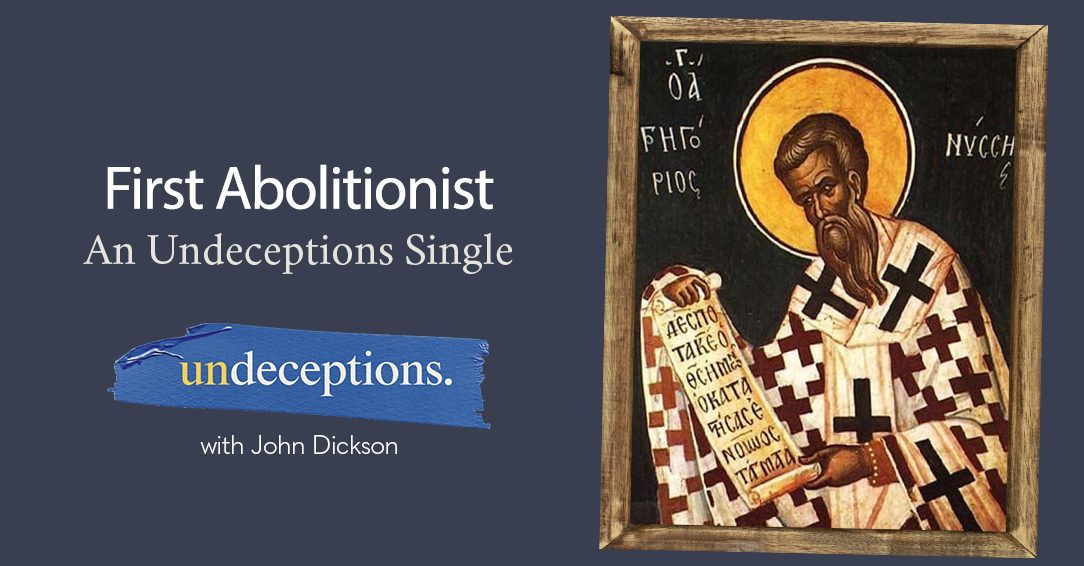
Gregory of Nyssa was a fourth-century bishop, theologian, and philosopher. He’s a big deal. There are still international symposia that meet to discuss his thoughts. Anyway, he also preached sermons. And one of them is a blistering critique of slavery. Imagine being a slave-holder in his church one Sunday morning and hearing this:
Reading
You condemn man to slavery when his nature is free and possesses free will, and you legislate in competition with God, overturning his law for the human species. The one made on the specific terms that he should be the owner of the earth, and appointed to government by the Creator—him you bring under the yoke of slavery, as though defying and fighting against the divine decree. By dividing the human species in two with “slavery” and “ownership” you have caused it to be enslaved to itself, and to be the owner of itself. For what price, tell me? What did you find in existence worth as much as this human nature? What price did you put on rationality? How many obols did you reckon the equivalent of the likeness of God? How many staters did you get for selling the being shaped by God? God said, let us make man in our own image and likeness (Gen 1, 26) … Whenever a human being is for sale, therefore, nothing less than the owner of the earth is led into the sale-room. But has the scrap of paper, and the written contract, and the counting out of obols deceived you into thinking yourself the master of the image of God? What folly! – Gregory of Nyssa, Homily 4 On Ecclesiastes
John Dickson:
So this one doctrine actually gives us a pretty comprehensive – left and right and everything in between – ethical system.
Carmen Imes:
Yeah, so last year I spoke at a conference with Miroslav Wolf and he said something really profound on along these lines. He said, Christians should be the most unreliable political allies.
John Dickson:
Boom.
Carmen Imes:
And I think his point is that there are issues on both sides of the aisle that we should care very deeply about. And if we, and if we’re concerned about racism, that makes us leftist. And if we’re concerned about abortion, that makes us, you know, right-wing. And so, as Christians, we should not belong to either party or either side. We should be looking at where these policies align with God’s purposes.
John Dickson (Studio)
We’ll be right back.
Break 2
Media – Human Rights Day 2025
John Dickson (Studio)
That’s the United Nations High Commissioner for Human Rights, Volker Türk, in a YouTube video marking Human Rights Day in 2025. Human Rights Day commemorates the anniversary of the adoption of the Universal Declaration of Human Rights in Paris on December 10, 1948.
Reading
All human beings are born free and equal in dignity and rights. Everyone has the right to life, liberty and security of person. No one shall be held in slavery or servitude. Everyone has the right to freedom of thought, conscience and religion. Everyone has the right to freedom of opinion and expression.
John Dickson (Studio)
That declaration is considered to be one of the most important documents ever written in human history. I agree. But it would be a mistake to think it was the modern world that came up with the idea. It derives from the Jewish and Christian notion that everyone, regardless of capacities or usefulness, is the image of God, and therefore, equal. The question is: Can we sustain the ethic without the underlying metaphysics?
John Dickson:
Some listeners, uh, might be nodding along to lots of what you say and they would reply, look, I’m happy to treat people as equal and dignified and all those lovely values. I just don’t need the theological mumbo jumbo about image of God to pull it off. What would you say to someone who wants that moral vision but doesn’t want the theological grounding?
Carmen Imes:
I would say that the language of “image of God” is what tells us where the dignity comes from, and we live in a culture that’s constantly looking inside to find some internal moral grounding or internal compass for finding out who I am and why I’m here, and without recognising that I am God’s image. I can’t totally understand who I am or why I’m here. So I think that, I think it’s, it’s the most important theological mumbo jumbo. We’ve got to tell us who we are as humans, and I, I would be very loath to get rid of it.
John Dickson:
Yeah. And it’s a sort of experimental period, isn’t it? All the, the, the human dignity and equality thing definitely came from Christianity.
Carmen Imes:
Yes.
John Dickson:
And now as we get rid of the theology that gave us that idea, it’s, you know, who knows how long we’re gonna be able to retain the idea?
Carmen Imes:
Well, and what happens is there’s this constant process of remaking myself, if I lose the theological grounding, it’s I am whoever I am today. And I’ve even heard about elementary school teachers who go around the classroom and have students identify themselves freshly every month because you might identify differently this month than you identified last month. And we wanna keep up with how you’re defining yourself so that we can fall in alignment with that. And the problem is it’s looking inside to try to find clarity where we can only ever find clarity by looking to the one who made us and who tells us who we are.
John Dickson (Studio)
In a previous episode, I asked a similar question to the uber-popular British historian Tom Holland – author of ‘Dominion – The Making of the Western Mind’ and co-host of the phenomenal podcast The Rest is History.
John Dickson:
Do you think we need a living Christianity in our society, thriving churches to sustain these Western ideals that you say come from Christianity?
Tom Holland:
Well, I think it’s too early to say. What I do think is that we are currently living through a process of cultural and moral, and spiritual change that can only really be compared to the reformation. So I think we are living through a new reformation, and I think that the 1960s will be seen as a period of transformation in the history of Christendom, analogous to the 1520s. I think a crucial part of the process of change that the 60s really kind of kicked off is the legacy of the Nazis and the Second World War, because I think it’s not a coincidence that it’s the kind of dawning realization of what exactly the Holocaust had been, that you start to get kind of precipitous decline in church attendance across Western countries. And one of the reasons for that is that basically in a sense, you don’t need the Christian story anymore to be taught Christian values because the Nazis do it for you, because the Nazis are so decisively opposite to Christian teaching, that in a way they, they kind of provide an incredibly potent morality story. So, whereas before the Second World War, people in the West would say they wanted to know what to do, what would Jesus do? And then they’d do it. Now people in the West say, “What would Hitler do?” And do the opposite. So instead of Satan, you have Hitler, and instead of the devils, you have the Nazis, and instead of hell, you have Auschwitz. And I think that, that basically serves to kind of instil Christian values, that you should care for the unfortunate, that you should care for those who are not like you, that racism is the ultimate evil. These are ultimately Christian values, but because they’re mediated through the history of the 30s and 40s, they’ve taken on a kind of new incarnation. Is that sufficient to maintain Christian values as kind of living… I’m not sure. I think that the history of the past decade suggests that it’s actually rather coming under strain and that we’ve seen again and again, that people kind of saying, “You’re Nazi or you are Hitler.” It’s the law of diminishing returns. It becomes less and less successful. And if in due course, people turn around and say, “Yeah, I’m a Nazi. What of it?” How then do you argue against them? The thing that Christianity provides is a sense that this is a story that is true, that it’s a story that permeates the entire sweep of history, the entire sweep of the cosmos, that there is a God, and that therefore the values that Christianity has taught are not just culturally contingent, and not just bread of kind of historical happenstance, but are fundamentally true. A post-Christian society doesn’t have that reassurance, and while of course, it’s perfectly true that the atheists have morals, it doesn’t alter the fact that those morals are basically Christian, and that if you lack the theological, the supernatural explanation for why these values should be held, where do you get them? And I think the intellectual history of the past few decades has basically been a kind of gathering attempt to try and explain Christian values and Christian teachings in ways that do not depend upon Christianity being true, and I think it’s proven to be a struggle personally.
John Dickson (Studio)
You can hear that full conversation in episode 45, ‘Christian Revolution’. In a more academic setting, Nicholas Wolterstorff of Yale University has traced the concept of ‘human rights’ directly to the doctrine of the image of God. In his remarkable book Justice: Rights & Wrongs (Princeton University Press) he shows two things:
- Historically, the use of ‘rights’ language goes back to 13th-century church lawyers discussing the ‘rights of the poor’ as outlined in Scripture and the church Fathers
- Philosophically, the concept of inherent human rights can only be rationally grounded on religious convictions.
He writes:
“It is impossible to develop a secular account of human dignity adequate for grounding human rights. Or to speak more cautiously: given that, after many attempts (Kant, Dworkin, Gewirth, et al.), no one has succeeded in developing such an account, it seems unlikely that it can be done.”
By contrast, he says, the biblical notion of the ‘image of God’ did it and does it:
“If God loves equally and permanently each and every creature who bears the imago dei, then the relational property of being loved by God is what we have been looking for in our search for the grounds of inherent human rights. Bearing that property gives to each human being who bears it the worth in which natural human rights inhere.” – Wolterstorff, Justice
This is a fancy way of saying what the Bible says: The value of human beings is not subjectively tied to their capacities or usefulness, to their ‘value-add’ to my group or me. Human value is objectively tied to our status as God’s image, God’s children. YOU MATTER! Regardless of capacities and usefulness, you matter to God. It seems fitting to close with CS Lewis, who ended a sermon in St Mary’s Church Oxford in 1941 with these words:
Reading
“There are no ordinary people. You have never talked to a mere mortal. Nations, cultures, arts and civilizations – these are mortal. But it is immortals whom we joke with, work with, marry, snub, and exploit. This does not mean that we are to be perpetually solemn. We must play. But our merriment must be of that kind (and it is, in fact, the merriest kind) which exists between people who have, from the outset, taken each other seriously. And our charity must be a real and costly love, with deep feeling for the sins in spite of which we love the sinner. Next to the Blessed Sacrament itself, your neighbour is the holiest object presented to your senses.” – ‘The Weight of Glory’, from Screwtape Proposes a Toast and Other Pieces
Undeceptions theme

The Universal Declaration of Human Rights reads: “All human beings are born free and equal in dignity and rights. They are endowed with reason and conscience and should act towards one another in a spirit of brotherhood”.
This seems obvious to us today, but many people throughout history didn’t believe in these ideals.
Many would wonder how it could be that every human being, regardless of capacity or usefulness, could be considered equally valuable.
Truth be told, it’s hard to find the logic behind the Universal Declaration of Human Rights anywhere in historical literature … apart from the Bible.
Meet our guests

Carmen Joy Imes is Associate Professor of Old Testament at Talbot School of Theology, Biola University, in Southern California. She is the author of several books, including Being God’s Image: Why Creation Still Matters.
Episode Sponsor
Special thanks to our season sponsor, Zondervan Academic. Get discounts on MasterLectures video courses and exclusive samples of their books at zondervanacademic.com/undeceptions
Our sponsors in Anglican Aid are currently running an appeal for those affected by food insecurity in Burundi. Head here if you would like to donate.
Head here to become an Undeceptions PLUS member, which gets you longer episodes and access to special events with John.
Make sure you get a copy of Carmen’s excellent book on this subject, Being God’s Image: Why Creation Still Matters. Here’s where you can get it.
A special thanks to our phone-a-friend for this episode, Rochelle Scheuermann.
Show Notes
SHOW NOTES

Here’s an excerpt of the letter Robert Dugan wrote to Senator Tom Harkin in 1989, protesting against churches having to comply with the Americans with Disabilities Act. It’s not his finest hour.
LINKS
Check out these links to what we discussed on the show!
To Read
- Here’s a great piece for The Gospel Coalition by friend of the pod, Michael Jensen (who co-hosts With All Due Respect), about the legacy of the concept of Imago Dei.
- The legacy of this idea that, due to being made in God’s image, all humans are valuable, regardless of capacity, is reflected perhaps nowhere better in the secular world than the Universal Declaration of Human Rights. Read about this remarkable document here.
- Here’s the Enuma Elish – the Babylonian creation epic that we talked about in this episode. Compare it with the Biblical creation story of Genesis, which you can read here.
- Being made in the Image of God isn’t unique to the Bible; here’s how the ancient Egyptians understood the concept.
- Here’s a digitised version of Gregory of Nyssa’s Homily 4, On Ecclesiasties, where he rails against the evils of slavery in the fourth century! The inspiration behind Gregory’s ideas was the fact that all are made in God’s Image, and therefore equal.
To Watch
- Here’s a short video from our friends at the Centre for Public Christianity that outlines the significance of the ‘Image of God’ concept.
- Check out the clip of the United Nations High Commissioner for Human Rights, Volker Türk, discussing human rights, which we featured on the episode here.
- Here are viral sceptic Alex O’Connor and Christian author and communicator Glen Scrivener debating the cultural legacy of Christianity, including the downstream effects of the theology of the Imago Dei.
- Here’s Nicholas Wolterstorff talking about the grounding for human rights – and where secularism does or doesn’t fit.
- Here, friend of the pod, N.T. Wright further talks about what it means to be made in the Image of God.
To Listen
- The concept of being made in God’s image has hugely influenced the modern idea of human rights – both directly and passively. Here’s a podcast about it, courtesy of the Centre for Public Christianity.
- There are a fair few Undeceptions episodes that are worth checking out in relation to this one. Here’s episode 43, ‘Big Porn’, with Melinda Tankard Reist and Willian Struthers.
- Here’s episode 45, ‘Christian Revolution’, with Tom Holland (before he was the famous podcaster we all know him as today!)
- Here’s episode 76, ‘Against Euthanasia’, with the all-star cast of Ilora Finlay, Charles Camosy, and Melanie Lovell.
- Here’s episode 49, ‘Pro Life’, with Margaret Somerville and Emma Wood.
… and finally
- We’ve featured the letter from Roman soldier Hilarion to his wife, Alis, a few times before on the show. Check out this Reddit thread if you want to get an idea of how shocking – and controversial – the themes of this ancient letter still are to people today.

Become an Undeceiver
Undeceptions Plus offers exclusive bonus content to members. By becoming an Undeceiver, you can unlock uncut interviews, extra question and answer sessions, and peeks behind our creative process as we put the shows together. We’d love to have you with us.