The miracles of Jesus pose a real problem for the historian. If they were marginal to the story of Jesus, perhaps only found in one source that was a late source, like say just John’s gospel. Historians would have no problem just sidelining them as late accretions to the story of Jesus. The problem is there is a surprising range of sources that refer to Jesus’ miracles across the sources recognised by mainstream scholars as, in a sense, independent of each other. One or two of them from the pens of those who don’t believe.
Everywhere you turn in the story of Jesus, there are these things moderns call miracles. And the problem just becomes more intense when we compare Jesus with our closest ancient parallel miracle worker, Apollonius of Tyana. He is a neo-Pythagorean philosopher whose biography says that he went round doing things that actually look a little bit like what Jesus did in the Gospels. But there is just one source for the miracle working of Apollonius, just one, and it was written 120 years after Apollonius died.
Jesus has, in the mainstream view, eight separate sources. Three of which come within twenty years of Jesus, another five within sixty. In the case of Jesus alone there is this weird surplus of evidence.
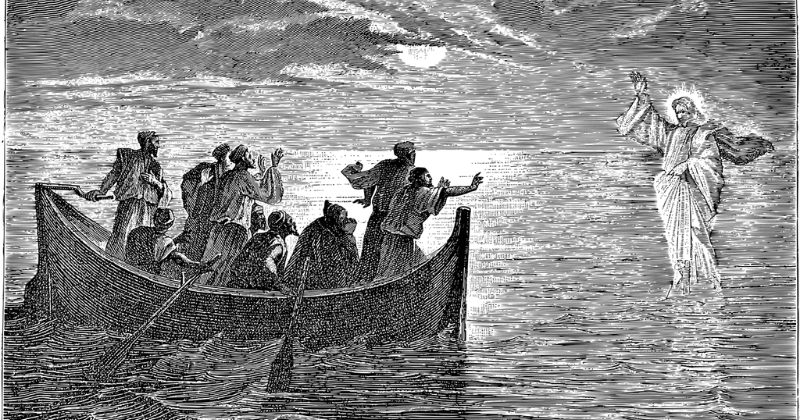
So what does the historian do? Historians of the Enlightenment had a very simple answer to this problem. They explained the stories of the miracles away, naturalistically. For example, Karl Friedrich Bahrdt said that the walking on water story in the Gospels was really just Jesus standing on logs that often float across the Galilee (Found in his work: Ausführung des Plans und Zwecks Jesu). That works. Heinrich Paulus said that the famous feeding of the 5000 miracle was really just that when the one boy shared his lunch, everyone went ‘aww, let’s share our lunch too,’ and suddenly everyone was fed. (editor’s note: See William Lane Craig’s The Problem of Miracles for reference to Paulus’ work and further insight into this occurrence)
Modern historians don’t take that quaint approach. Most modern, secular scholars of the historical Jesus plead ignorance. They say, yes, there’s a lot of evidence he did things people thought were miracles, but we can’t comment further. For example, Paula Fredriksen, very important scholar from Boston University:
Did Jesus of Nazareth, then, perform miracles? Here I as a historian have to weigh the testimony of tradition against what I think is possible in principle. I do not believe that God occasionally suspends the operation of what Hume called “natural law.” What I think Jesus might possibly have done, in other words, must conform to what I think is possible… So, to answer my own question: Yes, I think that Jesus probably did perform deeds that contemporaries viewed as miracles. Those I have least trouble imagining his working conform to those also named by Paul, healings and exorcisms. (Fredriksen, Paula. Jesus of Nazareth, King of the Jews : A Jewish Life and the Emergence of Christianity. 1st Vintage books ed. New York: Vintage Books, 2000, p.114)
Enlightenment scholars said because the supernatural realm doesn’t exist, there must be a natural explanation. Contemporary experts tend to say because history can’t adjudicate on anything like a supernatural realm, we just have to plead ignorance. We don’t know why people thought Jesus did miracles; we just leave it there.
But here’s the thing, Jesus probably didn’t believe in miracles. Jesus probably didn’t believe in the supernatural. If what we mean by supernatural and miracle is the invasion of an outside alien force into nature. That definition, of course, comes from the Enlightenment. It assumes a dualism, a spiritual, ethereal world, and the physical one. And every now and then, the spiritual injects itself into the material.
The Gospel writers didn’t share this outlook. From their viewpoint, which was really the Jewish viewpoint, there aren’t two worlds. There’s just one world. There is just the creation that comes from the Creator. Everything that happens in the universe from the regular rising of the sun to the very surprising sight given to the blind person, it’s all the powerful work of the one Creator working in and through nature. What we call miracles are not invasions from a parallel world, they are just powers, God’s powers in and through creation. And this is why the Gospels describe Jesus’ baffling deeds not as supernatural events, not even as miracles. They see them as special examples of power and as signs of the future.
The Greek terms in the Gospels are dunamis, which means strength or power, and sēmeia, which means signs. Powers, that’s easy enough to comprehend. But what about signs? What are they signs of? It would be tempting to think that what Jesus means when he describes his powers, his healings, as signs that what he means is these are signs of the spiritual world – if only you could pull the veil, you would see a spiritual world invading the natural. But actually that’s not what Jesus says, he says they are signs from the future. They are little displays in the present of God’s intentions with all of creation. After one of Jesus’ healings he offered this famous interpretation, “if by the Spirit of God I drive out demons, then the Kingdom of God has come upon you” (Matthew 12:28). This is repeated in Luke, it’s from the early source known as Q.
In other words, the healings of Jesus are evidences of the Kingdom. This was a Jewish concept, it doesn’t mean a spiritual realm, a heaven as opposed to Earth. The Kingdom of God is God’s promise to mend all things one day, to overthrow evil. To mend what’s broken. Read in context Jesus’ healings, according to his own words, were signs. You could glimpse God’s future activity in these special examples of power.
This is widely accepted in historical Jesus scholarship. Here are the great scholars Gerd Theissen and Annette Merz saying just this:
Jesus combines two conceptual worlds which had never been combined in this way before, the apocalyptic expectation of universal salvation in the future and the episodic realization of salvation in the present through miracles. Nowhere else do we find a charismatic miracle worker whose miraculous deeds are meant to be the end of an old world and the beginning of a new one. This puts a tremendous emphasis on the miracles (and it is unhistorical to relativise their significance for the historical Jesus). The present thus becomes a time of salvation in microcosm. (Gerd Theissen and Annette Merz, The Historical Jesus: a comprehensive guide. Fortress Press, 1998, p.309.)
Or more simply, if God’s Kingdom is the feature film in the future, Jesus’ healings, at least as the Gospels portray them, are the preview, the trailer, for the main film. Now, we may not believe any of this, that’s not my point. My point is that even the healings of Jesus in the Gospels don’t portray a supernatural world as distinct from a natural one. There is just one world, God’s world, where the Creator acts powerfully in every moment. And where in the moments of Jesus’ healings the Creator gave a preview that one day he will mend all things.
[editor’s note: want to see what else John has to say on the topic? See his article about the historical view of Jesus’ miracles over at the Centre for Public Christianity]
By John Dickson
Intelligible Universe
Want to hear the rest of the episode?
Check out episode 135: “Intelligible Univerise”