
We recently published our Undeceptions Season XIII Question Answer episode, which you can listen to here.
(By the way, if you want to ask a question – and maybe feature in our next Question Answer episode – head here and scroll down to the big, red, ‘start recording’ button at the bottom of the page).
One of the questions asked of John in that episode was about missionaries: were they a harmful part of the colonial project?
Or can we say there is some good in European Christians arriving in Africa, the Americas, and Oceania, alongside other colonists?
This is John’s answer.
This is a historical question, and empirical evidence is what should guide us, not some dogmatic theory about the angelic nature of the missionaries or about the destructiveness of missionaries.
Of course, I know the Australian situation much better (the question comes from a New Zealnder), and my simple answer is … it’s really mixed.
Missionaries often did culturally repressive things like banning sacred corroborees and forcing indigenous Australians to live and dress in a Western manner … and yes, even disciplining them physically for disobedience.
In this way, missionaries often treated First Nations people in much the same way that society at the time treated children.
Missionaries were part of the colonial project, not just bringing the gospel to people but also civilizing them in inverted commas, which often meant imposing Western forms of civilization on indigenous communities, and the fit really wasn’t great.
This pattern of cultural imposition goes back a long way, I’m afraid to say. In the early 500s, during the reign of Clovis of Gaul, the Merovingian kingdom, missionary bishops occasionally aligned themselves with Clovis’s imperial campaigns.
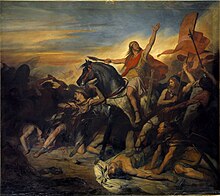
The conversion of Clovis is depicted in Ary Scheffer’s ‘The Battle of Tobiac’ (1836).
We have a surviving letter from Bishop Evitis of Vienne in Southeast France which I get my students here at Wheaton to study.
In it, the Bishop urges King Clovis to promote Christianity in the regions he intends to conquer.
Now we have this letter, which cuts off just before the Bishop describes Clovis’s military plans.
So it’s tantalizing, but it’s clear the Bishop viewed this as divinely orchestrated, an opportunity to spread Christianity deeper into pagan Europe.
Here’s what Avitus writes:
“There is one matter I would have you improve, King Clovis. Since God, through you, makes your people completely his own, I would have you extend from the good treasury of your heart the seed of faith to more remote peoples because they are still situated in a state of natural ignorance. Be not ashamed or reluctant to send embassies on the matter and to add to the realm of God who raised up your realm to such an extent.”
Bishop Avitus isn’t exactly advocating for Christian holy war as a method of evangelization, but he does hope that Christian embassies, he means like missionary parties, will accompany Clovis’s expanding European empire.
And this is the early 500s.
This is the beginning of religious imperialism.
Wherever the Merovingian armies went in the next two centuries, bishops, priests, and deacons would follow, establishing churches and monasteries.
It’s eerie to read this ancient material because it’s mirrored in the modern missions movement that expanded wherever the British, Dutch, or Spanish empires extended.
Similar patterns also occurred in New Zealand.
Among the proud Maori people, European settlers arrived with guns, and missionaries came with Bibles, schools, and hospitals.
But there are important questions I reckon we’ve got to ask as we reflect on all of this.
It’s right to ask what insights from our contemporary society might have better informed the behaviour of Christian missionaries in the 18th and 19th centuries. I don’t hold the view that you can’t judge people of the past by modern standards.
We need to be cautious about doing that, but it doesn’t mean we shouldn’t try it.
The flip side, of course, is that we should also allow the past to judge us – and frankly, I reckon the people of the past would utterly condemn us for our use of wealth and our obsession with comforts (and so on).
That’s a discussion for another day – but equally important is this question: How did the 18th and 19th-century missionaries compare to secularists at the same time?
Modern secularists like to compare themselves favourably to missionaries of centuries past, and then they use that comparison to criticize the modern church.
Okay – but why not compare the views of 18th and 19th-century missionaries on Indigenous Australians with the mainstream view toward Indigenous Australians at the same time?
As soon as you do that, it becomes clear that missionaries were the closest thing First Nations people had to friends in the entire Enlightenment project.
Only missionaries and church leaders dogmatically insisted against the tide of scientific secularism that Indigenous people were fully human, made in the image of God, and not a backward, forgotten step in the evolutionary history of humankind.
You only need to read newspaper clippings from the 1800s, which I’ve done, and you’ll see that the only advocacy on behalf of Indigenous peoples was coming from missionaries and church leaders, not from the government, not from social elites, certainly not from scientific associations.
In fact, these mainstream institutions were often the targets of stinging Christian criticism over the mainstream treatment of Australian Aboriginals.
Now, none of this excuses bad missionary behaviour, but it highlights that the only consistent impulses toward the equal treatment of First Nations peoples came either from Indigenous people themselves or from the missionaries who served them.
Missionaries were, of course, part of the colonial project, but they are also the reason the colonial project didn’t entirely wipe out indigenous people.
It’s the missionary view that prevailed.
I know this gets up the nose of secularists today, but the fact is secularists hold their enlightened humanitarian views about First Nations people because the Christian view planted in the 18th century came to full flowering in the 20th century.
I thank God for that.


Want to be further undeceived?
Check out our network of podcasts and articles in the Undeceptions Library.


