
On April 9, 1945, the celebrated theologian Dietrich Bonhoeffer was executed at the Flossenbürg concentration camp.
He was killed due to his ties to the July 20, 1944 conspiracy to overthrow the Nazi regime, the nucleus of which was an assassination attempt on Hitler (this is now known now as the July Plot).
Bonhoeffer had been on the radar of the Nazis for some time in years previous.
As a pastor working in Germany’s Confessing Church, he had vocally opposed the nationalist, violent, and racist rhetoric of the Nazi regime.
Writing in 1932, he decried the situation on the ground:
“How can one close one’s eyes here to the fact that the demons themselves have taken control of the world, that it is the forces of darkness that here gruesomely conspire and can burst forth at any moment—how can one think that, with a little bit of education toward international understanding and a bit of “’goodwill,’ these demons can be exorcised, these forces can be banished?”
It was passages like these – as well as his work illegally training up pastors of the Confessing Church to oppose the Nazi regime – that saw his wings “clipped” throughout the 1930s.

Bonhoeffer pictured with some of his students at the Finkenwalde Seminary, before he was banned from teaching
Authorities slowly prevented him from working, preaching, speaking, and writing.
He moved to America for a time in 1939 – mere months before Germany invaded Poland and the commencement of the Second World War – but he soon returned to Germany to “share the trials” of his fellow believers.
It was around this time that he received an offer that would change – and cost him – his life.
The Resistance Calls
In 1939 Bonhoeffer joined a German resistance, based within the Abwehr, the military intelligence of the Nazi regime.
Bonhoeffer was officially a double agent: a pastor-turned-spy.
Dr Matthew Kirkpatrick, a lecturer in Ethics and Doctrine, and world expert on Bonhoeffer at Wycliffe Hall, Oxford, notes that Bonhoeffer’s main job was bridge-building with foreign powers, in preparation for a hopeful Nazi overthrow.
“The Abwehr sent Bonhoeffer to various nations like the UK, Sweden, and Switzerland to say how good Germany was … but what he was actually doing was using his ecumenical connections to get a message across to the Allies that there is a German resistance and it was trying to take out Hitler and to put a new government in place.
“Consequently, when it does that, it wants to restart diplomatic relationships.”
The Plot to Kill Hitler
There were more than 20 plots to kill Hitler.
The July 20 Plot was the last one, and it – like the others – failed.
On July 20 a bomb was placed in a suitcase, and planted in a conference room in East Prussia, where Hitler was meeting with military staff.
The bomb did explode – but, despite killing four of his aides, failed to kill Hitler himself.
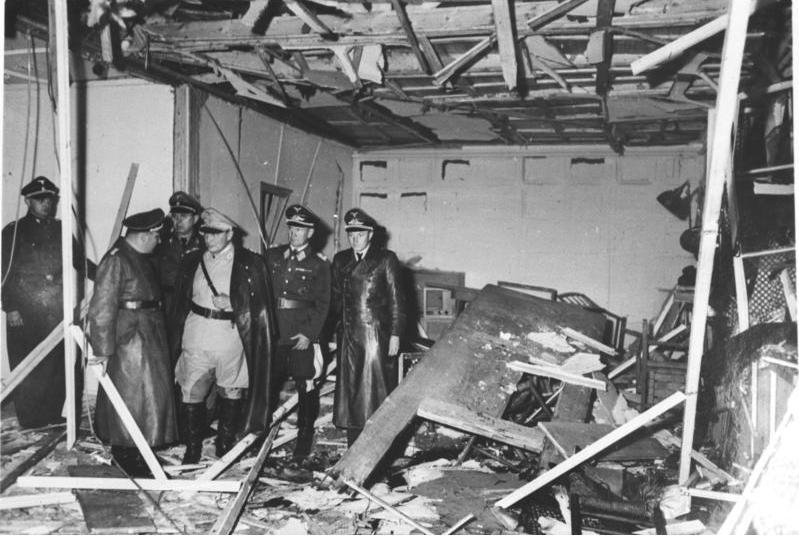
The aftermath of the July Plot
The plot itself came from within the Abwehr.
Ludwig Beck (formerly chief of the general staff), Major General Henning von Tresckow, Colonel General Friedrich Olbricht, and several other top officers(formerly chief of the general staff) were the chief instigators of the plot.
There’s less certainty around the involvement of Dietrich Bonhoeffer himself.
Could a theologian have justified getting blood on his hands and murdering someone else, even for the “greater good”?
Ethics vs . Action
‘Did Bonhoeffer try and kill Hitler’ has become one of the most controversial questions tackled by modern theologians.
The evidence around his involvement – and even knowledge of – the plot is flimsy.
Complicating things further are his theological works, which call for peacemaking.
“It’s hard for people coming from a more pacifist perspective, to see a great theologian – a Christian – getting blood on their hands”, Matthew said.
“My own mind is that Bonhoeffer did know he was getting blood on his hands, and his ethical theory provides the foundations for trying to understand how he’s able to justify that.”
For Bonhoeffer, being a Christian meant that one had to have a living relationship with God – and with that came a constant return to consult God Himself – not just ethical principles.
Matthew points to the Ten Commandments to explain this.
“The Ten Commandments … created a point of separation because if an Israelite wanted to know what God wanted them to do, they go to the tablet rather than to God.
“One of the dangers of ethical rules is they become this barrier to us having a relationship with God.
“For Bonhoeffer, ethical rules are important, but they are only human articulations of God’s will, which is much, much bigger than any human articulation, either in terms of our human conception or even in terms our human language could possibly contain.
“So, maybe 99.9 per cent of the time, those ethical rules are going to work great, but not in every single situation … you will be confused by situations that burst ethics in a certain sense, where instead of trying to figure out what’s the right and the wrong path, you might simply be confronted by two wrong possibilities, and you have to decide between them.
“For Bonhoeffer, that was the situation in Nazi Germany.”
… Responsible action takes place in the sphere of relativity, completely shrouded in the twilight that the historical situation casts upon good and evil. It takes place in the midst of the countless perspectives from which every phenomenon is seen. Responsible action must decide not simply between right and wrong, good and evil, but between right and right, wrong and wrong. …Those who act out of free responsibility are justified by others by dire necessity; before themselves they are acquitted by their conscience, but before God they hope only for grace.” – Bonhoeffer, Ethics
A Bonhoeffer Moment?
Bonhoeffer wasn’t originally arrested for being involved in the July Plot.
In fact – none of those involved were.
Initially, members of the Abwehr were arrested for allegedly facilitating money laundering.
However, as authorities kept digging and searching their headquarters, a paper trail tying them to the plot was eventually discovered.
After the July Plot, the German secret police – the Gestapo – went on a rampage to find anyone involved in the resistance.
Some historians estimate as many as six thousand people were rounded up, and tried, and most of them were executed after the July Plot failed.
This meant that all those associated with the instigators within the Abwehr were executed.
Bonhoeffer was among them.
Part of the importance of thinking through Bonhoeffer’s involvement in the July Plot is to know how Bonhoeffer thought – and how to avoid co-opting him for non-related causes.
A ‘Bonhoeffer moment’ is now an expression used to describe a crisis point where morally repugnant acts might be considered in order to head off a greater evil.
The trouble is, it seems almost anyone can have a ‘Bonhoeffer moment’, making Bonhoeffer’s actions fit their own cause.
Fundamentally though, the idea of a ‘Bonhoeffer moment’ asks the wrong question.
We shouldn’t be asking ‘What would Bonhoeffer do?’ …. because, for Bonhoeffer, his central driving question was, ‘Who is Christ for us, today?’
That’s something we could all ask a little more of ourselves.
For Bonhoeffer, knowing Jesus was a lived reality.
In his Ethics writings, he said:
“With every new day, therefore, the question arises, how, today, here, in this situation, can I remain and be preserved within this new life with God, with Jesus Christ?”
Just as we mustn’t co-opt Bonhoeffer and mould his thinking to justify extreme action today, we also mustn’t co-opt Jesus and make him into something that he is not.
We are fooling ourselves if we do, and playing with fire.
For Bonhoeffer, who Jesus was for him at the height of the horrors of World War II cost him his life.
Before he was executed though, while still in prison, he wrote a note for a book he was working on that would be discovered after his death, offering his most succinct answer to that question:
“Jesus is ‘the man for others’”.
It’s a message Bonhoeffer could not make the church of his day hear – but it’s one they needed, and that we still need today.
Adapted by Alasdair Belling from the Undeceptions episode ‘Dietrich Bonhoeffer’ with Matthew Kirkpatrick. Listen here


Want to be further undeceived?
Check out our network of podcasts and articles in the Undeceptions Library.


