The story of original sin is one of the most well-known in humankind: Adam and Eve, having succumbed to temptation (and egged on by a talking snake, representing Satan), eat the fruit of the Tree of the Knowledge of Good and Evil in the Garden of Eden.
Thus sin enters the world, Adam and Eve are expelled from the garden, and humanity stands estranged from God.
But what was at the heart of Adam and Eve’s temptation?
Theologian Miroslav Volf believes that, actually, a striving for superiority was the root cause of this ‘first sin’.
It’s an idea other thinkers have also explored, most notably the 17th-century English poet John Milton in his epics Paradise Lost and Paradise Regained.
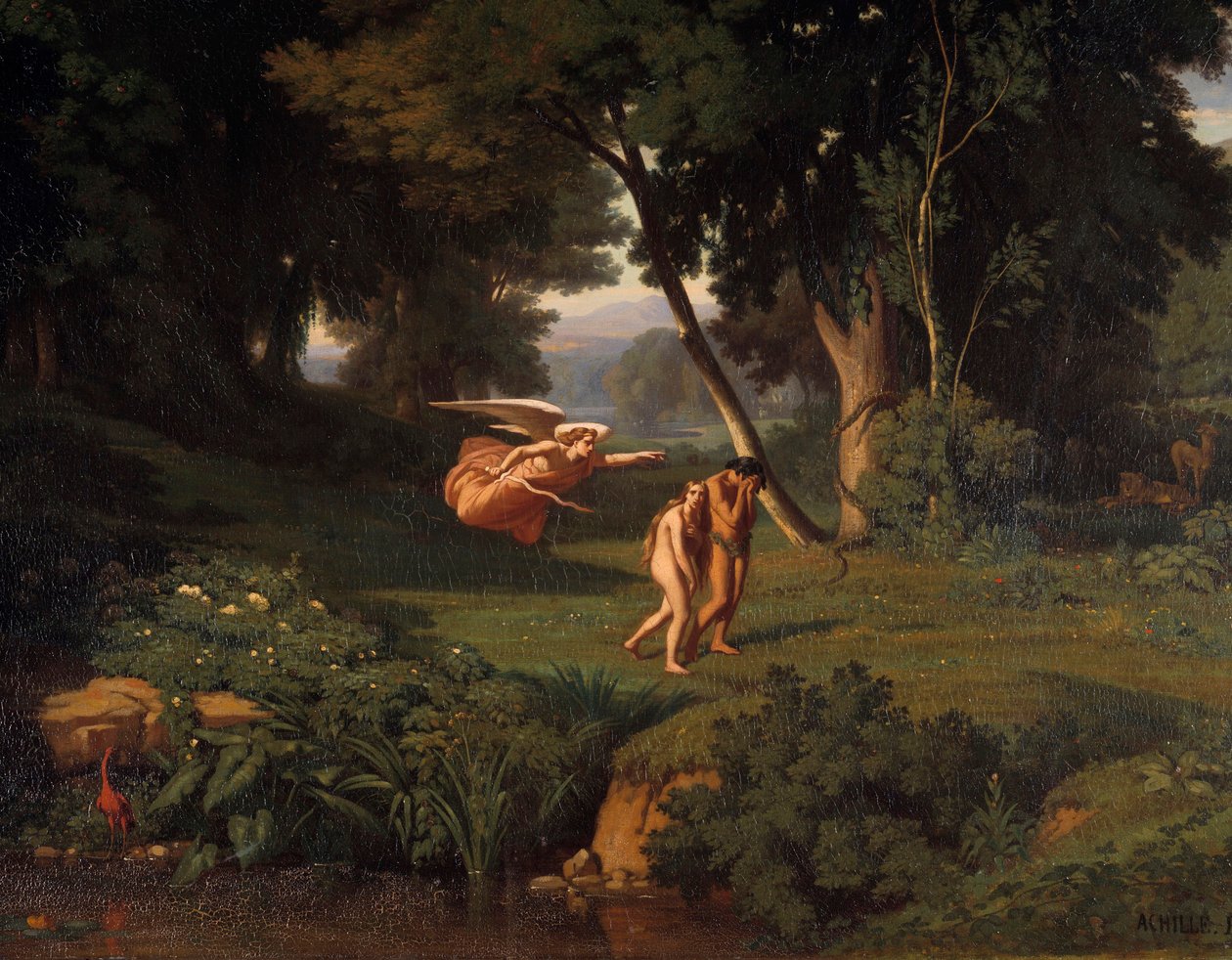
‘Adam and Eve Expelled from Paradise’ (1841) by Achille Benouville
For Milton, striving for superiority is at the heart of the human condition. More than that, it’s the condition of Satan, striving for preeminence over God.
Who first seduc’d them to that foul revolt?
Th’ infernal Serpent; he it was, whose guile
Stird up with Envy and Revenge, deceiv’d
The Mother of Mankind …
(Paradise Lost, Book 1)
‘I think that (Milton) reads the sweep of history and salvation through the lens of striving for superiority,’ Volf said, speaking on Undeceptions episode 178 ‘Against Ambition’.
‘The notion that we somehow have to be better than others can literally slither into us.
‘The goal of Satan is to spoil God’s world so that somehow he would increase his own kingdom and perhaps be even greater than God.’
In this sense, Adam and Eve were seduced by Satan’s vision for humankind: a pursuit of superiority over one another, and ultimately, over God.
Part of Milton’s reflection on ‘The Fall’ is that Eve was motivated by a desire to be superior over her husband (Adam), whom she was created inferior to. That idea obviously doesn’t track super well in a 21st-century context, and it may be an overinterpretation of the creation account.
Regardless of gender dynamics, though, the serpent (Satan) does play on the idea of superiority in convincing her to take the fateful step:
“God knows that when you eat from it your eyes will be opened, and you will be like God, knowing good and evil.” When the woman saw that the fruit of the tree was good for food and pleasing to the eye, and also desirable for gaining wisdom, she took some and ate it. She also gave some to her husband, who was with her, and he ate it.”
Genesis, chapter 3
The text does raise an important question: Why does God appear to laud superiority over His domain? Why is it okay for God to exalt in His own superiority, but not for people to pursue the same?
The premise of this question, Volf points out, hinges on our understanding of what superiority is, and what God’s aims are. When it comes to God’s superiority – or as the scriptures put it, ‘God’s glory ’-we enter new territory.
‘God is the supreme being who seeks to soak up all the glory, which is to say that our function is to deflect all the glory that may be anywhere and trace it back to God so that God can be elevated, and made higher – but the major problem with this is that God cannot be made higher,’ he said.
‘God always, from the beginning to the end and all the time in between, is the one who is the highest …. (and) doing the work of salvation is God’s glory. Once you start thinking of it in those terms, you realise that God’s glory is the glory of his infinite love.
‘We are climbing our way up wherever we find ourselves. God does the exact opposite. In this sense, God Almighty Himself is the example of the humility for which Christian faith stands. He lowers Himself so that He can lift us; that’s his glory.’
Striving for earthly superiority may have been the root cause of the original sin – but by striving against this – in and through the crucifixion and resurrecting of His son Jesus – Christians believe that God has bridged the divide that existed between Himself and humanity.
As Milton writes in book three of Paradise Regained:
Yet so much bounty is in God, such grace,
That who advances his glory, not their own,
Then he himself to glory will advance.
Or, to take the words from the scriptures themselves from Philippians chapter 2:
In your relationships with one another, have the same mindset as Christ Jesus:
Who, being in very nature God,
did not consider equality with God something to be used to his own advantage;
rather, he made himself nothing
by taking the very nature of a servant,
being made in human likeness.
And being found in appearance as a man,
he humbled himself
by becoming obedient to death—
even death on a cross!
(Philippians chapter 2)
Adapted by Alasdair Belling from Undeceptions episode 178, ‘Against Ambition’. You can listen to the full episode here.


Want to be further undeceived?
Check out our network of podcasts and articles in the Undeceptions Library.